GS 3: Science & TechnologyGS 2: International RelationsPrelimsGS 3: Infrastructure: Energy, Ports, Roads, Airports, Railways etc.GS 2: Bilateral, Regional and Global Groupings and Agreements
How Do Tokamaks Work To Make Nuclear Fusion Possible?, Pg13
Explore how tokamaks use magnetic fields for nuclear fusion, detailing global ITER project and India's indigenous efforts in clean energy technology.
Practice MCQs
840 Students attempted
Key Highlights:
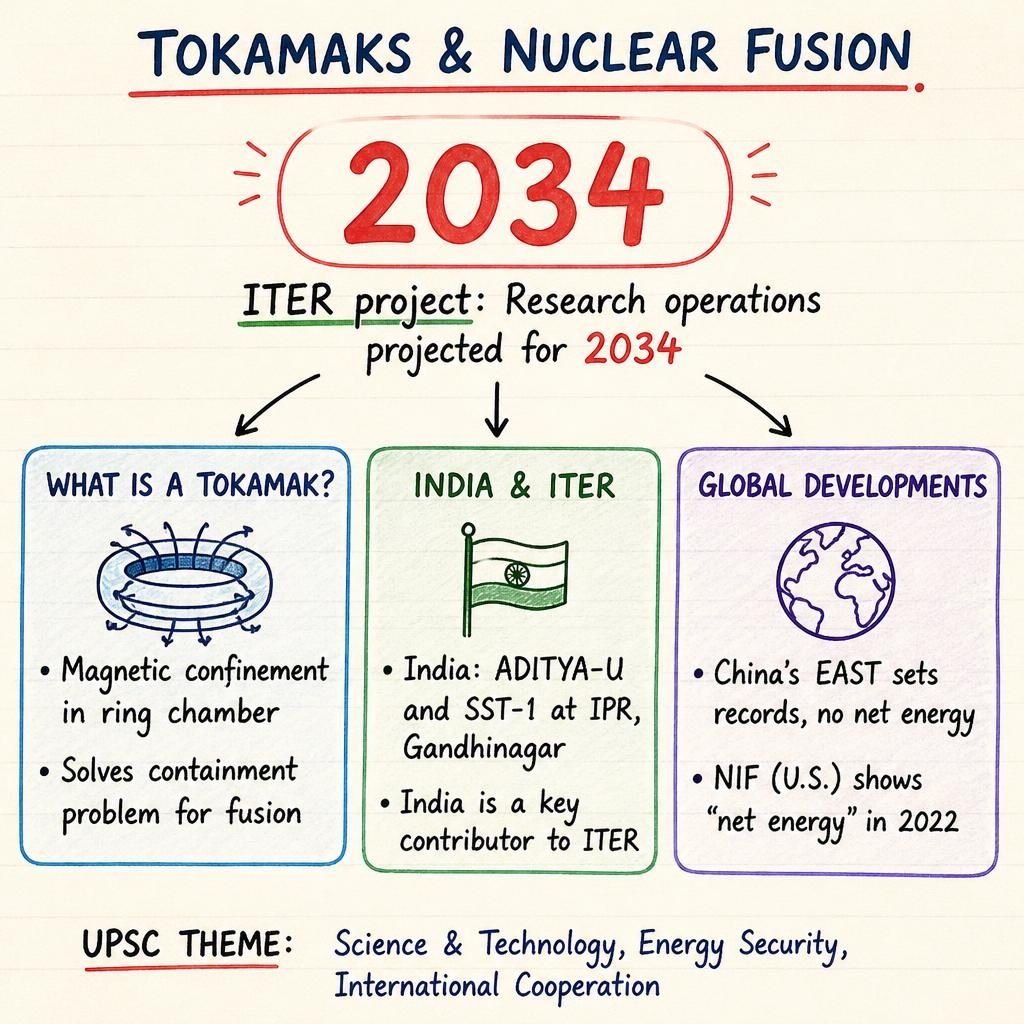
- A tokamak is a device that uses magnetic fields to confine extremely hot plasma in a ring-shaped vacuum chamber to achieve nuclear fusion.
- It addresses the "containment problem" for fusion, as no physical material can withstand the temperatures required, which are hotter than the sun's core.
- The concept was developed in the early 1950s in the Soviet Union, primarily by physicists Igor Tamm and Andrei Sakharov.
- The International Thermonuclear Experimental Reactor (ITER), a collaborative global project, is a tokamak currently under construction in France.
- India operates its own tokamaks, ADITYA-U and SST-1, at the Institute for Plasma Research (IPR) in Gandhinagar and is a key contributor to ITER.
- China's EAST tokamak has set records for plasma confinement duration and density but has not yet generated net energy.
Tokamak.jpg
Detailed Insights:
- Nuclear fusion involves light atomic nuclei, such as deuterium and tritium, combining to form helium, releasing a substantial amount of energy.
- The tokamak's unique toroidal shape and an electric current driven through the plasma create a helical magnetic field, effectively isolating the plasma from the chamber walls.
- In a future fusion power plant, neutrons from the reaction would heat a surrounding blanket containing lithium, generating steam for electricity and breeding tritium fuel.
- The ITER project has faced considerable engineering challenges, funding delays, and cost escalations, with research operations now projected for 2034 and deuterium-tritium operations for 2039.
- ITER is primarily a physics experiment designed to demonstrate net energy gain (producing ten times the heating power input), not to directly convert heat into electricity.
- Other approaches to fusion research include stellarators, which use complex external coils to create the twisted magnetic field, and inertial confinement, which compresses fuel pellets with lasers.
- The U.S. National Ignition Facility successfully demonstrated "net energy" production using the inertial confinement approach in 2022.
Scientific/Technical Concepts Involved:
- Tokamak: A toroidal device that uses magnetic fields to confine plasma for controlled nuclear fusion reactions.
- Plasma: The fourth state of matter, an ionized gas consisting of free electrons and atomic nuclei.
- Nuclear Fusion: A process where two light atomic nuclei combine to form a single heavier nucleus, releasing a large amount of energy.
- Deuterium & Tritium: Heavy isotopes of hydrogen that are the primary fuel candidates for nuclear fusion reactors.
- Magnetic Confinement: A method of containing superheated plasma using strong magnetic fields to prevent it from touching reactor walls.

SuperKalam is your personal mentor for UPSC preparation, guiding you at every step of the exam journey.
Download the App


STUDY RESOURCES
CONTACT US
ⓒ Snapstack Technologies Private Limited