GS 2: International RelationsGS 3: EconomyPrelimsGS 2: Bilateral, Regional and Global Groupings and AgreementsGS 2: Effect of Policies and Politics of Developed and Developing Countries on India's Interests
A Middle Power Moment In A Fragmenting World, Pg10
Middle powers, including India, are asserting influence in a fragmenting world, challenging outdated global institutions and fostering pragmatic diplomacy to stabilize international order.
Practice MCQs
840 Students attempted
Key Highlights:
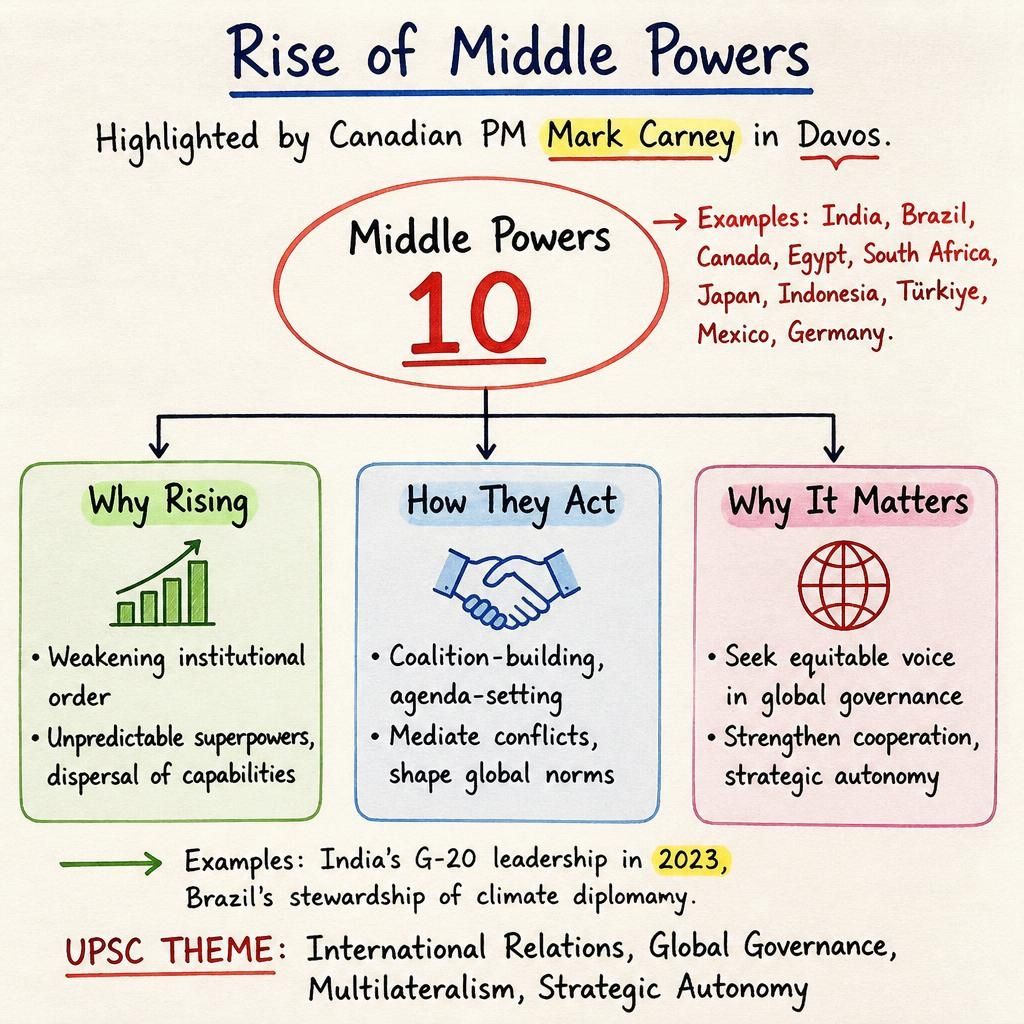
- The concept of "middle powers" has gained renewed prominence, highlighted by Canadian Prime Minister Mark Carney in Davos.
- Middle powers are states with significant regional presence, growing economic capabilities, and diplomatic networks, acting beyond their immediate neighborhoods.
- They are not "great" powers but possess enough weight for global governance and autonomy for independent strategies.
- Examples include India, Brazil, Canada, Egypt, South Africa, Japan, Indonesia, Türkiye, Mexico, and Germany.
- These nations aim to make the international order more representative and credible, advocating for reforms in multilateral governance.
- Their role is expanding due to a weakening institutional order, unpredictable superpowers, and the dispersal of economic and technological capabilities.
- Middle powers act as stabilizers, mediating conflicts, and shaping global norms in areas like digital governance and climate finance.
Rise of Middle Powers.jpg
Detailed Insights:
- The global landscape is shifting from superpower dominance or Cold War-era binary alignments to a wider constellation of influential states.
- Middle powers exert influence through coalition-building, agenda-setting, and bridging different parts of the international system.
- The United Nations Security Council is cited as an institution that has not adequately evolved to reflect contemporary power shifts.
- Middle powers are no longer content to be rule-takers but are not yet rule-makers, seeking a more equitable distribution of voice and influence.
- Their diplomacy is often pragmatic, multi-vector, and focused on preserving strategic autonomy amidst intensifying great-power rivalry.
- The erosion of great power consensus and fragmentation of global supply chains create both constraints and opportunities for middle powers.
- They can convene issue-based coalitions and mediate in conflicts where great powers are distrusted.
- Recent examples include India's leadership of the G-20 in 2023 and Brazil's stewardship of climate diplomacy.
- Middle powers have a substantial stake in cooperation and a growing capacity to help shape the world together.
- Initiatives like the Quad, BRICS, the India-Middle East-Europe Economic Corridor (IMEC), and the International North-South Transport Corridor involve cooperation between middle and great powers.
- Middle powers are more vulnerable to economic shocks than superpowers, which can limit their overall influence.
Key Concepts Involved:
- Middle Powers: States with significant regional influence and economic weight, seeking to shape global governance without being superpowers.
- Multipolar World: An international system where power is distributed among multiple major poles or states, rather than one or two.
- Global Governance: The sum of laws, norms, policies, and institutions that define, mediate, and promote cooperation in international relations.
- Strategic Autonomy: The capacity of a state to pursue its national interests and foreign policy objectives independently, without undue external influence.

SuperKalam is your personal mentor for UPSC preparation, guiding you at every step of the exam journey.
Download the App


STUDY RESOURCES
CONTACT US
ⓒ Snapstack Technologies Private Limited