GS 2: GovernanceGS 1: Indian SocietyGS 2: International RelationsGS 3: EconomyPrelims
The looming crisis of world unemployment, Pg6
World Bank warns of 800 million job deficit in Global South by 2030, risking demographic dividend turning into disaster.
Practice MCQs
833 Students attempted
Key Highlights:
- The World Bank forecasts a deficit of 800 million jobs for 1.2 billion young people entering the workforce in the Global South over the next decade.
- World Bank President Ajay Banga warned that this job deficit could transform the demographic dividend into widespread instability.
- The traditional blueprint of the demographic dividend is failing as rapid population growth outpaces job creation capacity.
- Automation and advanced technology are causing premature deindustrialization, reducing labor intensity in manufacturing.
- India, with a median age under 30, faces challenges including underemployment and low female labor force participation.
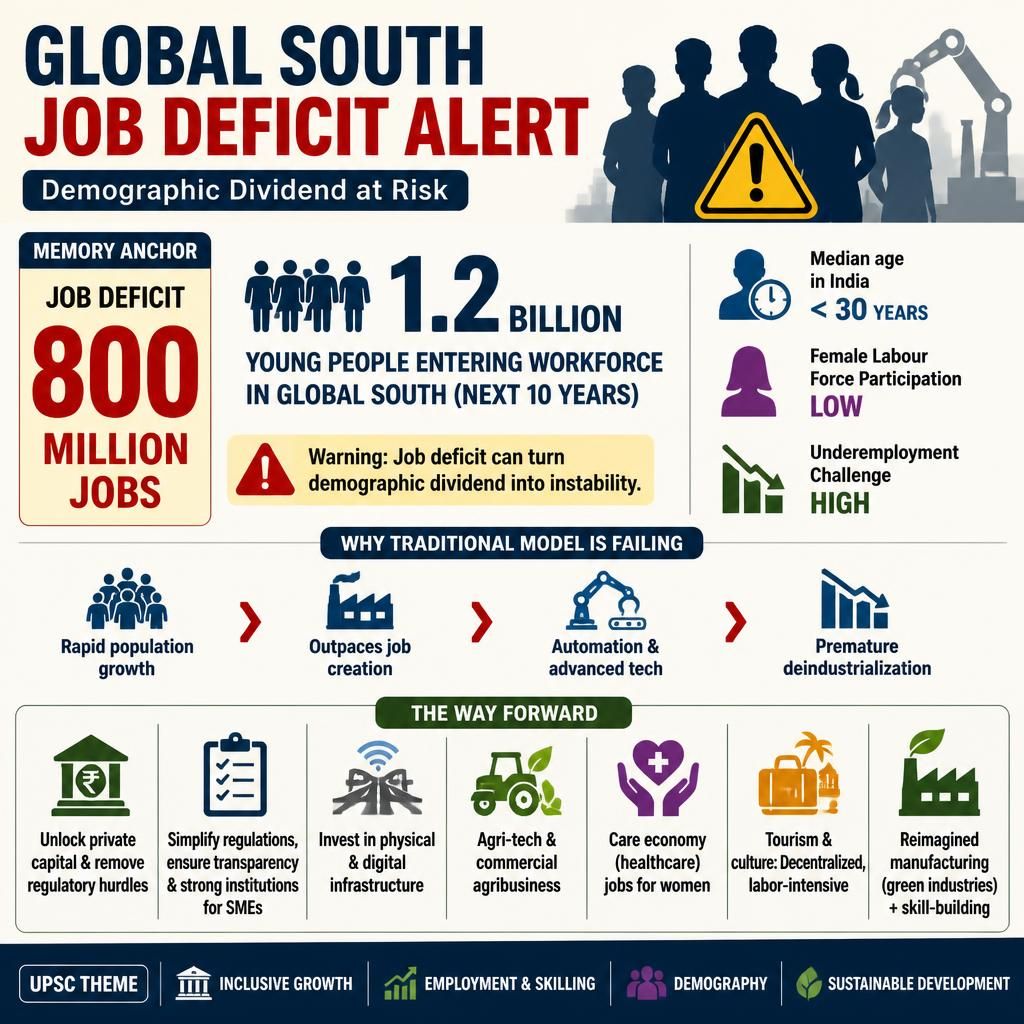
Global South Job Deficit.jpg
Detailed Insights:
- The demographic dividend, historically an engine for poverty reduction, is now threatened by insufficient economic opportunities.
- Developing nations are experiencing youth bulges at a time when traditional avenues for economic mobility are stalling.
- Light manufacturing, once a key bridge for low-income nations, is less labor-absorptive due to automation and robotics.
- The global economy increasingly rewards high-skilled, technology-driven labor, widening the skill gap for youth in developing countries.
- Solutions include unlocking private sector capital and dismantling regulatory hurdles that stifle domestic enterprise.
- Simplifying regulatory regimes, transparent governance, and strong institutional integrity are crucial for Small and Medium-sized Enterprises (SMEs).
- Improved physical and digital infrastructure lowers business costs and creates immediate employment during its development phase.
- Transitioning to agri-tech and commercial agribusiness can create remunerative employment in rural economies.
- The care economy, including healthcare, offers resilient, non-outsourceable jobs, particularly for young women.
- Tourism and culture provide decentralized, labor-intensive employment with significant multiplier effects on local economies.
- Reimagined manufacturing, such as green-transition industries, can still absorb substantial labor when paired with agile skill-building.
- Prolonged youth unemployment risks social polarization, extremism, civil unrest, and increased forced migration flows.
- Addressing this crisis requires an unprecedented alignment of international finance, domestic political courage, and private sector dynamism.
- India's agrarian sector, employing nearly half the population, contributes only 16% of the GDP (FY24), highlighting a need for value creation.
Key Concepts Involved:
- Demographic Dividend: A period when a country's population structure shifts, with a larger proportion of working-age individuals relative to dependents.
- Global South: Refers to countries often described as developing or less developed, primarily located in Africa, Asia, and Latin America.
- Premature Deindustrialization: The decline of a country's manufacturing sector at lower levels of income and development than historically observed.
- Care Economy: The sector encompassing paid and unpaid work related to caring for people, including healthcare, childcare, and eldercare services.

SuperKalam is your personal mentor for UPSC preparation, guiding you at every step of the exam journey.
Download the App


STUDY RESOURCES
CONTACT US
ⓒ Snapstack Technologies Private Limited