GS 3: Science & TechnologyPrelimsGS 3: BiotechnologyGS 3: Science and Technology in Everyday Life
New discovery comes ‘close’ to test biology’s central dogma, Pg II
Novel bacterial enzyme, DRT3b, synthesizes DNA without a nucleic acid template, a major conceptual advance that leaves Crick's central dogma intact.
Practice MCQs
833 Students attempted
Key Highlights:
- Recent studies in Cell and Science journals have reported the discovery of a new family of bacterial reverse transcriptases, DRT3, capable of synthesizing DNA without a nucleic acid template.
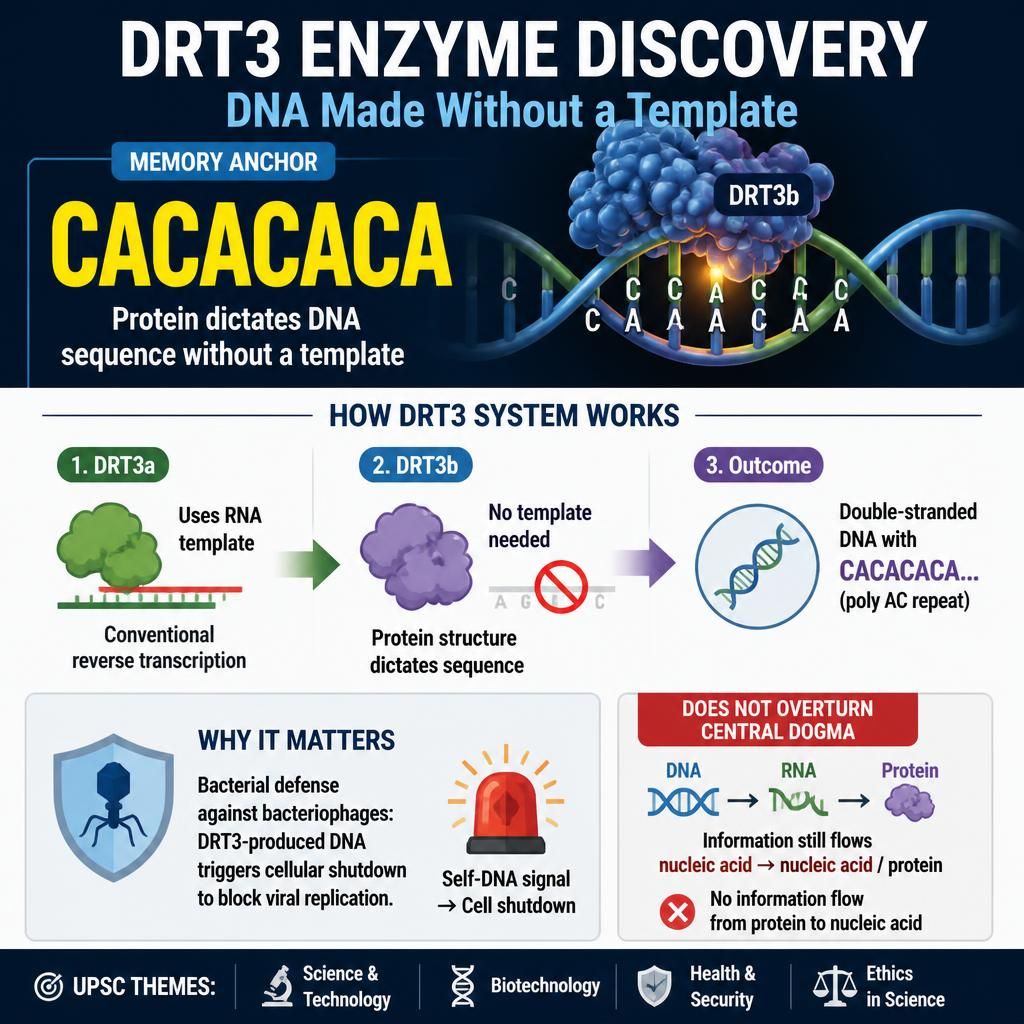
- One enzyme within this system, DRT3b, dictates the sequence of the newly synthesized DNA directly from its protein structure, producing a repetitive sequence like CACACACA.
- This mechanism is unprecedented in molecular biology, where DNA synthesis typically requires a nucleic acid template.
- The DRT3 system functions as a bacterial defense mechanism against bacteriophages, producing DNA that triggers cellular shutdown to prevent viral replication.
- While a significant conceptual advance, this discovery does not overturn the Central Dogma of molecular biology, as it does not demonstrate information transfer from protein sequence back to nucleic acid sequence.
DRT3 Discovery.jpg
Detailed Insights:
- The concept of DNA as the genetic material was established by experiments like those of Oswald Avery, Colin MacLeod, and Maclyn McCarty in 1944 and Alfred Hershey and Martha Chase in 1952.
- Francis Crick proposed the Central Dogma in 1958, stating that information flows from nucleic acid to nucleic acid, or from nucleic acid to protein, but not from protein to protein or protein to nucleic acid.
- The discovery of retroviruses and the enzyme reverse transcriptase by Howard Temin and David Baltimore in 1970 showed information flowing from RNA to DNA, which was accommodated by Crick's original framework as a "special transfer."
- The DRT3 system involves two enzymes, DRT3a and DRT3b, working together to produce a double-stranded DNA molecule.
- DRT3a synthesizes one DNA strand using an RNA template, similar to conventional reverse transcriptases.
- DRT3b is unique because its protein structure directly determines the sequence of the second DNA strand, specifically an alternating poly(AC) sequence, without relying on a nucleic acid template.
- This protein-templated DNA synthesis is a highly specialized adaptation for bacterial defense, not a general mechanism for encoding arbitrary genetic information.
- The Central Dogma's core principle, that information is lost when transferred from nucleic acid to protein (meaning a protein's sequence cannot fully reconstruct its original DNA sequence), remains unchallenged.
Scientific/Technical Concepts Involved:
- Central Dogma: The fundamental principle in molecular biology describing the flow of genetic information from DNA to RNA to protein.
- DNA (Deoxyribonucleic Acid): The molecule carrying genetic instructions for the development, functioning, growth, and reproduction of all known organisms and many viruses.
- RNA (Ribonucleic Acid): A polymeric molecule essential in various biological roles in coding, decoding, regulation, and expression of genes.
- Protein: Large biomolecules, or macromolecules, consisting of one or more long chains of amino acid residues, essential for cell structure and function.
- Reverse Transcriptase: An enzyme that synthesizes DNA from an RNA template, found in retroviruses and some other biological systems.
- Bacteriophage: A virus that infects and replicates within bacteria and archaea.

SuperKalam is your personal mentor for UPSC preparation, guiding you at every step of the exam journey.
Download the App


STUDY RESOURCES
CONTACT US
ⓒ Snapstack Technologies Private Limited