GS 3: Internal SecurityGS 2: International RelationsGS 2: Bilateral, Regional and Global Groupings and AgreementsGS 2: Effect of Policies and Politics of Developed and Developing Countries on India's Interests
The limits of US's West Asia strategy are showing, Pg14
US reassesses its West Asia strategy amid prolonged conflicts, troop withdrawals, and rising regional instability, impacting global security and trade routes.
Practice MCQs
833 Students attempted
Key Highlights:
- The US-Israel war against Iran has entered its eighth month, with no immediate prospect of a durable agreement on Tehran's nuclear program.
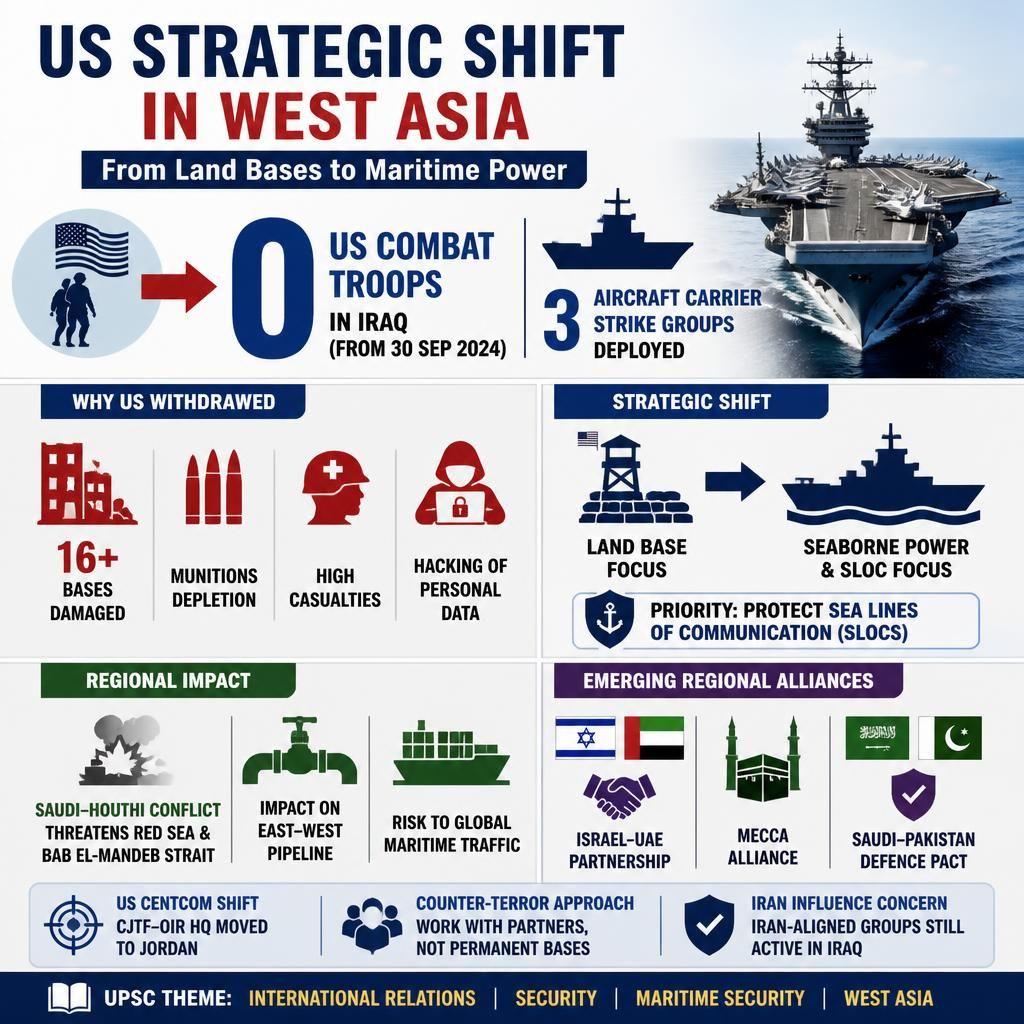
- The US has withdrawn its last troops from Iraq on September 30 and from Syria in April, reassessing its military footprint in the region.
- Reasons for US withdrawals include damage to over 16 bases, depletion of munitions, high casualties, and hacking of US forces' personal information.
- The US is shifting its strategy towards strengthening seaborne resources and focusing on Sea Lines of Communication (SLOCs), deploying a third aircraft carrier strike group.
- Regional conflicts, including the Saudi-Houthi conflict, continue to pose risks to maritime traffic through the Red Sea and the Bab el-Mandeb strait.
US In West Asia.jpg
Detailed Insights:
- The ongoing tensions have reignited the Saudi-Houthi conflict, impacting the East-West pipeline and maritime security.
- Israel remains militarily engaged in Gaza, the West Bank, Lebanon, and Syria, facing persistent threats from Iran and its allies.
- The US withdrawal from Iraq occurred despite Iran-aligned armed groups not being fully under Iraqi government control, raising concerns about Iranian influence.
- US Central Command (US CENTCOM) has relocated its Combined Joint Task Force-Operation Inherent Resolve headquarters to Jordan.
- This strategic shift aligns with the US's counter-terrorism approach of working with partners rather than maintaining large ground bases in high-risk areas.
- New regional alliances, such as the Israel-UAE partnership, the Mecca alliance, and the Saudi-Pakistan Defence Pact, are emerging to seek regional security.
- Several Gulf Cooperation Council (GCC) countries are exploring ways to integrate Iran into a broader regional security framework.
- Upcoming Israeli and US midterm elections could introduce political outcomes unfavorable to regional stability.
Key Concepts Involved:
- Bab el-Mandeb: A strategic strait located between Yemen on the Arabian Peninsula and Djibouti and Eritrea in the Horn of Africa, connecting the Red Sea to the Gulf of Aden.
- Sea Lines of Communication (SLOCs): The primary maritime routes used for global trade, energy transport, and military deployments.
- US Central Command (US CENTCOM): One of the eleven unified combatant commands of the U.S. Department of Defense, responsible for operations in the Middle East, Central Asia, and parts of South Asia.
- Operation Inherent Resolve: The military intervention by the United States and its allies against the Islamic State of Iraq and Syria (ISIS).

SuperKalam is your personal mentor for UPSC preparation, guiding you at every step of the exam journey.
Download the App


STUDY RESOURCES
CONTACT US
ⓒ Snapstack Technologies Private Limited