GS 2: GovernanceGS 3: EconomyPrelimsGS 3: Indian Economy, Planning, Mobilization of Resources, Growth, Development and EmploymentGS 4: Corporate Governance
NSE IPO: India's biggest issue faces key questions ahead of its listing, Pg11
NSE's Rs 30,000 crore IPO faces regulatory conflict over self-listing on its own platform, awaiting SEBI's decision on 'permitted-to-trade' route.
Practice MCQs
826 Students attempted
Key Highlights:
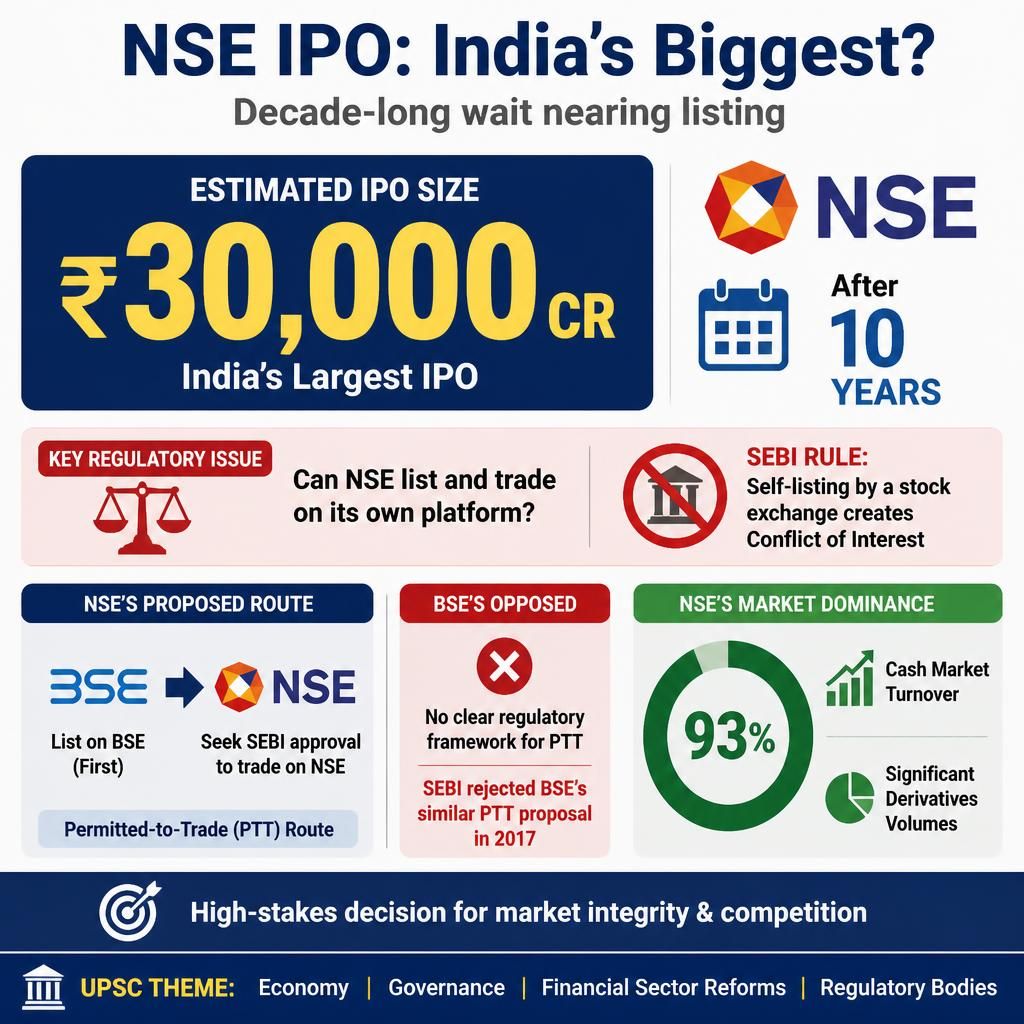
- The National Stock Exchange (NSE) is preparing for India's largest Initial Public Offering (IPO), estimated at Rs 30,000 crore, following a decade-long wait for regulatory clearance.
- A key regulatory hurdle involves whether NSE shares will be allowed to trade on its own platform, as SEBI regulations prohibit self-listing due to potential conflict of interest.
- NSE is exploring the Permitted-to-Trade (PTT) route, which would involve listing its shares first on BSE and then seeking SEBI approval to trade on NSE.
- BSE Managing Director Sundararaman Ramamurthy has expressed strong opposition to NSE's PTT proposal, citing the absence of a clear regulatory framework.
- The Securities and Exchange Board of India (SEBI) had previously rejected a similar PTT proposal from BSE in 2017 due to conflict of interest concerns.
NSE IPO.jpg
Detailed Insights:
- SEBI's stance is that a stock exchange acting as a first-level regulator cannot list on its own platform without creating a conflict of interest.
- The Permitted-to-Trade (PTT) route would allow NSE to trade its shares on its platform by making BSE responsible for primary compliance.
- NSE holds a dominant market position, accounting for approximately 93% of India's cash market turnover and significant derivatives volumes.
- Trading NSE shares on its own exchange could lead to their inclusion in key indices like Nifty 500 and Nifty Financial Services, potentially boosting passive mutual fund inflows.
- The IPO is set to launch amidst a recovering Indian IPO market, with July and August 2025 seeing substantial funds raised.
- Brokerages anticipate NSE's IPO to achieve a Price-to-Earnings (P/E) ratio between 35 and 49 times its FY26 earnings.
Key Concepts Involved:
- Initial Public Offering (IPO): The process by which a private company first offers its shares to the public for sale.
- Securities and Exchange Board of India (SEBI): The primary regulator for the securities market in India, responsible for investor protection and market development.
- Stock Exchange: An organized marketplace where financial instruments like stocks, bonds, and derivatives are traded.
- Conflict of Interest: A situation where an entity's multiple interests could potentially compromise its objectivity or decision-making.
- Permitted-to-Trade (PTT) route: A regulatory mechanism allowing shares to be traded on an exchange without being primarily listed there, with compliance managed by the primary listing exchange.
- Price-to-Earnings (P/E) ratio: A valuation metric comparing a company's current share price to its per-share earnings, indicating market expectations for future growth.

SuperKalam is your personal mentor for UPSC preparation, guiding you at every step of the exam journey.
Download the App


STUDY RESOURCES
CONTACT US
ⓒ Snapstack Technologies Private Limited