GS 2: GovernanceGS 2: PolityPrelimsGS 2: Government policies and interventions for development in various sectorsGS 2: Statutory, Regulatory and Quasi Judicial Bodies
Why is the Indian Statistical Institute Bill controversial?, Pg8
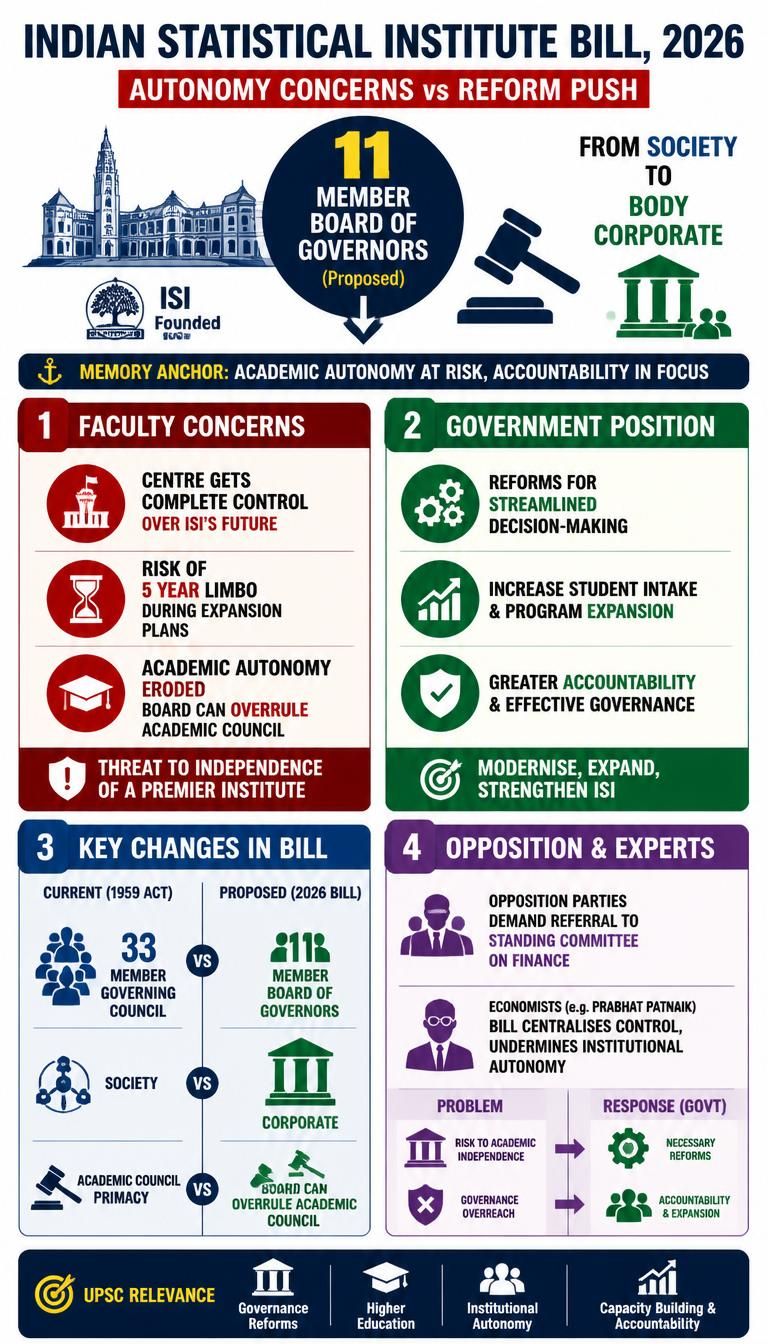
New Indian Statistical Institute Bill 2026 sparks controversy over proposed governance changes, centralizing control and raising concerns about institutional autonomy.
Practice MCQs
819 Students attempted
Key Highlights:
- The Indian Statistical Institute Bill, 2026, has been introduced in Parliament to replace the Indian Statistical Institute Act, 1959.
- The Bill aims to restructure the governance of the Indian Statistical Institute (ISI), aligning it with other Institutions of National Importance like IITs and IIMs.
- The proposed changes include replacing the current society-based governance with a compact Board of Governors.
- Faculty members and Members of Parliament have raised concerns, alleging increased government control and lack of stakeholder consultation.
- The Indian Statistical Institute was founded by P.C. Mahalanobis in 1931 and was declared an Institution of National Importance in 1959.
ISI Bill.jpg
Detailed Insights:
- The existing governance model of the Indian Statistical Institute (ISI), based on a society, requires General Body approval for regulatory amendments.
- The government argues this current structure is prescriptive and hinders reforms, necessitating a more "robust and contemporary governance framework".
- The new Bill proposes an 11-member Board of Governors, with the government having direct or indirect control over eight members.
- Critics contend that this shift will transfer significant control of the Indian Statistical Institute from its internal stakeholders to the Union government.
- The government asserts that past Review Committees had recommended reducing the size of the ISI Council and addressing structural issues.
- A brainstorming session was held in July 2025 to discuss pathways for transforming ISI into a world-class center by its 100th anniversary in 2031.
- Public comments and suggestions on the draft Bill were invited as part of the pre-legislative consultation policy.
Key Concepts Involved:
- Institution of National Importance: An institution recognized by an Act of Parliament as crucial for developing highly skilled human resources.
- Board of Governors: A principal executive body responsible for the policy-making and strategic direction of an institution.
- Societies Registration Act, 1860: A legislative act that provides for the registration of literary, scientific, and charitable societies in India.
- Visitor: In the context of central educational institutions, the President of India often holds this position, signifying ultimate authority.

SuperKalam is your personal mentor for UPSC preparation, guiding you at every step of the exam journey.
Download the App


STUDY RESOURCES
CONTACT US
ⓒ Snapstack Technologies Private Limited