GS 2: GovernanceGS 3: Environment & EcologyPrelimsGS 3: Conservation, Pollution and DegradationGS 2: Government policies and interventions for development in various sectors
The road ahead for the Asiatic lion, Pg8
Proposed limestone mining threatens crucial Asiatic lion habitat and movement corridors in Gujarat, jeopardizing decades of conservation success and raising concerns about the species' future.
Practice MCQs
819 Students attempted
Key Highlights:
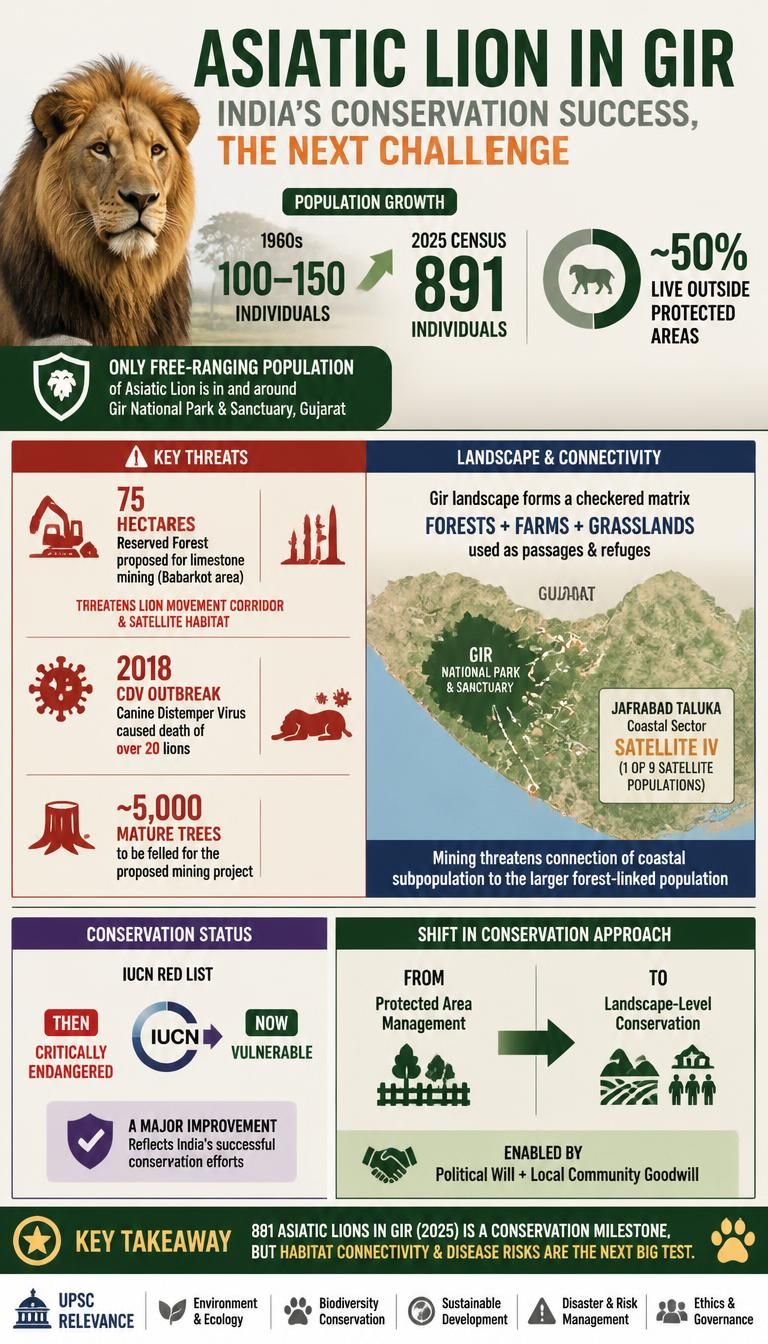
- The only free-ranging population of the Asiatic lion is found in and around Gir National Park and Sanctuary in Gujarat.
- The lion population has grown from 100-150 individuals six decades ago to 891 in the 2025 census, with nearly half residing outside designated protected areas.
- A proposal to divert approximately 75 hectares of reserved forest for limestone mining in the Babarkot area threatens a crucial lion movement corridor and satellite habitat.
- In 2018, over 20 lions succumbed to an outbreak of Canine Distemper Virus (CDV), highlighting the vulnerability of a geographically concentrated population.
- The International Union for Conservation of Nature (IUCN) Red List currently classifies the Asiatic lion as Vulnerable, a significant improvement from its previous Critically Endangered status.
Asiatic Lion.jpg
Detailed Insights:
- The semi-arid landscape of Gir extends into agricultural fields and grasslands, forming a checkered matrix that lions use as passages and refuges.
- The Gujarat Forest Department’s 2025 lion population estimation identifies the coastal sector of Jafrabad Taluka as Satellite IV, one of nine recognized satellite lion populations.
- The proposed mining project would require felling nearly 5,000 mature trees, potentially disrupting the coastal subpopulation's connection to the larger forest-linked population.
- The success of lion conservation has transitioned from protected-area management to landscape-level conservation, supported by political will and local community goodwill.
- The 2018 CDV outbreak, which caused significant mortality, underscored the risk of disease in a single, concentrated population, prompting calls for a second home for the lions.
- The IUCN Green Status assessments indicate that while the Asiatic lion has recovered from the brink, it remains "largely depleted" and far from fully restored across its historical range.
- The Gir National Park and Sanctuary was established in 1965, and conservation efforts have led to a substantial increase in the lion population.
Key Concepts Involved:
- Asiatic Lion: A subspecies of lion (Panthera leo leo) whose only wild population exists in the Gir region of Gujarat, India.
- Gir National Park and Sanctuary: A protected area in Gujarat, India, established in 1965, serving as the last natural habitat for the Asiatic lion.
- IUCN Red List: A comprehensive inventory of the global conservation status of biological species, classifying species based on their extinction risk.
- Green Status Assessment: A complementary tool to the IUCN Red List that measures the recovery of species' populations and the impact of conservation efforts.
- Canine Distemper Virus (CDV): A highly contagious viral disease affecting a wide range of carnivores, posing a significant threat to lion populations.

SuperKalam is your personal mentor for UPSC preparation, guiding you at every step of the exam journey.
Download the App


STUDY RESOURCES
CONTACT US
ⓒ Snapstack Technologies Private Limited