GS 2: PolityPrelimsGS 2: Parliament and State LegislaturesGS 2: Structure and Functioning of Executive and Judiciary
RS Clears Bill to Increase Number of SC Judges, Pg11
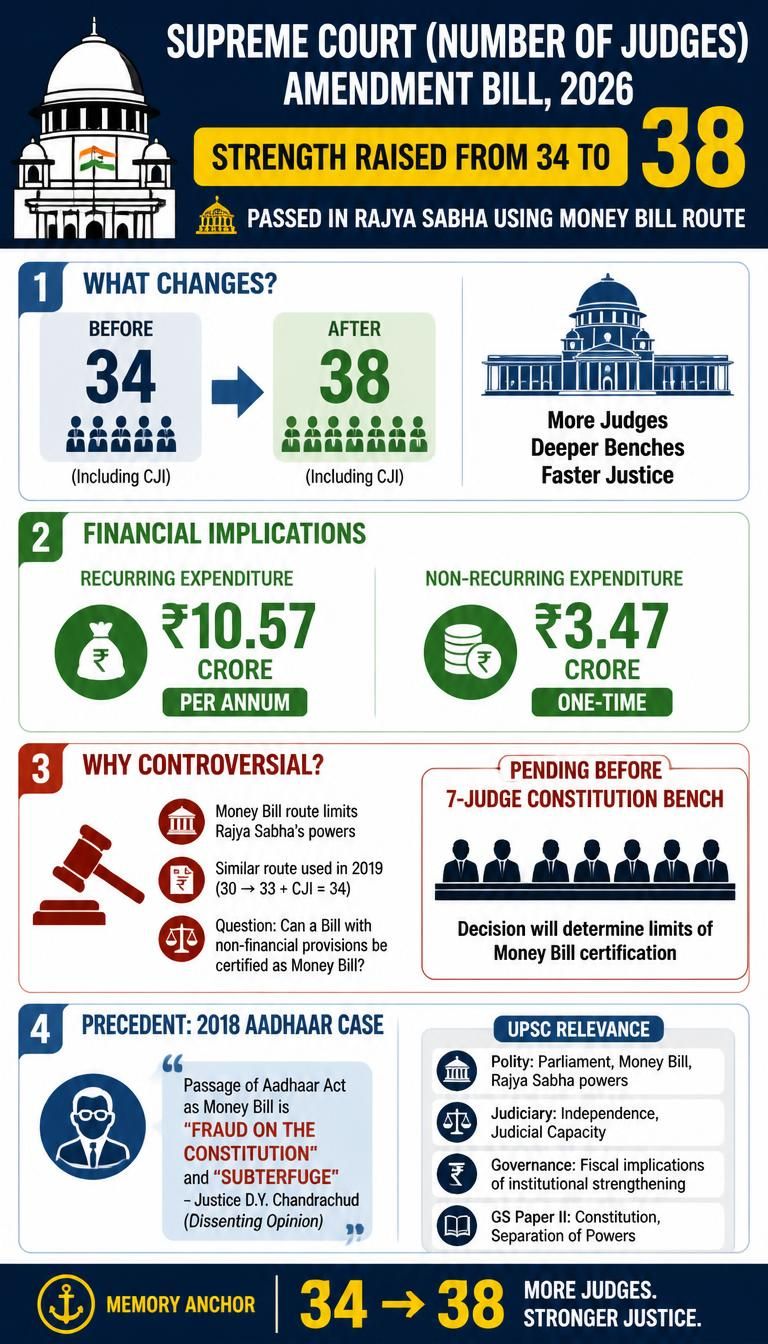
Rajya Sabha clears Bill increasing Supreme Court judges to 38, aiming to boost judicial efficiency, despite opposition concerns over ordinance route.
Practice MCQs
819 Students attempted
Key Highlights:
- The Supreme Court (Number of Judges) Amendment Bill, 2026 was passed by the Rajya Sabha, following its clearance by the Lok Sabha.
- The Bill increases the sanctioned strength of Supreme Court judges from the current 34 to 38, including the Chief Justice of India.
- This legislation replaces an Ordinance that had been issued by the government earlier.
- The primary objective of increasing the judicial strength is to enhance judicial efficiency and address the growing backlog of cases.
SC judges.jpg
Detailed Insights:
- The Supreme Court (Number of Judges) Amendment Bill, 2026 amends the existing Supreme Court (Number of Judges) Act, 1956.
- Article 124 of the Indian Constitution grants Parliament the authority to determine the number of judges in the Supreme Court through legislation.
- The Supreme Court initially began functioning in 1950 with a strength of 8 judges, including the Chief Justice of India.
- This marks the latest in a series of increases, with the last augmentation occurring in 2019 when the strength was raised from 31 to 34 judges.
- The increase is aimed at facilitating the quicker disposal of pending cases, which exceeded 92,000 as of early 2026.
- The Bill was introduced as a Money Bill, which entails specific procedural advantages for the Lok Sabha over the Rajya Sabha.
- Opposition members raised concerns regarding the government's decision to initially promulgate an Ordinance instead of directly introducing the Bill in Parliament.
Key Concepts Involved:
- Supreme Court (Number of Judges) Act, 1956: The central legislation that governs and defines the sanctioned strength of judges in the Supreme Court of India.
- Money Bill: A type of bill, defined under Article 110 of the Constitution, that deals exclusively with financial matters and can only be introduced in the Lok Sabha, giving it greater powers in its passage.
- Ordinance: A temporary law promulgated by the President under Article 123 when Parliament is not in session, which has the same force as an Act of Parliament but must be approved by Parliament within six weeks of its reassembly.
- Article 124: A constitutional provision that establishes the Supreme Court of India and empowers Parliament to legislate on the number of judges it comprises.

SuperKalam is your personal mentor for UPSC preparation, guiding you at every step of the exam journey.
Download the App


STUDY RESOURCES
CONTACT US
ⓒ Snapstack Technologies Private Limited