GS 2: GovernanceGS 3: Environment & EcologyPrelimsGS 3: Conservation, Pollution and DegradationGS 2: Development Processes and Role of NGOs, SHGs and Other Stakeholders
Meghalaya launches mission to protect clouded leopards, Pg12
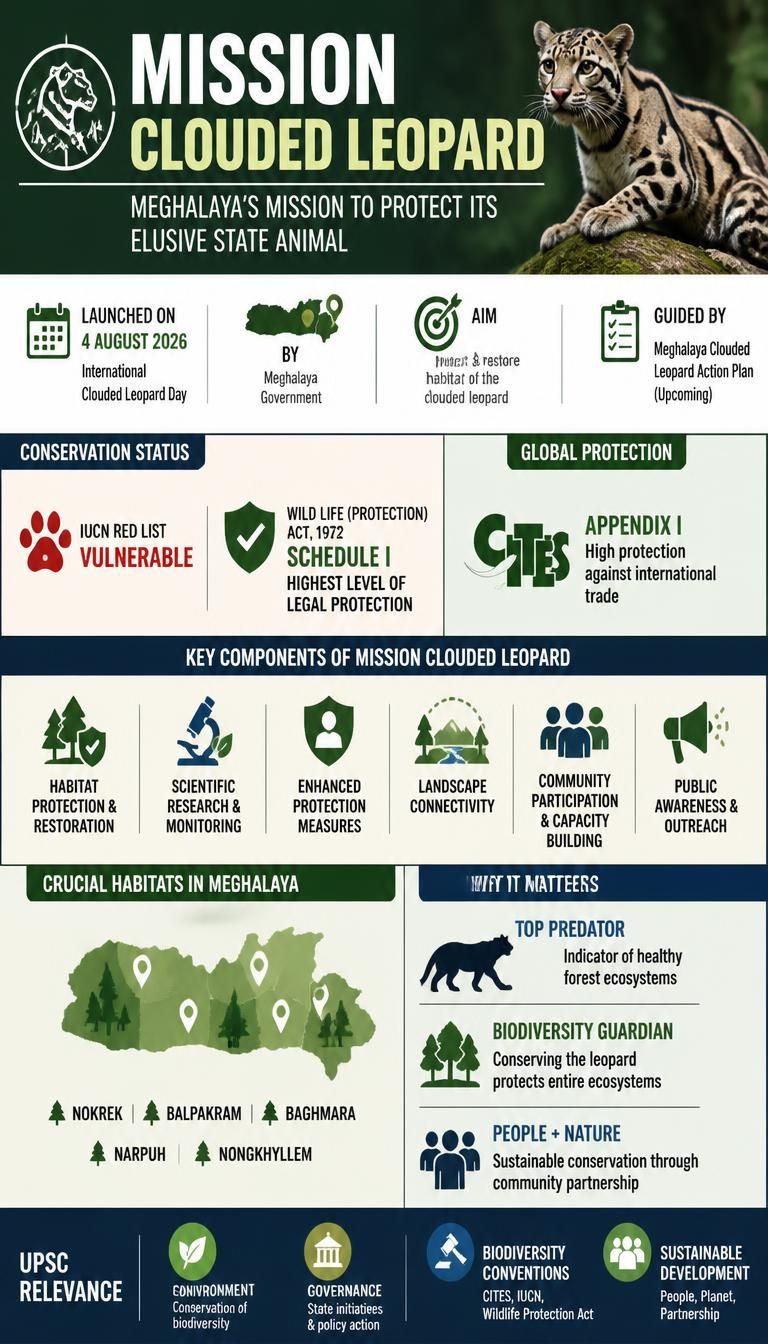
Meghalaya launches ambitious 'Mission Clouded Leopard' to protect its state animal, focusing on habitat restoration, scientific research, and community participation.
Practice MCQs
819 Students attempted
Key Highlights:
- Meghalaya has launched Mission Clouded Leopard, a dedicated program for the conservation of its state animal, the mainland clouded leopard (Neofelis nebulosa).
- Chief Minister Conrad K. Sangma unveiled the mission on International Clouded Leopard Day (August 4, 2026).
- The mission aims to protect and restore the habitat of the elusive cat, guided by the upcoming Meghalaya Clouded Leopard Action Plan.
- The mainland clouded leopard is listed as 'Vulnerable' on the IUCN Red List and is protected under Schedule I of the Wild Life (Protection) Act, 1972.
Clouded Leopard.jpg
Detailed Insights:
- The mainland clouded leopard (Neofelis nebulosa) is also included in Appendix I of CITES, signifying its high protection status against international trade.
- Key components of Mission Clouded Leopard include habitat protection and restoration, scientific research, long-term monitoring, enhanced protection measures, and promoting landscape connectivity.
- The mission also focuses on capacity building for frontline staff, fostering community participation, and raising public awareness regarding conservation.
- Meghalaya's forest landscapes, such as Nokrek, Balpakram, Baghmara, Narpuh, and Nongkhyllem, are crucial habitats for the species.
- Preliminary scientific assessments have identified 21 individual clouded leopards within the Balpakram landscape, highlighting the species' presence in the state.
- Threats to the clouded leopard include habitat loss, deforestation, poaching, illegal wildlife trade, and human-wildlife conflict.
- India has also launched a broader Clouded Leopard Conservation Action Plan (CAP), identifying 14 priority landscapes across Northeast India and including the species under the Species Recovery Programme of the Integrated Development of Wildlife Habitats (IDWH) scheme.
Key Concepts Involved:
- IUCN Red List: A global inventory of the conservation status of biological species, assessing extinction risk.
- Wild Life (Protection) Act, 1972: An Act of the Parliament of India that provides for the protection of wild animals, birds, and plants.
- CITES (Convention on International Trade in Endangered Species of Wild Fauna and Flora): An international agreement between governments to ensure that international trade in specimens of wild animals and plants does not threaten their survival.
- Habitat Fragmentation: The process by which large, continuous habitats are divided into smaller, isolated patches, often leading to population declines.

SuperKalam is your personal mentor for UPSC preparation, guiding you at every step of the exam journey.
Download the App


STUDY RESOURCES
CONTACT US
ⓒ Snapstack Technologies Private Limited