GS 2: GovernanceGS 3: EconomyPrelimsGS 3: Indian Economy, Planning, Mobilization of Resources, Growth, Development and EmploymentGS 2: Statutory, Regulatory and Quasi Judicial Bodies
RBI Keeps Interest Rates Unchanged, Opts For Caution Amid Uncertain Global Outlook, Pg1
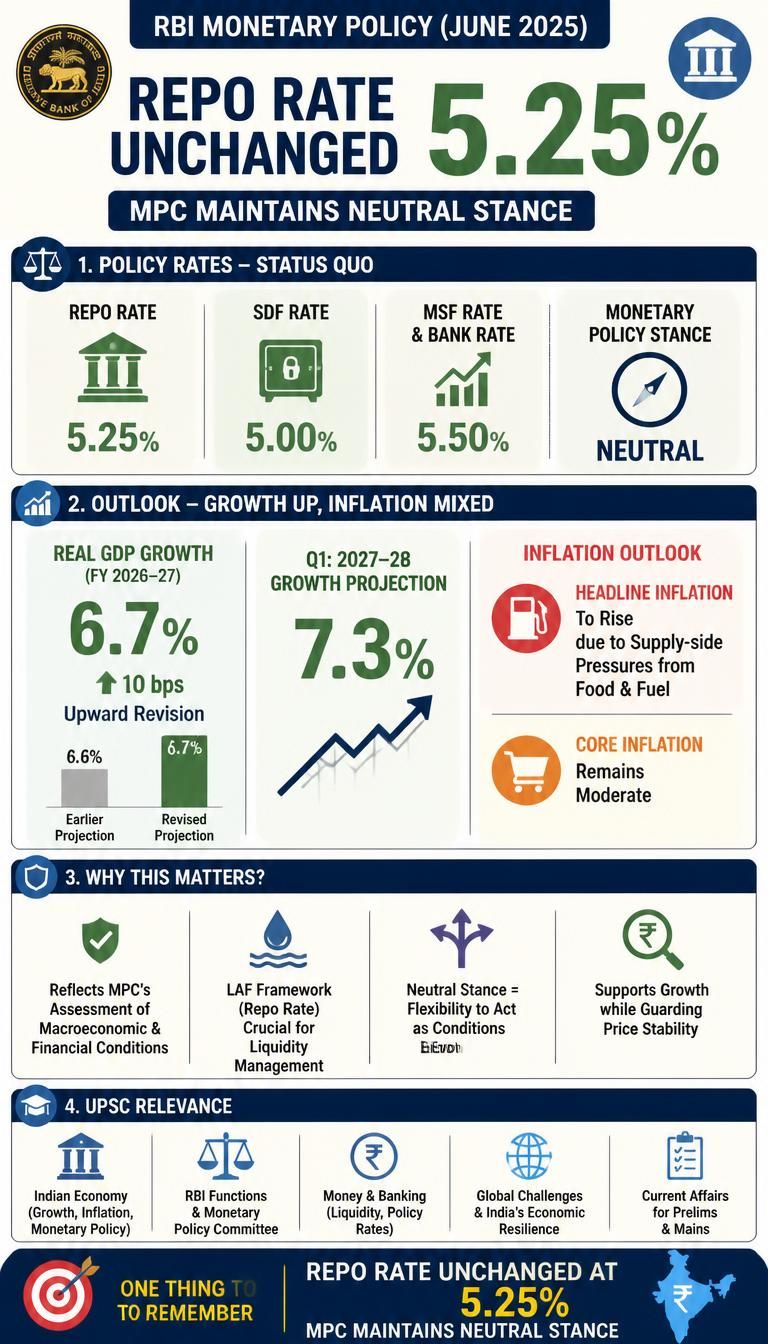
RBI's MPC maintains repo rate at 5.25% due to global uncertainties, marginally raising growth forecast while cutting inflation projection.
Practice MCQs
819 Students attempted
Key Highlights:
- The Reserve Bank of India's (RBI) Monetary Policy Committee (MPC) unanimously kept the key policy repo rate unchanged at 5.25 per cent.
- The decision was taken by the six-member MPC, chaired by RBI Governor Sanjay Malhotra.
- The MPC maintained a neutral policy stance, citing caution due to global uncertainties and volatile crude oil prices.
- India's growth forecast for FY27 was marginally raised to 6.7 per cent from 6.6 per cent.
- The inflation projection was lowered to 5 per cent from 5.1 per cent, indicating expected moderation despite near-term risks.
Repo Rate.jpg
Detailed Insights:
- The MPC prioritized caution amidst geopolitical tensions in West Asia, which contribute to global economic uncertainty and volatile crude oil prices.
- The unchanged repo rate is expected to keep borrowing and deposit rates stable, thus impacting Equated Monthly Installments (EMIs) for various loans.
- The RBI noted that headline inflation, while above target, was primarily driven by food and fuel prices rather than broad-based demand pressures.
- Inflation is projected to peak in the third quarter of the current year, mainly due to food and fuel, before moderating thereafter.
- The central bank is awaiting greater clarity on the inflation outlook, particularly concerning the south-west monsoon and El Nino conditions.
- The Indian economy, especially the agriculture sector, has demonstrated resilience, partly supported by government measures such as distributed irrigation.
Key Concepts Involved:
- Monetary Policy Committee (MPC): A statutory body in India responsible for determining the benchmark interest rate to maintain price stability while keeping in mind the objective of growth.
- Repo Rate: The interest rate at which the Reserve Bank of India lends money to commercial banks for short-term needs, typically against government securities.
- Neutral Policy Stance: A monetary policy approach where the central bank maintains flexibility to either increase or decrease policy rates, giving equal priority to inflation control and economic growth.
- Inflation: The rate at which the general level of prices for goods and services is rising, leading to a decrease in purchasing power.
- El Nino: A climate pattern characterized by the unusual warming of surface waters in the eastern tropical Pacific Ocean, which can significantly impact global weather patterns, including the Indian monsoon.

SuperKalam is your personal mentor for UPSC preparation, guiding you at every step of the exam journey.
Download the App


STUDY RESOURCES
CONTACT US
ⓒ Snapstack Technologies Private Limited