GS 2: GovernanceGS 2: PolityPrelimsGS 2: Government policies and interventions for development in various sectorsGS 2: Parliament and State Legislatures
LS clears Bankers' Books Evidence Bill with voice vote amid Opposition din, Pg6
Lok Sabha passes Bankers' Books Evidence Bill, 2026, by voice vote amidst Opposition protests, updating legal use of digital bank records.
Practice MCQs
819 Students attempted
Key Highlights:
- The Lok Sabha passed the Bankers' Books Evidence Bill, 2026 by a voice vote on Wednesday.
- The Bill was passed without debate amidst continuous protests and disruptions by Opposition members.
- It aims to repeal and replace the colonial-era Bankers' Books Evidence Act, 1891.
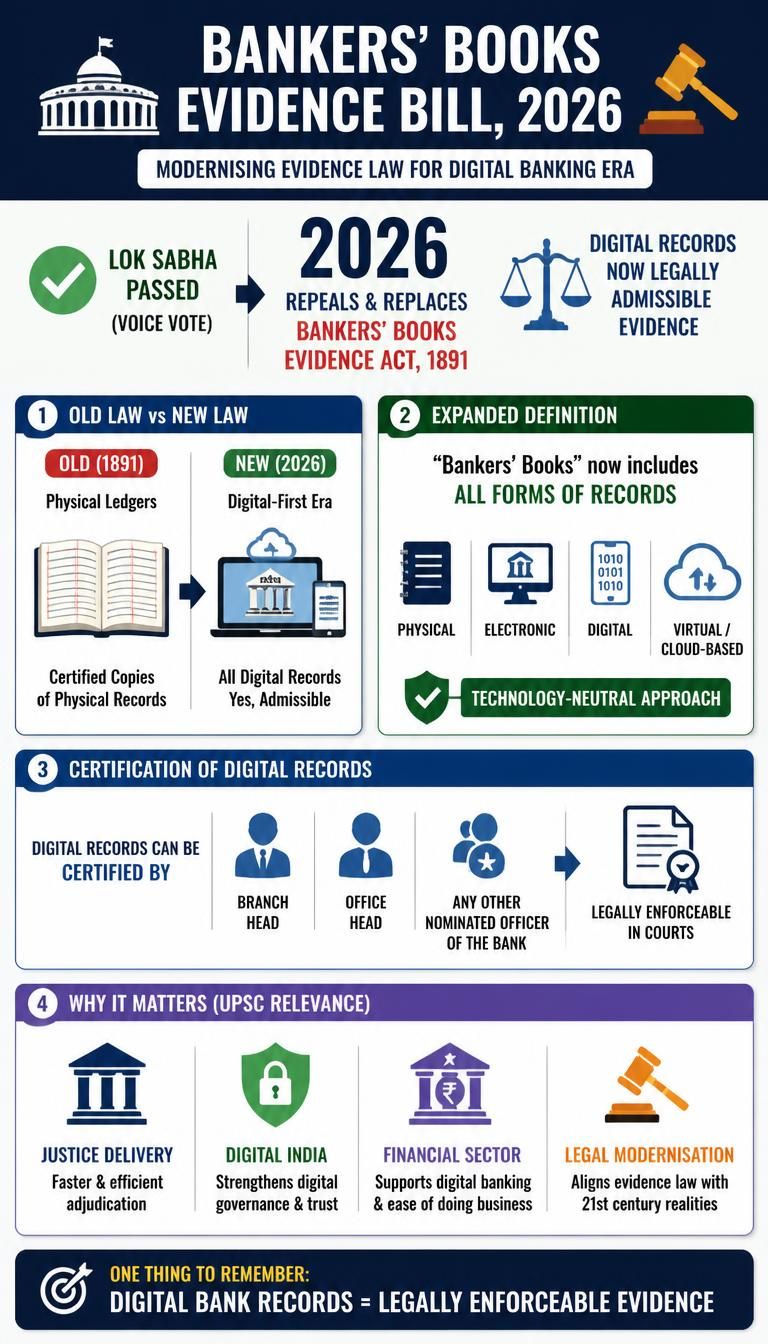
- The new legislation recognizes digital banking records, including electronic, virtual, and cloud-based formats, as admissible and legally enforceable evidence in legal proceedings.
Bankers Bill.jpg
Detailed Insights:
- The Bankers' Books Evidence Act, 1891, was enacted when bank records were predominantly maintained in physical ledgers, allowing certified copies to be used as evidence to avoid producing original documents.
- The Bankers' Books Evidence Bill, 2026, seeks to modernize this framework to align with contemporary digital banking practices and technological advancements.
- The Bill expands the definition of "bankers' books" to encompass all forms of records, whether physical, electronic, digital, virtual, or cloud-based, ensuring a technology-neutral approach.
- It allows for the certification of these digital records by a branch head, office head, or any other nominated officer of the bank.
- Concerns have been raised regarding provisions that may allow investigative agencies, specifically officers not below the rank of Superintendent of Police, to access bank records without a court order, potentially expanding state access to financial data.
- The passage of the Bill without discussion highlights ongoing parliamentary disruptions, which also affected the functioning of Question Hour and Zero Hour.
Key Concepts Involved:
- Bankers' Books Evidence Bill, 2026: New legislation aimed at updating the legal framework for the admissibility of bank records as evidence in line with digital banking.
- Bankers' Books Evidence Act, 1891: A British colonial-era law that allowed certified copies of bank records to be used as evidence in legal proceedings.
- Voice Vote: A method of voting in legislative bodies where the presiding officer determines the outcome based on the audible response of "Ayes" and "Noes" from members.
- Question Hour: The first hour of a parliamentary sitting during which Members of Parliament can ask questions to ministers regarding government policies and administration.
- Zero Hour: An informal parliamentary device in India that allows Members of Parliament to raise matters of urgent public importance without prior notice, immediately following the Question Hour.

SuperKalam is your personal mentor for UPSC preparation, guiding you at every step of the exam journey.
Download the App


STUDY RESOURCES
CONTACT US
ⓒ Snapstack Technologies Private Limited