EthicsGS 2: GovernanceGS 2: PolityGS 2: Social JusticePrelims
How SC's Gender Guide Differs From the 2023 Version, Pg12
Supreme Court releases new gender sensitivity report for judges, emphasizing emotional quotient and compassionate practices for sexual assault survivors, differing from 2023 language guide.
Practice MCQs
819 Students attempted
Key Highlights:
- The Supreme Court published a new report titled 'Judgments and Gender: Sensitivity and compassion in writing judgments' on Monday.
- Drafted by an expert panel led by retired Justice Aniruddha Bose, the report aims to enhance gender sensitivity within the Indian judiciary.
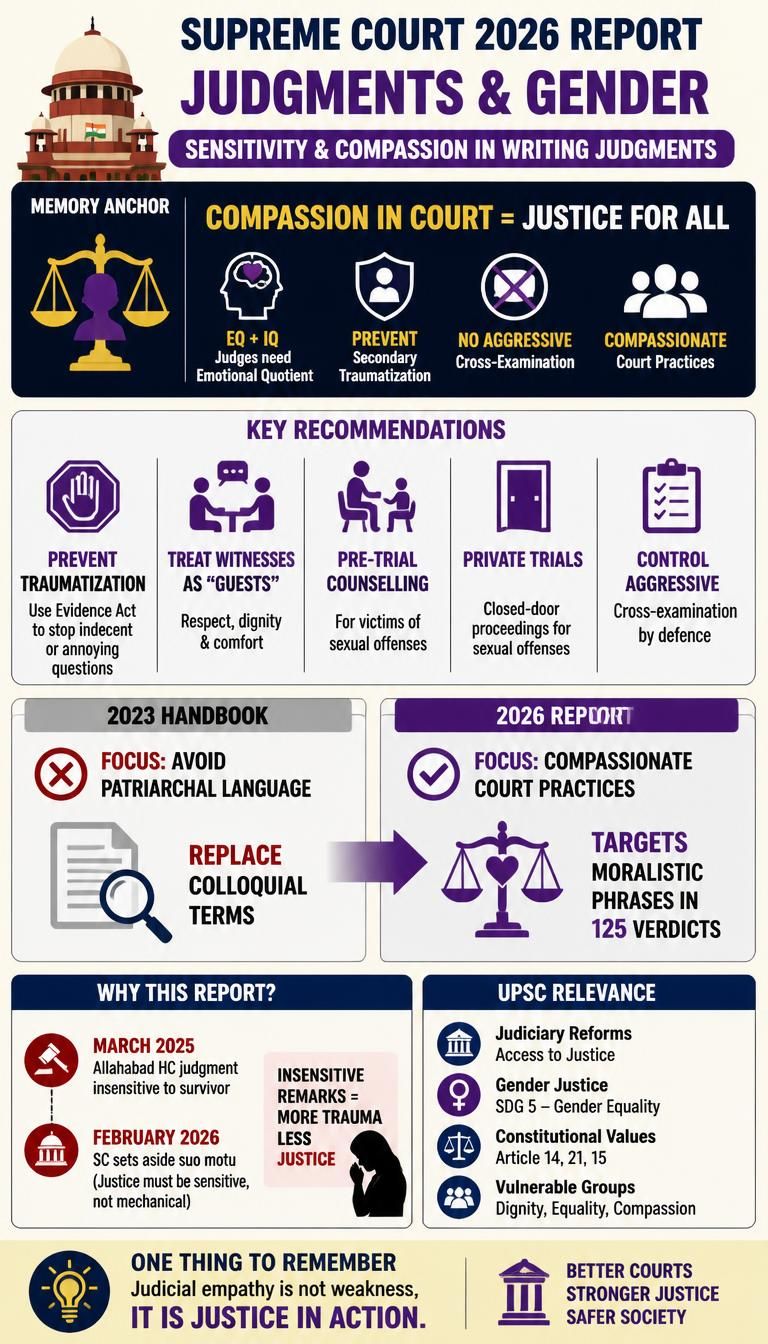
- It recommends that trial court judges actively prevent secondary traumatization of sexual assault survivors and control aggressive cross-examinations.
- The report emphasizes the need for judges to develop an "Emotional Quotient" alongside their Intelligence Quotient for handling cases involving crimes against women.
- This new report marks a shift from the 2023 handbook, focusing on "compassionate court practices" rather than solely on avoiding patriarchal language.
SC Gender Report.jpg
Detailed Insights:
- The report highlights how survivors often face insensitive remarks from police and authorities, leading to further trauma and deterring them from seeking justice.
- It advocates for "compassionate court practices" and urges judges to utilize provisions of the Bharatiya Sakshya Adhiniyam to prevent indecent or annoying questions, especially concerning a survivor's sexual history.
- Recommendations include treating witnesses as "guests," providing pre-trial counselling for victims, and holding trials for sexual offenses in private, closed-door proceedings.
- Unlike the 2023 handbook, which focused on replacing colloquial terms, the 2026 report targets moralistic phrases found in trial court judgments, based on an analysis of 125 verdicts.
- The impetus for this new report stemmed from a March 2025 Allahabad High Court judgment, which the Supreme Court later set aside suo motu in February 2026.
- Then Chief Justice of India (CJI) Surya Kant had criticized the 2023 handbook as "too Harvard-oriented" and directed the National Judicial Academy to formulate practical training guidelines.
Key Concepts Involved:
- Emotional Quotient (EQ): The capacity to understand, use, and manage one's own emotions in positive ways to relieve stress, communicate effectively, empathize with others, overcome challenges, and defuse conflict.
- Bharatiya Sakshya Adhiniyam: A new law that replaced the Indian Evidence Act, 1872, governing the admissibility of evidence in Indian courts.
- Suo Motu Cognisance: The power of a court to take notice of a matter on its own initiative, without any formal petition or application from any party.
- National Judicial Academy: An institution established by the Supreme Court of India to provide training and continuing education to judicial officers across the country.

SuperKalam is your personal mentor for UPSC preparation, guiding you at every step of the exam journey.
Download the App


STUDY RESOURCES
CONTACT US
ⓒ Snapstack Technologies Private Limited