GS 2: Social JusticeGS 3: EconomyPrelimsGS 3: Inclusive GrowthGS 3: Indian Economy, Planning, Mobilization of Resources, Growth, Development and Employment
From poverty alleviation to prosperity, Pg8
India rapidly reduces extreme poverty, but faces a huge prosperity gap and poor job quality, World Bank data reveals.
Practice MCQs
833 Students attempted
Key Highlights:
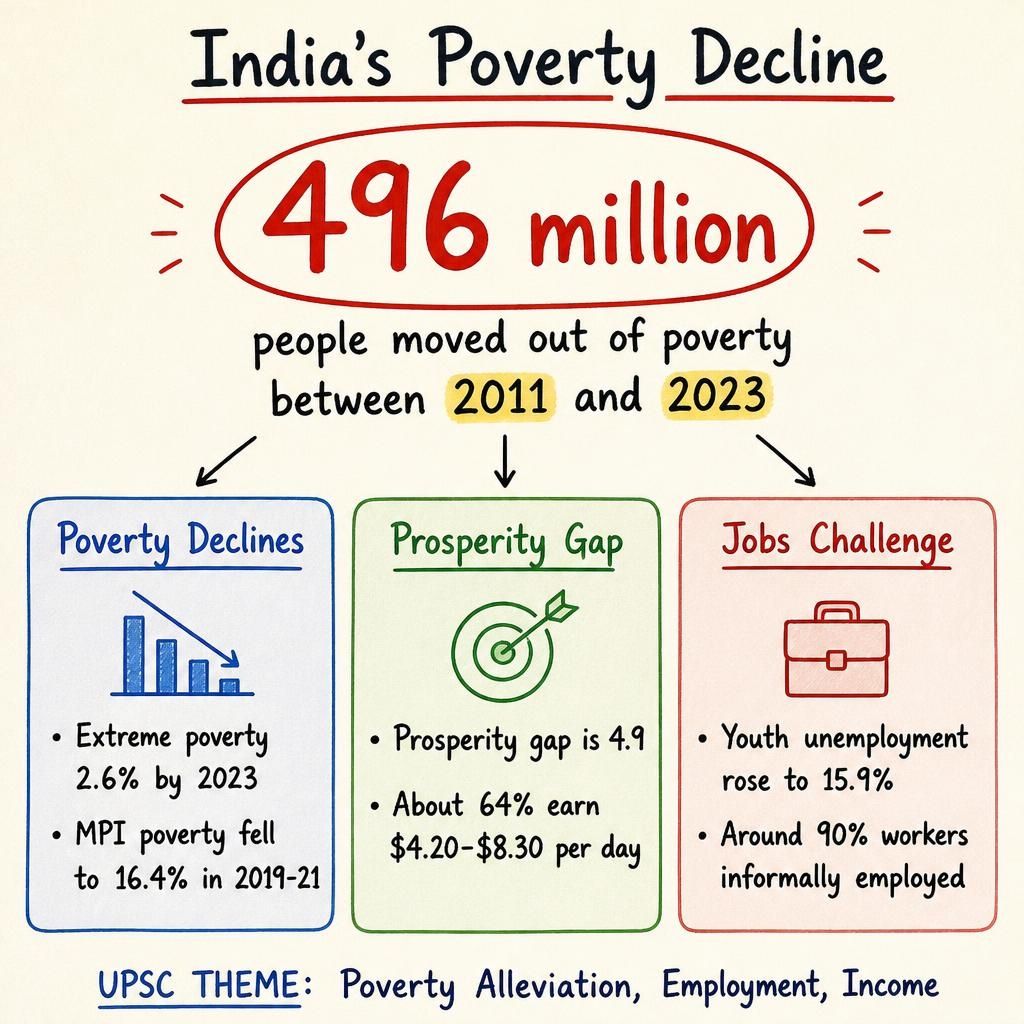
- India recorded one of the fastest extreme income-poverty declines globally, with an estimated 496 million people moving out of poverty between 2011 and 2023.
- Extreme income-based poverty ($3/day) in India declined to 2.6% by 2023, according to World Bank estimates.
- The share of the population living below the lower middle-income country line ($4.20/day) decreased significantly from 57.7% to 16.1% in the same period.
- The OPHI's Multi-dimensional Poverty Index (MPI) also showed a sharp reduction in overall poverty from 53.8% in 2005-06 to 16.4% in 2019-21.
- India's World Bank prosperity gap is 4.9, implying average consumption levels need to increase by this factor to reach the global benchmark of $28 per person per day.
- Approximately 80% of India's population currently falls below the upper middle-income poverty line of $8.30 per day.
India's Poverty Decline.jpg
Detailed Insights:
- India's progress in reducing extreme poverty is notable, but the article highlights the challenge of transitioning from poverty alleviation to widespread prosperity.
- The World Bank defines the prosperity gap as an indicator measuring how far a society is from a baseline standard of prosperity, set at $28 per person per day.
- A significant portion of India's population, about 64%, earns between $4.20 and $8.30 per day, contributing substantially to the high prosperity gap.
- For this segment, incomes would need to rise three to sevenfold to reach the desired standard of prosperity.
- India's labor market faces issues such as broadly flat real earnings and employment growth concentrated in low-productivity work.
- Youth unemployment reportedly rose from 14.6% to 15.9% between Q1 FY2026 and Q1 FY2027, as per the World Bank brief.
- The ILO India Employment Report 2024 indicated that around 90% of India’s workers were informally employed in 2022.
- The PLFS annual report 2025 showed only a marginal increase in regular wage work from 22.4% in 2024 to 23.6% in 2025.
- An increase in unpaid family helpers from 12.41% (2017-18) to 17.10% (2023-24) suggests distress-driven employment rather than opportunity.
- The India Employment Report 2024 revealed that educated young people accounted for approximately 65.7% of India’s unemployed youth in 2022, indicating a skills-jobs mismatch.
- Real wages for regular, salaried workers remained stagnant or declined between 2012 and 2022, as per the ILO India Employment Report 2024.
- Achieving prosperity requires tackling structural and institutional barriers to ensure better livelihoods, effective human capital building, and genuine economic opportunities.
Key Concepts Involved:
- Extreme Income Poverty: A measure indicating individuals living below a specific income threshold, typically $3 per day, used for least developed countries.
- Multi-dimensional Poverty Index (MPI): An international measure of acute poverty covering deprivations in health, education, and living standards.
- Prosperity Gap: An indicator developed by the World Bank to measure the distance a society has to cover to reach a baseline standard of prosperity ($28/day).
- Human Capital Markets: Refers to the ecosystem of private providers for education and healthcare services, where quality assessment can be challenging.

SuperKalam is your personal mentor for UPSC preparation, guiding you at every step of the exam journey.
Download the App


STUDY RESOURCES
CONTACT US
ⓒ Snapstack Technologies Private Limited