GS 3: Environment & EcologyGS 2: GovernanceGS 1: Indian SocietyPrelimsGS1: Distribution of Key Natural Resources
Why MP is cutting down 1.4 lakh trees to save them from a century-old pest, Pg8
Madhya Pradesh approves felling 1.4 lakh sal trees in Dindori to combat century-old sal heartwood borer pest infestation, impacting forest ecology and tribal livelihoods.
Practice MCQs
826 Students attempted
Key Highlights:
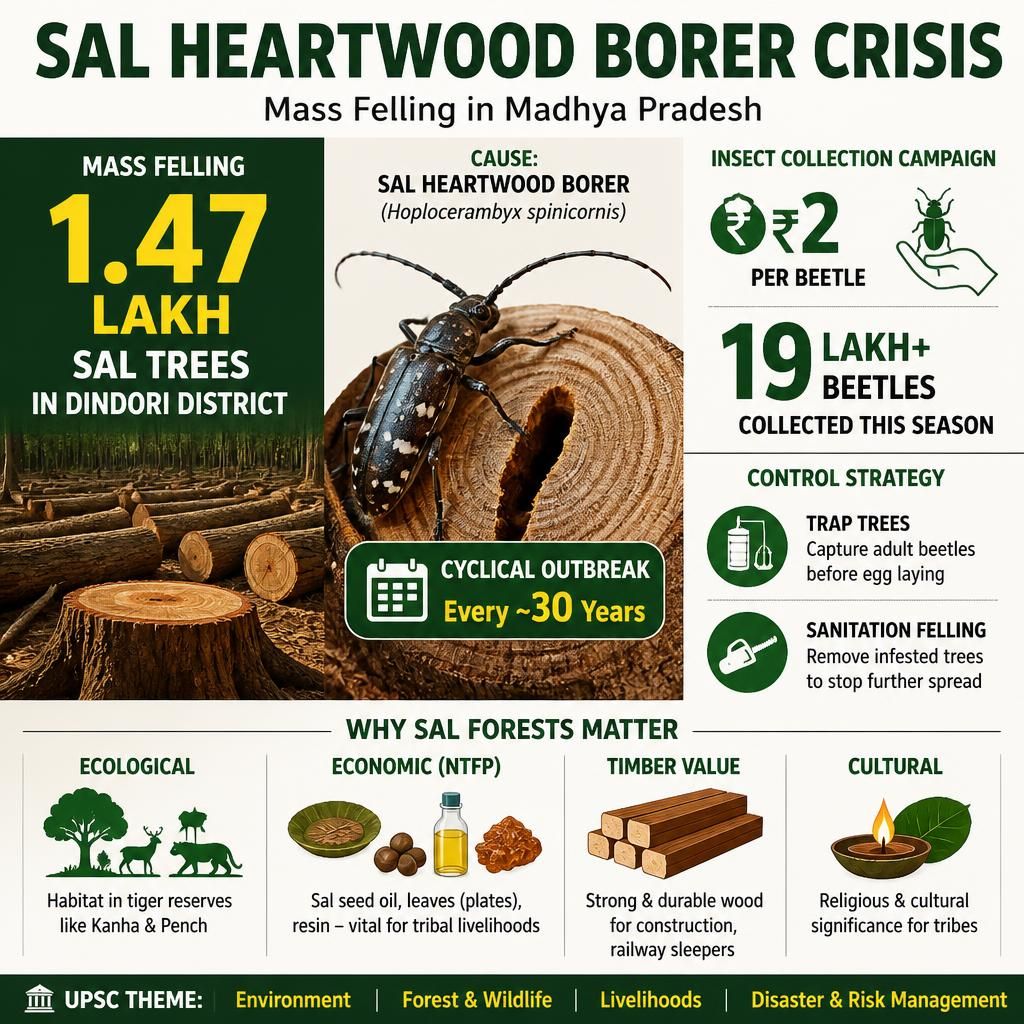
- Madhya Pradesh is undertaking a large-scale operation to fell 1.47 lakh (147,000) sal trees in Dindori district due to a severe infestation by the sal heartwood borer (Hoplocerambyx spinicornis).
- The sal heartwood borer, a longhorn beetle, has been a known pest since 1897 and is responsible for over 21 recorded epidemics in India.
- Alongside felling, an insect collection campaign is underway, where villagers collect adult beetles from "trap trees" for Rs 2 per beetle, having collected over 19 lakh beetles this season.
- Sal (Shorea robusta) is a dominant tree species in central India's dry deciduous forests, crucial for ecology, timber, and Non-Timber Forest Produce (NTFP), supporting tribal livelihoods.
Sal Heartwood Borer.jpg
Detailed Insights:
- The current infestation in Dindori, Madhya Pradesh, is considered unusual in scale but follows a cyclical pattern, with major outbreaks occurring approximately every 30 years.
- The sal heartwood borer primarily targets weaker trees, but during epidemics, it can kill mature trees with girths between 91 and 150 cm, which are vital for forest structure and yield.
- Control measures involve two parallel strategies: the insect collection campaign using "trap trees" to capture adult borers before they lay eggs, and sanitation felling of already infected standing trees to prevent further spread.
- Previous major outbreaks include one between 1997 and 2000, which affected approximately 3 lakh hectares of sal forest in Madhya Pradesh and Chhattisgarh.
- Weather conditions, such as unusually high rainfall, are believed to contribute to the spike in borer populations by creating favorable conditions for the insect.
- Sal forests are ecologically significant, forming habitats for wildlife in tiger reserves like Kanha and Pench, and hold cultural and religious importance for tribal communities.
- The wood of Shorea robusta is highly valued for construction and railway sleepers due to its strength and resistance to decay.
- NTFPs derived from sal trees, such as sal seed oil, sal leaves for plates, and resin for religious offerings, are crucial for the economic sustenance of forest-dwelling communities.
Key Concepts Involved:
- Sal Heartwood Borer (Hoplocerambyx spinicornis): A destructive longhorn beetle that infests and kills sal trees by tunneling into their heartwood.
- Shorea robusta (Sal Tree): A dominant, economically, and ecologically significant tree species found in central and northern Indian dry deciduous forests.
- Non-Timber Forest Produce (NTFP): Forest products other than timber, such as leaves, seeds, resins, and medicinal plants, vital for local livelihoods.
- Sanitation Felling: A silvicultural practice involving the removal of infected or diseased trees to prevent the spread of pests and pathogens to healthy trees.

SuperKalam is your personal mentor for UPSC preparation, guiding you at every step of the exam journey.
Download the App


STUDY RESOURCES
CONTACT US
ⓒ Snapstack Technologies Private Limited