GS 3: Internal SecurityGS 2: International RelationsGS 3: EconomyPrelimsGS 2: Bilateral, Regional and Global Groupings and Agreements
The Gulf is calling and New Delhi must listen, Pg6
Amidst shifting West Asian geopolitics and new security pacts, India must abandon passive diplomacy for proactive hard-power engagement.
Practice MCQs
819 Students attempted
Key Highlights:
- India's traditional "multi-alignment" approach to West Asia is deemed insufficient due to evolving geopolitical dynamics.
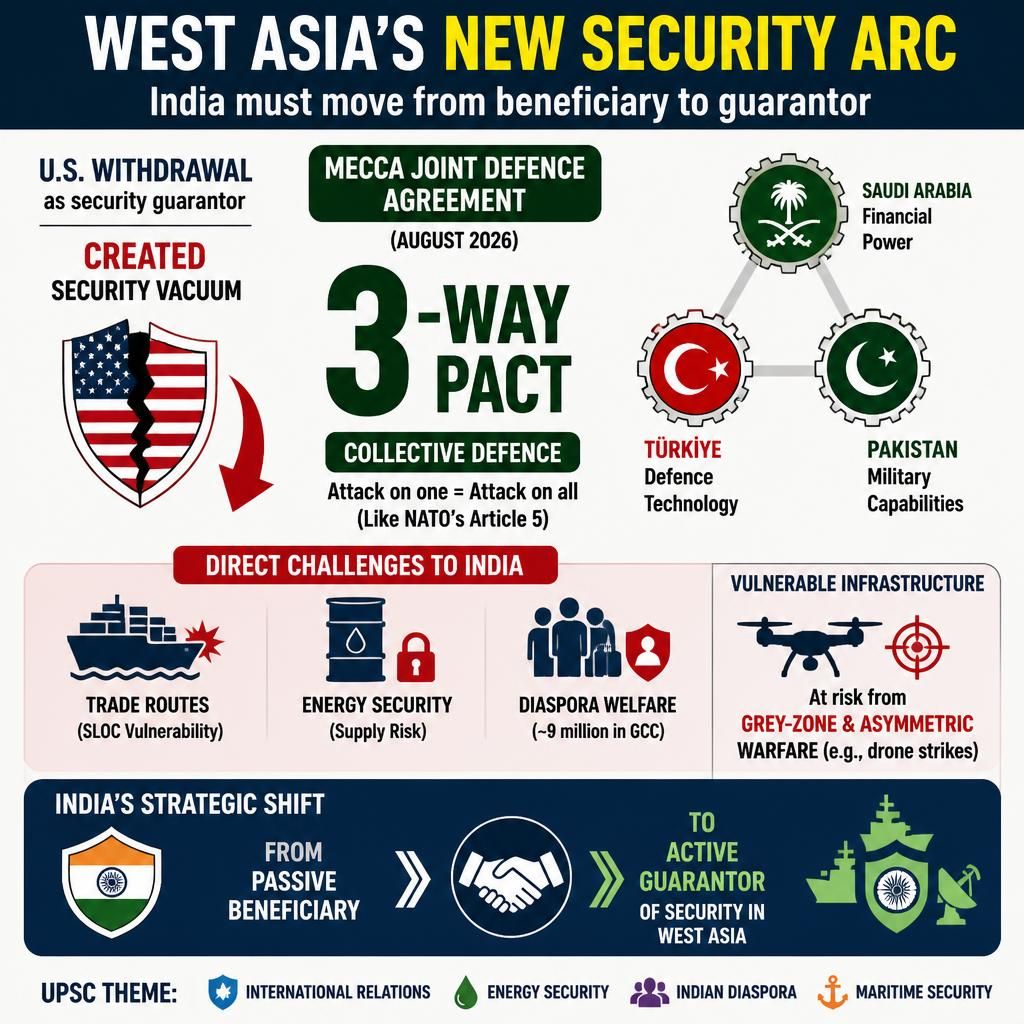
- The withdrawal of the United States as a primary security guarantor has created a significant security vacuum in the region.
- The formation of the Mecca Joint Defence Agreement between Saudi Arabia, Türkiye, and Pakistan signifies a new regional security architecture.
- This new pact poses direct challenges to India's trade routes, energy security, and the welfare of its diaspora in the Gulf.
- New Delhi is urged to shift from a passive beneficiary of regional stability to an active guarantor of security in West Asia.
West Asia.jpg
Detailed Insights:
- Historically, India maintained a policy of "deliberate ambiguity" and strategic distance, treating West Asia primarily as an economic partner for crude oil, labor, and remittances.
- The previous regional stability was largely underpinned by the U.S. ensuring open sea lines of communication and security.
- The Mecca Joint Defence Agreement, signed in August 2026, is a trilateral defence pact that aims to strengthen cooperation among its members.
- This agreement functions on a collective defence principle, where an armed attack on one member is considered an attack on all, similar to NATO's Article 5.
- The pact integrates Saudi Arabia's financial power, Türkiye's defence technology, and Pakistan's military capabilities.
- The region's integrated economic infrastructure is vulnerable to "grey-zone, asymmetric warfare" tactics, such as drone strikes, highlighting security gaps.
- India must expand its naval and maritime security partnerships across crucial chokepoints including the Strait of Hormuz, Gulf of Oman, Gulf of Aden, and Bab-el-Mandeb.
- India should leverage its growing defence manufacturing ecosystem to offer hardware and technology alternatives to West Asian states.
- Developing "minilateral" security frameworks with partners like the United Arab Emirates, Israel, and Saudi Arabia can help build a strategic counterweight.
Key Concepts Involved:
- Multi-alignment: India's foreign policy approach of engaging with multiple global powers and blocs simultaneously to safeguard its national interests and strategic autonomy.
- Grey-zone warfare: Conflict tactics that fall below the threshold of conventional warfare, employing ambiguity, deniability, and coercion to achieve strategic objectives without direct military confrontation.
- Maritime Chokepoints: Narrow, strategically important sea lanes through which a large volume of global shipping, especially oil and trade, must pass, making them critical for energy and economic security.

SuperKalam is your personal mentor for UPSC preparation, guiding you at every step of the exam journey.
Download the App


STUDY RESOURCES
CONTACT US
ⓒ Snapstack Technologies Private Limited