GS 2: GovernanceGS 3: Science & TechnologyGS 2: International RelationsPrelimsGS 2: Bilateral, Regional and Global Groupings and Agreements
SpaceX rocket stage hurtles toward moon, astronomers hot on its trail, Pg2
Astronomers track a SpaceX Falcon 9 rocket stage on collision course with the moon, offering unique scientific insights and highlighting space debris challenges.
Practice MCQs
811 Students attempted
Key Highlights:
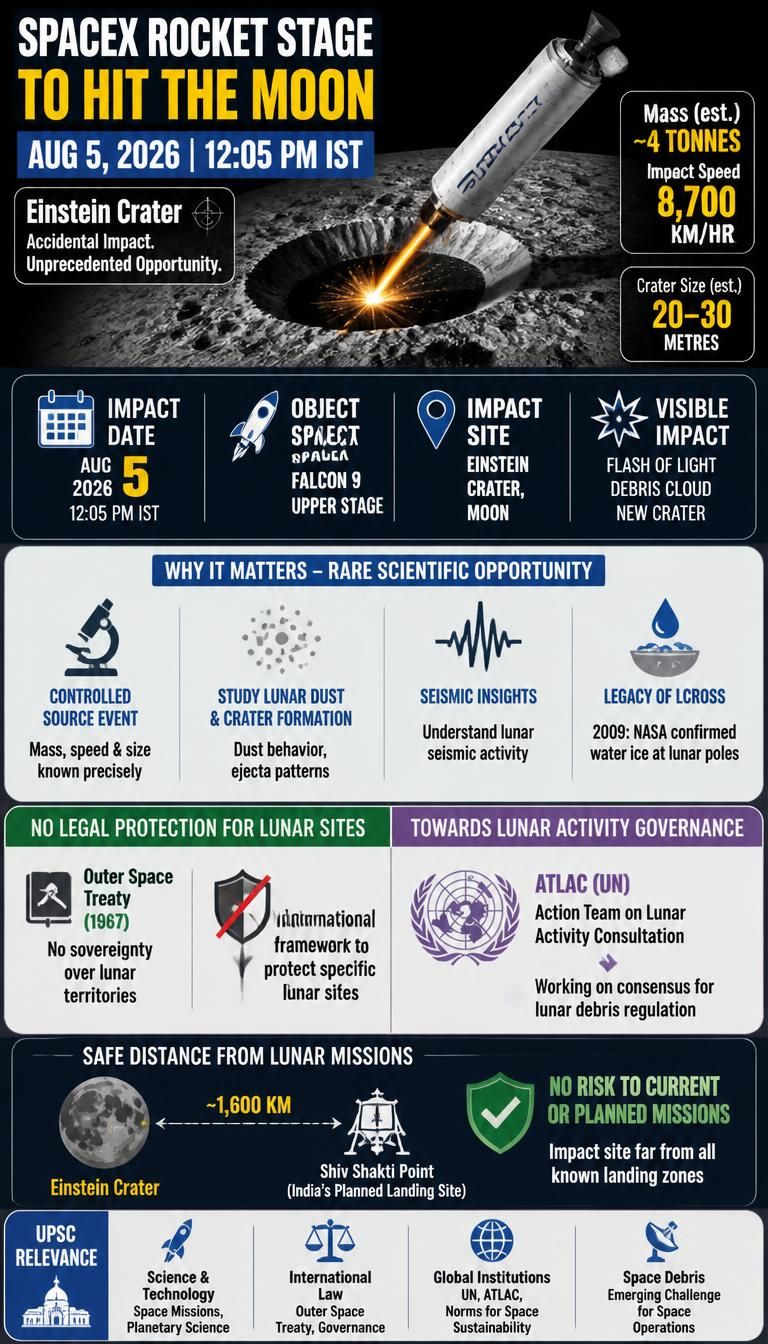
- A SpaceX Falcon 9 rocket stage is projected to impact the moon's Einstein Crater on August 5, 2026, at 12:05 p.m. IST.
- The rocket stage was abandoned in an unstable orbit after launching two satellites in January 2025.
- Independent astronomer Bill Gray tracked the object and confirmed its collision course with the moon.
- This accidental impact presents a rare scientific opportunity to study lunar dust and crater formation.
- There is currently no international legal framework to protect specific lunar sites from such impacts.
SpaceX.jpg
Detailed Insights:
- The Falcon 9 upper stage lacked sufficient fuel to return to Earth or proceed into deep space after its mission.
- Bill Gray's website, Project Pluto, provides detailed information and tracking data for the impending impact.
- Scientists consider this a "controlled source event" because the impactor's mass, speed, and size are known.
- The last similar event was NASA's LCROSS mission in 2009, which deliberately crashed a rocket stage to confirm water ice.
- The impact is expected to create a flash of light, a cloud of debris, and a crater estimated to be 20-30 meters across.
- The impact speed is estimated at 8,700 km/hr, offering insights into lunar dust behavior and seismic activity.
- The impact site is far from current and planned lunar landing zones, such as India's Shiv Shakti point.
- The Outer Space Treaty does not recognize sovereignty over lunar territories, leaving significant sites unprotected.
- The Action Team on Lunar Activity Consultation (ATLAC) at the United Nations is working on consensus for lunar debris regulation.
Key Concepts Involved:
- Controlled Source Event: An impact where the characteristics of the impacting object (mass, speed, size) are known beforehand.
- Outer Space Treaty: An international agreement that forms the basis of international space law, prohibiting national appropriation of outer space.
- Action Team on Lunar Activity Consultation (ATLAC): A United Nations working group focused on developing international consensus on lunar activities, including debris mitigation and landing site coordination.

SuperKalam is your personal mentor for UPSC preparation, guiding you at every step of the exam journey.
Download the App


STUDY RESOURCES
CONTACT US
ⓒ Snapstack Technologies Private Limited