GS 2: International RelationsPrelimsGS 2: Bilateral, Regional and Global Groupings and AgreementsGS 2: Effect of Policies and Politics of Developed and Developing Countries on India's InterestsGS 2: Important International Institutions, Agencies and Fora
NATO enters a new strategic era of transformation, Pg6
US rebalances global strategy, pushing Europe to shoulder greater defence burden as NATO transforms for a new era.
Practice MCQs
811 Students attempted
Key Highlights:
- The United States is asking European NATO allies to assume primary responsibility for their own security, marking a fundamental shift in the transatlantic compact.
- The National Security Strategy of the United States of America (November 2025) signaled this change, advocating for a stronger, more self-reliant Europe.
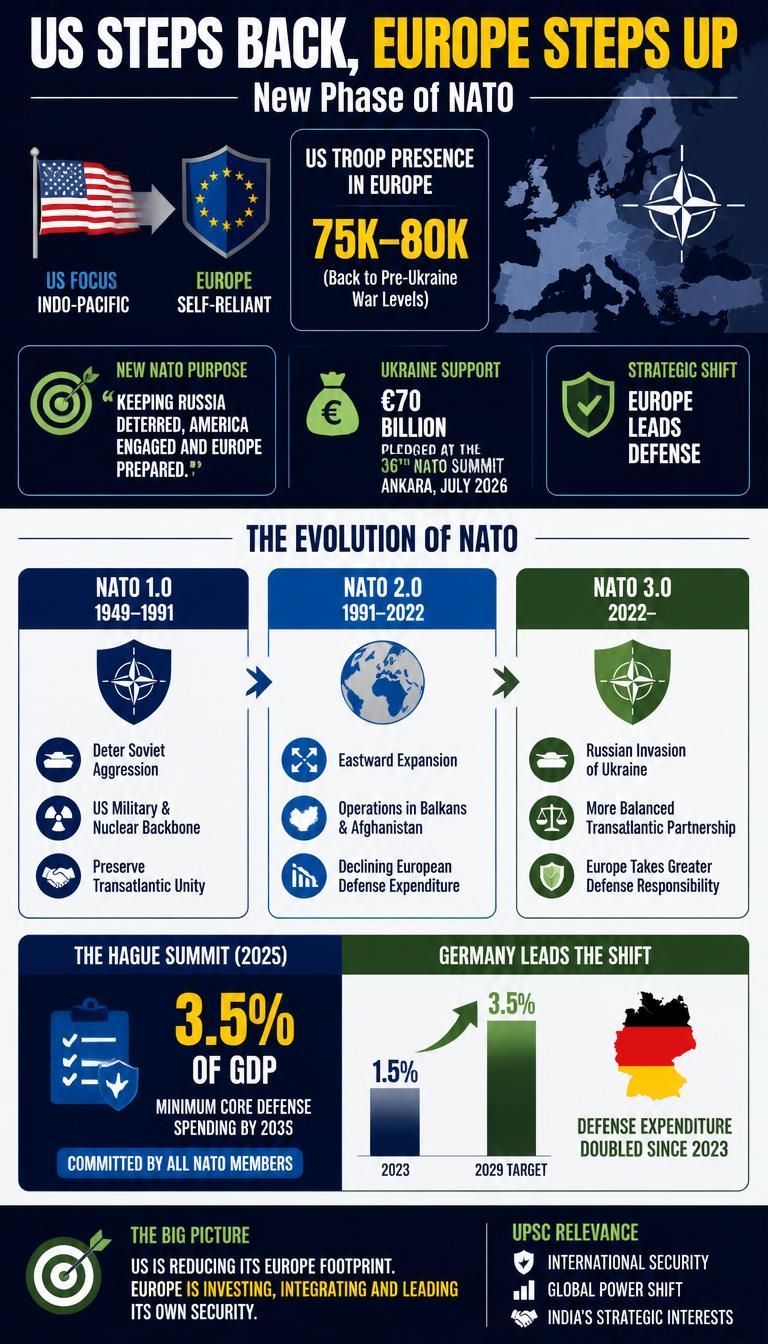
- US troop presence in Europe has been reduced to approximately 75,000-80,000, close to pre-Ukraine war levels, allowing Washington to focus on the Indo-Pacific.
- The 36th NATO Summit in Ankara (July 2026) reinforced this transition, with members pledging €70 billion for Ukraine and endorsing European-led defense capabilities.
- NATO's new strategic purpose is described as "keeping Russia deterred, America engaged and Europe prepared."
NATO.jpg
Detailed Insights:
- NATO 1.0 (1949-1991) relied on American military and nuclear power to deter Soviet aggression and preserve transatlantic unity.
- NATO 2.0 (1991-2022) saw eastward expansion and operations in the Balkans and Afghanistan, but also declining European defense expenditure.
- The Russian invasion of Ukraine ushered in NATO's third phase, aiming for a more balanced transatlantic partnership.
- The Hague Summit (2025) committed NATO members to increase core defense spending to at least 3.5% of GDP by 2035.
- Germany has doubled its defense expenditure since 2023 and aims to reach the 3.5% target by 2029.
- Europe faces the challenge of replacing the American military ecosystem, including intelligence, satellite support, and strategic airlift.
- For India, this shift presents an opportunity for increased US strategic attention on the Indo-Pacific and potential partnerships in defense manufacturing and advanced technologies.
- India can leverage NATO's transformation to expand defense industrial partnerships and accelerate technological modernization while maintaining its strategic autonomy.
Key Concepts Involved:
- North Atlantic Treaty Organization (NATO): A military alliance established in 1949, based on the principle of collective defense.
- Article 5: The cornerstone of the NATO treaty, stating that an attack against one member is an attack against all.
- Burden-sharing: The equitable distribution of defense costs and responsibilities among alliance members.
- Indo-Pacific: A geopolitical region encompassing the Indian Ocean and the Pacific Ocean, increasingly central to global strategy.
- Strategic Autonomy: A nation's capacity to act independently in international affairs, pursuing its own interests without external dependence.

SuperKalam is your personal mentor for UPSC preparation, guiding you at every step of the exam journey.
Download the App


STUDY RESOURCES
CONTACT US
ⓒ Snapstack Technologies Private Limited