GS 2: GovernanceGS 2: PolityGS 3: Science & TechnologyGS 3: Internal SecurityPrelims
Adopt SOP against mule accounts in 4 weeks, SC directs states & UTs, Pg9
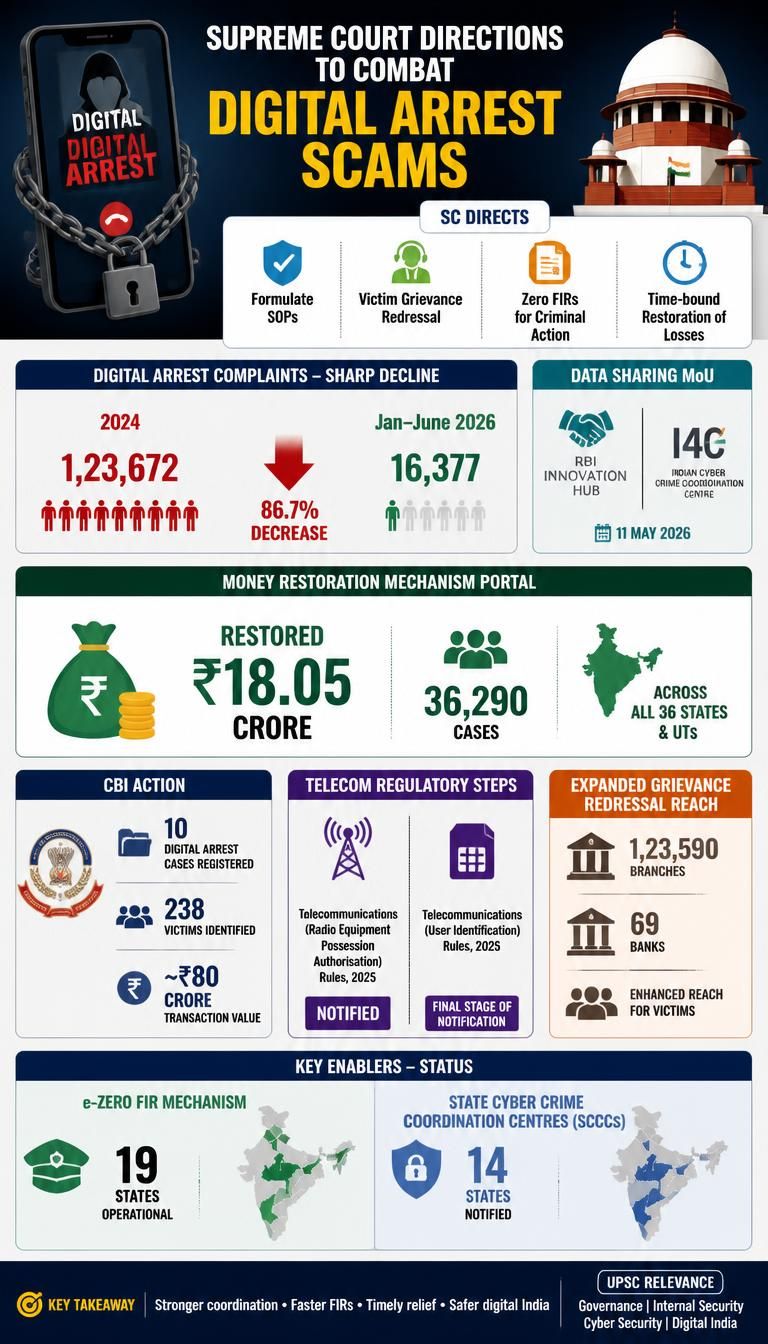
Supreme Court mandates states and UTs to adopt anti-mule account SOP within four weeks, combating 'digital arrest' scams and cyber-enabled financial fraud with new grievance mechanisms.
Practice MCQs
811 Students attempted
Key Highlights:
- The Supreme Court has directed all states and Union Territories to formally adopt and circulate a Standard Operating Procedure (SOP) within four weeks to combat 'digital arrest' scams and mule accounts.
- The SOP, proposed by the Reserve Bank of India, mandates temporary debit holds on suspicious accounts to prevent cyber-enabled fraud.
- The bench, comprising CJI Surya Kant, Justice Joymalya Bagchi, and Justice V Mohana, also ordered the operationalization of State Cyber Crime Coordination Centres and the adoption of the e-zero FIR mechanism.
- The Inter-Departmental Committee (IDC) is tasked with issuing advisories, considering a shared liability and victim compensation framework, and examining a lower investigation threshold for the CBI.
- The directive stems from the Supreme Court taking suo motu cognizance in November last year following a 'digital arrest' fraud complaint.
- Over ₹18.05 crore has been restored to victims in 36,290 cases, and complaints on the National Cybercrime Reporting Portal (NCRP) have shown a decline.
Digital Arrest.jpg
Detailed Insights:
- The SOP aims to streamline the process of freezing suspicious bank accounts, which are often used by fraudsters in 'digital arrest' scams.
- The Inter-Departmental Committee (IDC) had previously agreed with the framework for action by banks, emphasizing a coordinated approach.
- The new directives require the SOP to incorporate a grievance redressal mechanism, a money restoration module, and public awareness measures.
- The e-zero FIR mechanism, to be adopted in consultation with the Indian Cyber Crime Coordination Centre (I4C), allows for filing First Information Reports irrespective of jurisdiction.
- The IDC will coordinate with banks to prevent 'digital arrest' scams, facilitate recovery of defrauded money, and assist investigations.
- The Ministry of Electronics and Information Technology (MeitY), Department of Telecommunications (DoT), and I4C are to examine time-based restrictions on audio and video calls to curb misuse by fraudsters.
- Legal services committees across the country are urged to enhance public awareness regarding cyber-enabled financial frauds.
- The Supreme Court initiated the action after an Ambala couple was defrauded of ₹1.08 crore by scammers using forged orders.
Key Concepts Involved:
- Digital Arrest Scam: Fraudsters impersonate law enforcement or government officials, threatening arrest to extort money, often through video calls and fake documents.
- Mule Account: A bank account used by criminals to receive and transfer illegally obtained money, often belonging to unsuspecting individuals, to obscure the money trail.
- Standard Operating Procedure (SOP): A set of step-by-step instructions detailing how routine tasks or processes should be carried out consistently and correctly within an organization.
- e-zero FIR: An electronic First Information Report that can be registered at any police station, irrespective of jurisdiction, especially for cyber financial crimes, to expedite investigation.
- Indian Cyber Crime Coordination Centre (I4C): An initiative by the Ministry of Home Affairs to combat cybercrime in India in a coordinated and comprehensive manner.
- National Cybercrime Reporting Portal (NCRP): An online platform established under I4C for citizens to report various types of cybercrime complaints, including financial fraud.

SuperKalam is your personal mentor for UPSC preparation, guiding you at every step of the exam journey.
Download the App


STUDY RESOURCES
CONTACT US
ⓒ Snapstack Technologies Private Limited