GS 2: GovernanceGS 3: Environment & EcologyPrelimsGS 3: Infrastructure: Energy, Ports, Roads, Airports, Railways etc.GS 3: Conservation, Pollution and Degradation
India’s river interlinks may create invasive species ‘highways’, Pg13
Researchers warn India's ambitious river-linking project could create 'ecological highways' for invasive species, threatening native biodiversity and downstream ecosystems.
Practice MCQs
819 Students attempted
Key Highlights:
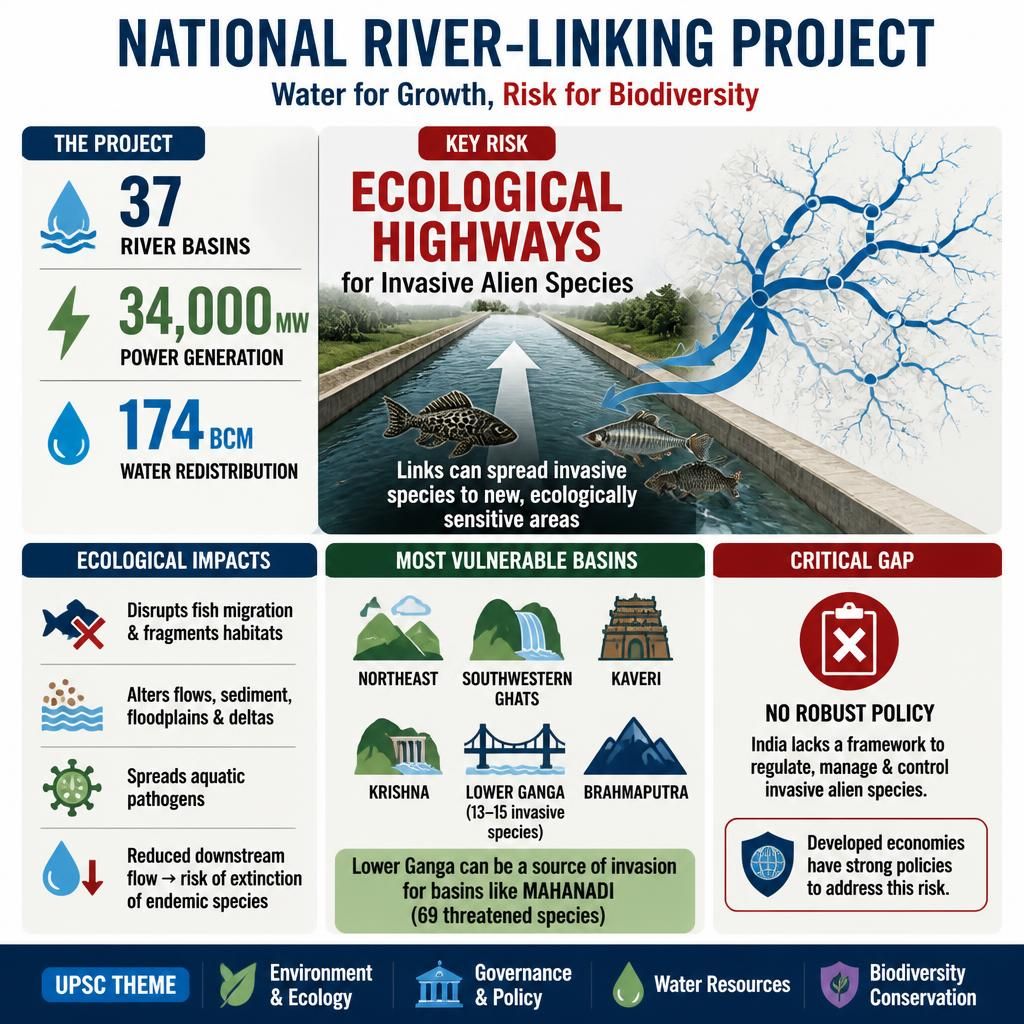
- The National River-Linking Project (NRLP) proposes linking 37 major rivers through 30 links, to move about 174 billion cubic metres of water and generate 34,000 MW.
- Researchers from the Ashoka Trust for Research in Ecology and the Environment (ATREE) have identified a significant risk: the project could create "ecological highways" for invasive alien species.
- Their findings, published in Scientific Reports, indicate that river links could threaten endemic species by allowing invasive species to spread to new, ecologically sensitive areas.
- Northeast and peninsular Indian basins, including the Southwestern Ghats, Kaveri, Krishna, Lower Ganga, and Brahmaputra, are particularly vulnerable to these biological invasions.
River Linking Project.jpg
Detailed Insights:
- The National River-Linking Project involves transferring water from 'surplus' to 'deficit' basins, a concept that may not account for seasonal and annual variations in river flows.
- Inter-basin water transfer can significantly alter downstream flows, sediment transport, floodplains, deltas, and the habitats dependent on them.
- Dams, reservoirs, and canals associated with the project can fragment ecosystems and disrupt crucial ecological processes like fish migration.
- Many native species in India's isolated river basins are endemic and may not be able to compete with newly introduced invasive alien species.
- The Lower Ganga basin, which already hosts 13-15 invasive species, could become a source for the Mahanadi basin, home to 69 threatened species.
- Water connections could also facilitate the spread of aquatic pathogens, potentially harming species in new basins that lack natural immunity.
- Reduced downstream water flow, as highlighted by the potential impact of the Ken-Betwa link, can severely affect biodiversity and lead to the extinction of endemic species.
- India currently lacks a robust policy framework to regulate, manage, and control invasive alien species, a gap that developed economies have addressed.
- Holistic infrastructure planning for such large-scale projects must integrate evidence-based management of river basins, considering ecological impact, biodiversity, and local livelihoods.
Key Concepts Involved:
- National River-Linking Project (NRLP): A large-scale infrastructure project in India designed to connect major rivers for water transfer and power generation.
- Invasive Alien Species: Non-native species whose introduction causes or is likely to cause economic or environmental harm or harm to human health.
- Biodiversity Hotspots: Biogeographic regions with significant levels of biodiversity that are threatened by human habitation.
- Ecological Highways: Pathways created by human infrastructure, such as river interlinks, that facilitate the movement and spread of species to new areas.

SuperKalam is your personal mentor for UPSC preparation, guiding you at every step of the exam journey.
Download the App


STUDY RESOURCES
CONTACT US
ⓒ Snapstack Technologies Private Limited