GS 3: Science & TechnologyGS 3: Environment & EcologyPrelimsGS 3: Conservation, Pollution and DegradationGS 1: Changes in Critical Geographical Features, Water Bodies, Ice Caps, Flora and Fauna
Breaking up forests is just as bad for global warming, Pg13
New study reveals forest fragmentation significantly raises local temperatures in tropical zones, impacting global warming, while cooling boreal regions.
Practice MCQs
819 Students attempted
Key Highlights:
- A new study reveals that the degree of forest fragmentation significantly influences local temperatures, comparable to the impact of total forested area.
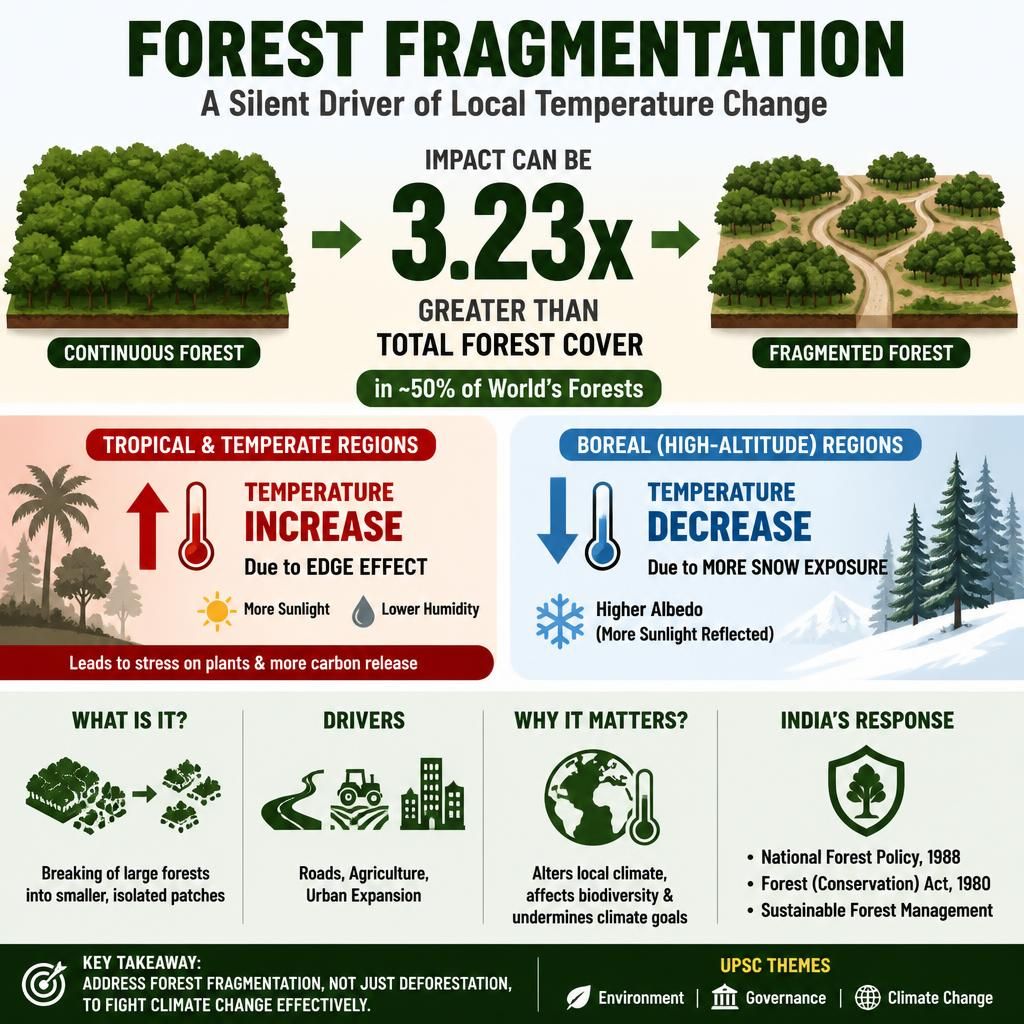
- In tropical and temperate regions, the division of continuous forests into smaller, isolated patches leads to a notable increase in surface temperature.
- Conversely, in boreal zones with mean annual temperature below 0°C, fragmentation can cool the area, as exposed snow reflects more sunlight.
- The research utilized satellite data to analyze these temperature variations across different forest types.
- The findings underscore the necessity for climate action strategies to monitor and address forest fragmentation as a critical factor in global warming.
Forest Fragmentation.jpg
Detailed Insights:
- Forest fragmentation is the process by which large, unbroken forest areas are broken down into smaller, isolated segments, often due to human activities like road construction, agriculture, or urban expansion.
- The observed temperature increase in fragmented tropical and temperate forests is largely attributed to the edge effect, where environmental conditions at the forest boundaries, such as increased sunlight and reduced humidity, differ significantly from the forest interior.
- This warming in tropical forest fragments can negatively impact plant physiological processes, potentially leading to a greater release of carbon into the atmosphere.
- Boreal forests, also known as taiga, are extensive coniferous forests found in the northern latitudes, characterized by long, cold winters and short, cool summers.
- The study indicates that the influence of fragmentation on land surface temperature can be 3.23 times greater than that of forest cover in nearly half of the world's forests.
- Recognizing the role of fragmentation is vital for developing effective forestry policies and optimizing landscape configurations to achieve climate goals.
- India's efforts in forest conservation are guided by policies such as the National Forest Policy, 1988, and legislative measures like the Forest (Conservation) Act, 1980, which aim for sustainable management and protection of forest resources.
- International frameworks like REDD+ (Reducing Emissions from Deforestation and Forest Degradation, plus conservation, sustainable management of forests, and enhancement of forest carbon stocks) provide incentives for developing countries to mitigate climate change through forest management.
Key Concepts Involved:
- Forest Fragmentation: The process where large, continuous forest areas are divided into smaller, isolated patches, typically by human-induced disturbances.
- Edge Effect: The altered environmental conditions and ecological processes that occur at the boundaries between different habitats, particularly at the interface of forest fragments and non-forest areas.
- Boreal Forests: Cold-climate forests, also known as taiga, characterized by coniferous trees and found across high northern latitudes.
- Climate Change Mitigation: Actions aimed at reducing the emission of greenhouse gases or enhancing their removal from the atmosphere to lessen the impacts of climate change.

SuperKalam is your personal mentor for UPSC preparation, guiding you at every step of the exam journey.
Download the App


STUDY RESOURCES
CONTACT US
ⓒ Snapstack Technologies Private Limited