GS 2: International RelationsGS 3: EconomyPrelimsGS 3: Effects of Liberalization on the EconomyGS 3: Indian Economy, Planning, Mobilization of Resources, Growth, Development and Employment
US-Japan Joint Action: How A Stronger Yen Affects Indian Markets, Pg9
US-Japan's joint currency intervention strengthens yen, raising concerns for Indian markets due to potential FII exodus from carry trades.
Practice MCQs
804 Students attempted
Key Highlights:
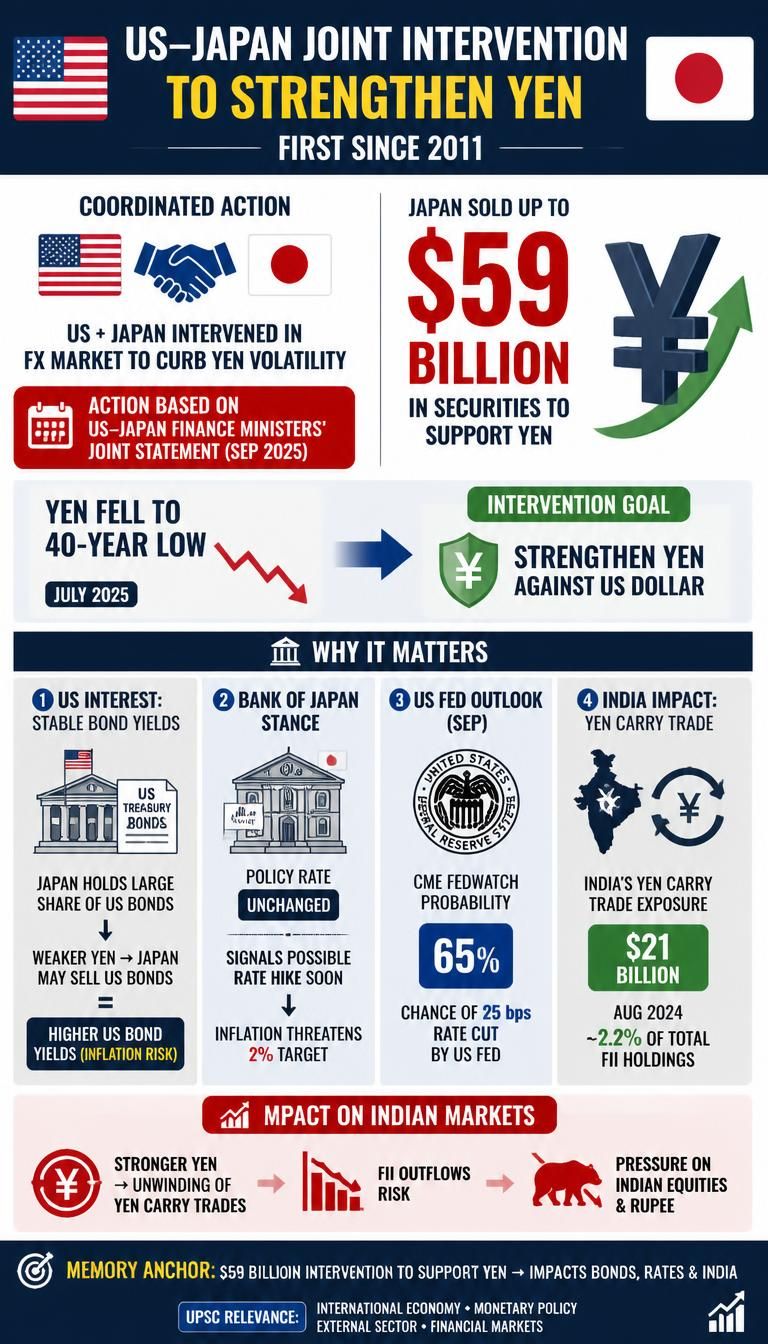
- The US and Japan conducted a joint coordinated intervention in the Japanese currency market on Friday to address excessive volatility in the yen.
- This action, the first since 2011, aimed to strengthen the yen against the US dollar, following its fall to 40-year lows in July.
- The intervention was based on the US-Japan Finance Ministers’ Joint Statement issued in September 2025.
- The Japanese government reportedly sold as much as $59 billion in securities to support its currency.
- A stronger yen could potentially impact Indian markets, particularly due to the unwinding of yen carry trades.
Japan Yen.jpg
Detailed Insights:
- The US has a vested interest in the yen's performance to prevent US Treasury bond yields from rising, as Japan holds a large share of these bonds.
- A weaker yen could compel Japan to sell US bonds, further elevating US bond yields, which are already under pressure from inflation.
- The Bank of Japan kept short-term interest rates steady but signaled a potential need to raise rates soon as underlying inflation threatened its 2% target.
- The CME Fedwatch tool indicated a nearly 65% probability of a 25-basis-point rate cut by the US Federal Reserve in September.
- India's yen carry trade exposure was estimated at $21 billion in August 2024, representing about 2.2% of total Foreign Institutional Investor (FII) holdings.
- While unwinding of the yen carry trade might lead to short-term FII outflows, crude oil prices remain a more significant concern for the Indian market.
- The Indian stock market saw FII inflows of $2.1 billion in July 2026, but overall outflows for 2026 reached $27.2 billion.
Key Concepts Involved:
- Currency Intervention: A government or central bank's action to influence the exchange rate of its currency, typically by buying or selling foreign currencies.
- Carry Trade: A strategy where an investor borrows in a low-interest-rate currency and invests in a higher-interest-rate currency to profit from the interest rate differential.
- Foreign Institutional Investor (FII): An investor or investment fund incorporated in a country other than the one in which it is investing.
- Basis Point: A common unit of measure for interest rates and other financial percentages, equal to one-hundredth of a percentage point (0.01%).

SuperKalam is your personal mentor for UPSC preparation, guiding you at every step of the exam journey.
Download the App


STUDY RESOURCES
CONTACT US
ⓒ Snapstack Technologies Private Limited