GS 1: Physical GeographyGS 2: International RelationsGS 3: Disaster ManagementGS 3: Environment & EcologyPrelims
Mountains Bind India, China, and Nepal to a Shared Destiny. They Need to Honour It, Pg13
Nepal's recent catastrophe underscores urgent need for India, China, and Nepal to establish a tripartite mechanism for environmental cooperation in the climate-vulnerable Himalayas.
Practice MCQs
804 Students attempted
Key Highlights:
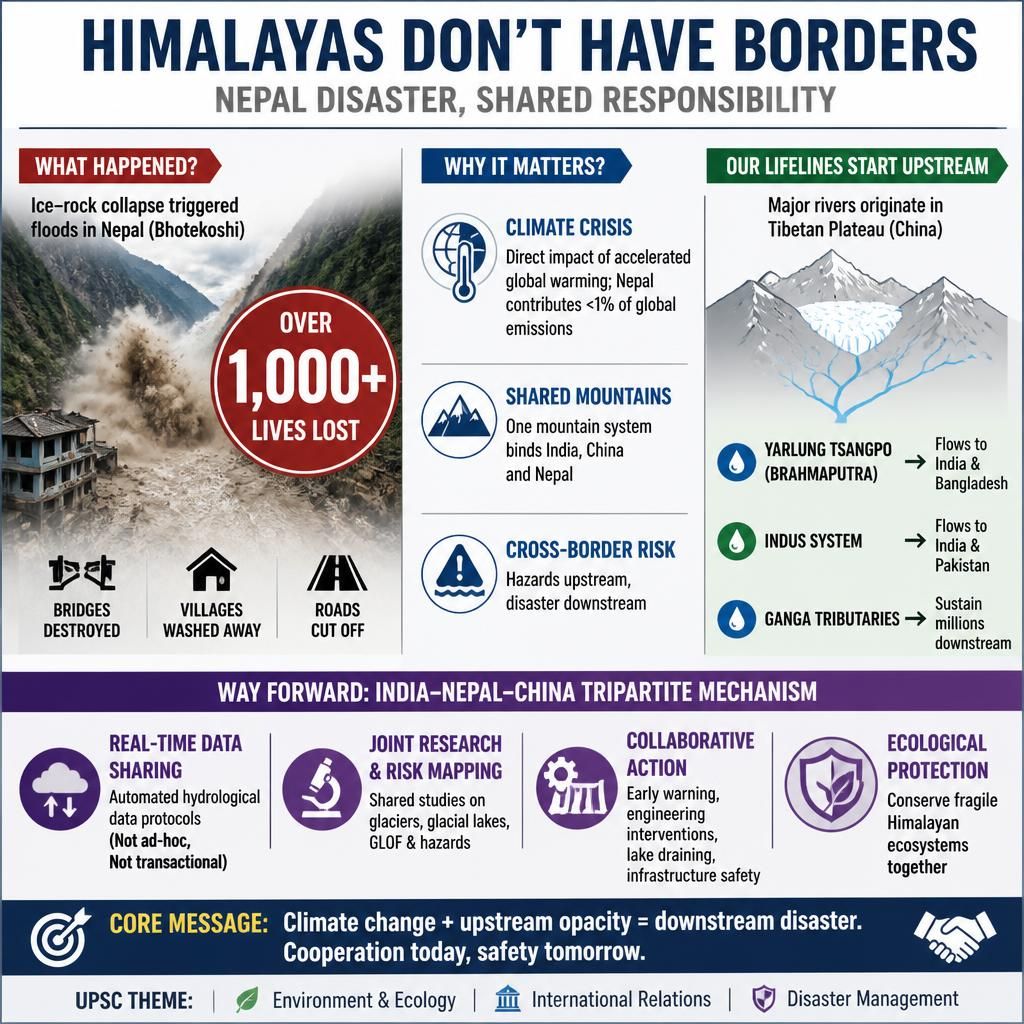
- A recent catastrophe in Nepal, involving a sudden collapse of ice and rock, triggered a violent surge of water, mud, and debris.
- This disaster claimed over a thousand lives and destroyed critical infrastructure in the affected border region.
- Rabi Lamichhane, leader of Nepal's ruling Rashtriya Swatantra Party, emphasized the shared mountain system binding India, China, and Nepal.
- The tragedy is viewed as a direct consequence of accelerated global warming, disproportionately impacting Nepal despite its minimal greenhouse gas emissions.
Himalayas.jpg
Detailed Insights:
- The incident, likely a Glacial Lake Outburst Flood (GLOF) or a similar ice-rock avalanche, occurred along the Bhotekoshi river system.
- This event highlights the fragile and interconnected ecological reality of Himalayan Asia, where natural hazards transcend national borders.
- Historically, cooperation on ecological transparency and data sharing among upper-riparian and lower-riparian states in the Himalayas has been inconsistent due to national security concerns.
- China, as the upper-riparian state controlling the Tibetan Plateau, has often provided hydrological data transactionally rather than through open, automatic commitments.
- The article advocates for an institutionalized tripartite mechanism among India, Nepal, and China for ecological protection, real-time hydrological information sharing, and joint climate adaptation.
- Such a mechanism should include automated data protocols, joint ecological research and risk mapping, and collaborative engineering interventions for high-risk glacial lakes.
- Major transboundary rivers like the Yarlung Tsangpo (Brahmaputra), Indus, and tributaries of the Ganges originate in the Tibetan Plateau, making upstream data crucial for downstream safety.
Key Concepts Involved:
- Glacial Lake Outburst Flood (GLOF): A sudden release of water from a glacial lake due to the failure of its natural dam, often triggered by glacier melt, avalanches, or seismic activity.
- Upper-riparian state: A country or region situated upstream in a river basin, controlling the initial flow of water.
- Lower-riparian state: A country or region located downstream in a river basin, dependent on the water flow from upstream areas.
- Tripartite Mechanism: A collaborative framework involving three parties to address shared challenges and foster cooperation.
- Himalayan Biome: The distinct ecological region encompassing the Himalayan mountain range, characterized by diverse climates, ecosystems, and biodiversity.

SuperKalam is your personal mentor for UPSC preparation, guiding you at every step of the exam journey.
Download the App


STUDY RESOURCES
CONTACT US
ⓒ Snapstack Technologies Private Limited