GS 2: PolityGS 3: Science & TechnologyPrelimsGS 2: Statutory, Regulatory and Quasi Judicial BodiesGS 3: Intellectual Property Rights, IPR
Can AI claim copyright for original work? A question of authorship, Pg15
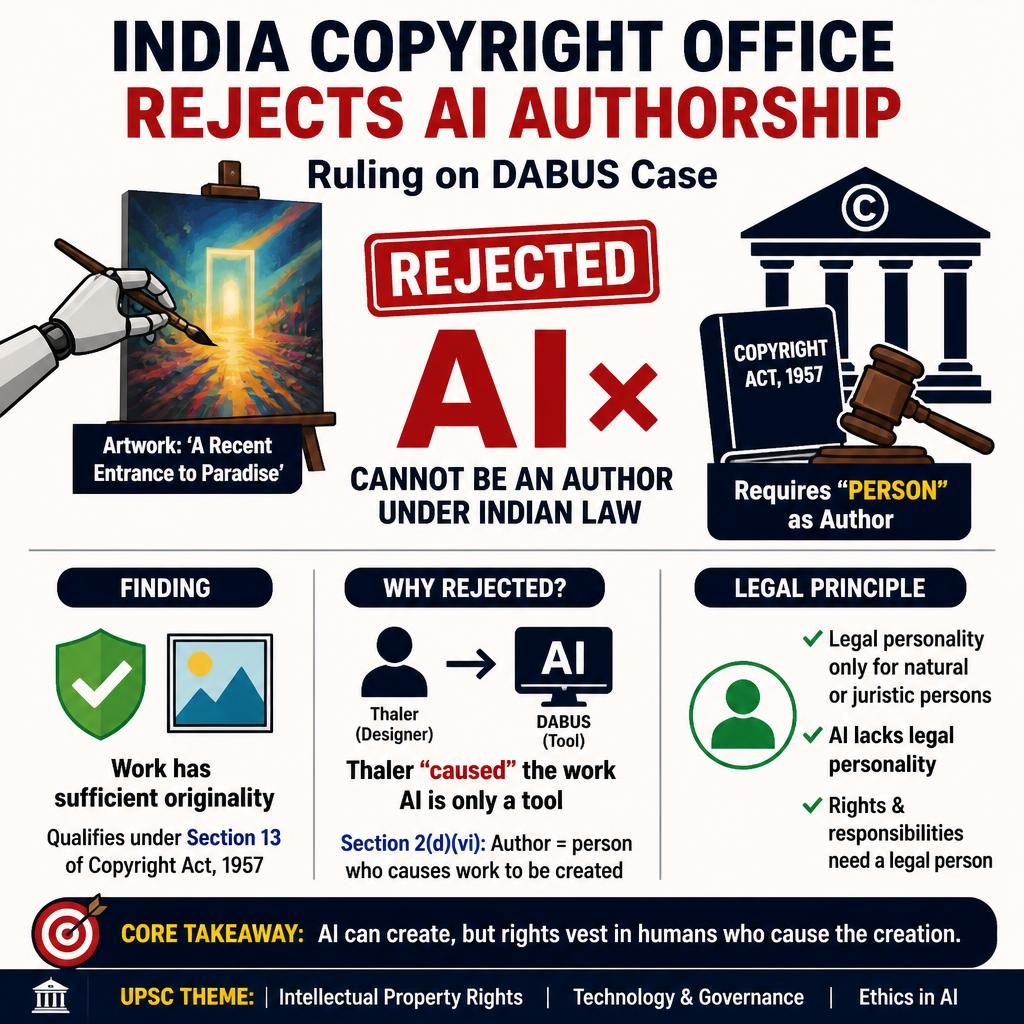
India's Copyright Office rejects AI system DABUS as author for artwork, affirming human authorship under Copyright Act, 1957, for AI-generated content.
Practice MCQs
804 Students attempted
Key Highlights:
- India's Copyright Office rejected an application by American computer scientist Stephen Thaler seeking copyright for an artwork generated by his AI system, DABUS.
- The artwork, titled ‘A Recent Entrance to Paradise’, was claimed by Thaler to be autonomously created by DABUS.
- The rejection was based on the premise that an AI system cannot be recognized as an author under the Copyright Act, 1957, as it lacks legal personality.
- The decision underscores the current legal framework in India, which requires a "person" to be the author of a copyrighted work.
Copyright.jpg
Detailed Insights:
- The Copyright Office found the AI-generated image to possess sufficient originality to qualify for copyright protection under Section 13 of the Copyright Act, 1957.
- The primary contention was the interpretation of Section 2(d)(vi), which defines the author of computer-generated works as "the person who causes the work to be created".
- The Office concluded that DABUS acted as a tool, and Stephen Thaler, who designed and operated the system, was the legal person who "caused" the work's creation.
- Authorship under Indian law is a legal status that confers rights and responsibilities, which an AI system, lacking legal recognition, cannot possess.
- The ruling aligns with the principle that copyright ownership is vested in natural or juristic persons capable of holding rights and entering contracts.
- The Copyright Office emphasized that extending legal personhood or authorship to autonomous AI systems is a policy decision reserved for Parliament.
- The case referenced the Supreme Court ruling in Eastern Book Company v. D. B. Modak, which established that originality requires a minimum degree of creativity.
Key Concepts Involved:
- Copyright: A legal right granted to creators of original works, giving them exclusive rights to use and distribute their work.
- Authorship: The legal recognition of an individual or entity as the creator of a work, entitling them to associated rights.
- Originality (in copyright): The requirement that a work must originate from the author and show a minimum degree of creativity, not merely be copied.
- Juristic Person: An entity, such as a corporation, that is treated as a person in law, capable of holding rights and duties.

SuperKalam is your personal mentor for UPSC preparation, guiding you at every step of the exam journey.
Download the App


STUDY RESOURCES
CONTACT US
ⓒ Snapstack Technologies Private Limited