GS 2: GovernanceGS 3: Environment & EcologyPrelimsGS 3: Conservation, Pollution and DegradationGS 2: Government policies and interventions for development in various sectors
Translocate, Keep In Enclosures: Chhattisgarh Bid To Save Its Wild Buffaloes From Extinction, Pg9
Facing extinction, Chhattisgarh launches ambitious plan to translocate wild buffaloes from Assam, establishing enclosures and a five-point conservation strategy.
Practice MCQs
797 Students attempted
Key Highlights:
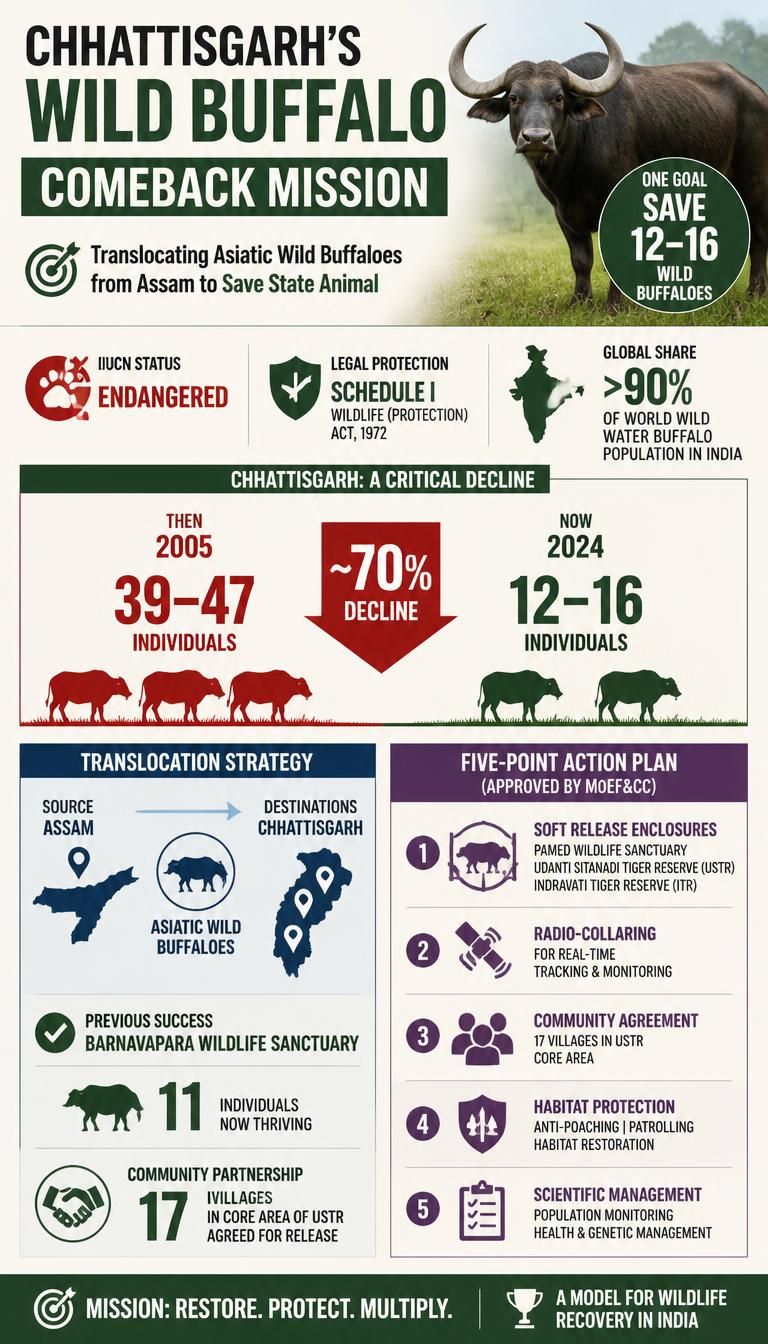
- Chhattisgarh's Forest Department plans to translocate Asiatic Wild Buffaloes from Assam to boost the dwindling population of its state animal.
- The wild buffaloes will be housed in enclosures at Pamed Wildlife Sanctuary, Udanti Sitanadi Tiger Reserve (USTR), and Indravati Tiger Reserve (ITR).
- The Asiatic Wild Buffalo is listed as "Endangered" on the IUCN Red List and enjoys the highest protection under Schedule I of the Wildlife (Protection) Act, 1972.
- Chhattisgarh's wild buffalo population has declined significantly, estimated at 12-16 individuals, down from 39-47 in 2005.
- A five-point action plan, developed with the Wildlife Institute of India, Dehradun, and approved by the Ministry of Environment, Forest & Climate Change, aims for comprehensive conservation.
Wild Buffalo.jpg
Detailed Insights:
- India is home to over 90% of the global wild water buffalo population, with most found in Assam.
- The translocation strategy involves bringing buffaloes from Assam, a method previously successful at Barnawapara Wildlife Sanctuary, where a population of 11 now thrives.
- The plan includes radio-collaring the translocated animals for tracking and securing agreement from 17 villages in the core area of USTR for their release.
- Threats to the wild buffalo include poaching, shrinking habitat, retaliatory killings by villagers due to crop raiding, and interbreeding with domestic buffaloes, leading to genetic dilution.
- The comprehensive action plan focuses on scientific monitoring, habitat improvement, grassland and waterhole development, anti-poaching measures, disease surveillance, and genetic management.
- Past conservation efforts, such as cloning a female wild buffalo named Deepasha in 2015, were ultimately abandoned.
- The Wildlife Institute of India (WII), an autonomous institution under the Ministry of Environment, Forest & Climate Change, provides scientific expertise and advisory support for wildlife conservation.
Key Concepts Involved:
- Asiatic Wild Buffalo (Bubalus arnee): The largest wild bovine, native to the Indian Subcontinent and Southeast Asia, ancestor of domestic water buffalo.
- IUCN Red List: A comprehensive inventory of the global conservation status of biological species, classifying species into categories like "Endangered".
- Wildlife (Protection) Act, 1972: Indian legislation providing legal protection to wild animals, birds, and plants, with Schedule I offering the highest level of protection.
- Translocation: The capture, transport, and release of wild animals from one location to another for conservation purposes.

SuperKalam is your personal mentor for UPSC preparation, guiding you at every step of the exam journey.
Download the App


STUDY RESOURCES
CONTACT US
ⓒ Snapstack Technologies Private Limited