GS 2: GovernanceGS 3: Science & TechnologyGS 1: Art & CultureGS 3: Environment & EcologyPrelims
Air pollution in Capital accelerating Humayun’s Tomb decay: IIT study, Pg5
IIT study reveals Delhi's air pollution accelerates Humayun's Tomb decay, forming pollutant-rich black crusts on sandstone surfaces, necessitating urgent conservation strategies.
Practice MCQs
797 Students attempted
Key Highlights:
- A joint study by IIT Kanpur and IIT Roorkee found that air pollution is accelerating the decay of Humayun’s Tomb in Delhi.
- The decay is caused by the formation of pollutant-rich black crusts on the monument's sandstone surfaces.
- The study, published in the International Journal of Architectural Heritage, provides evidence for preventive conservation strategies.
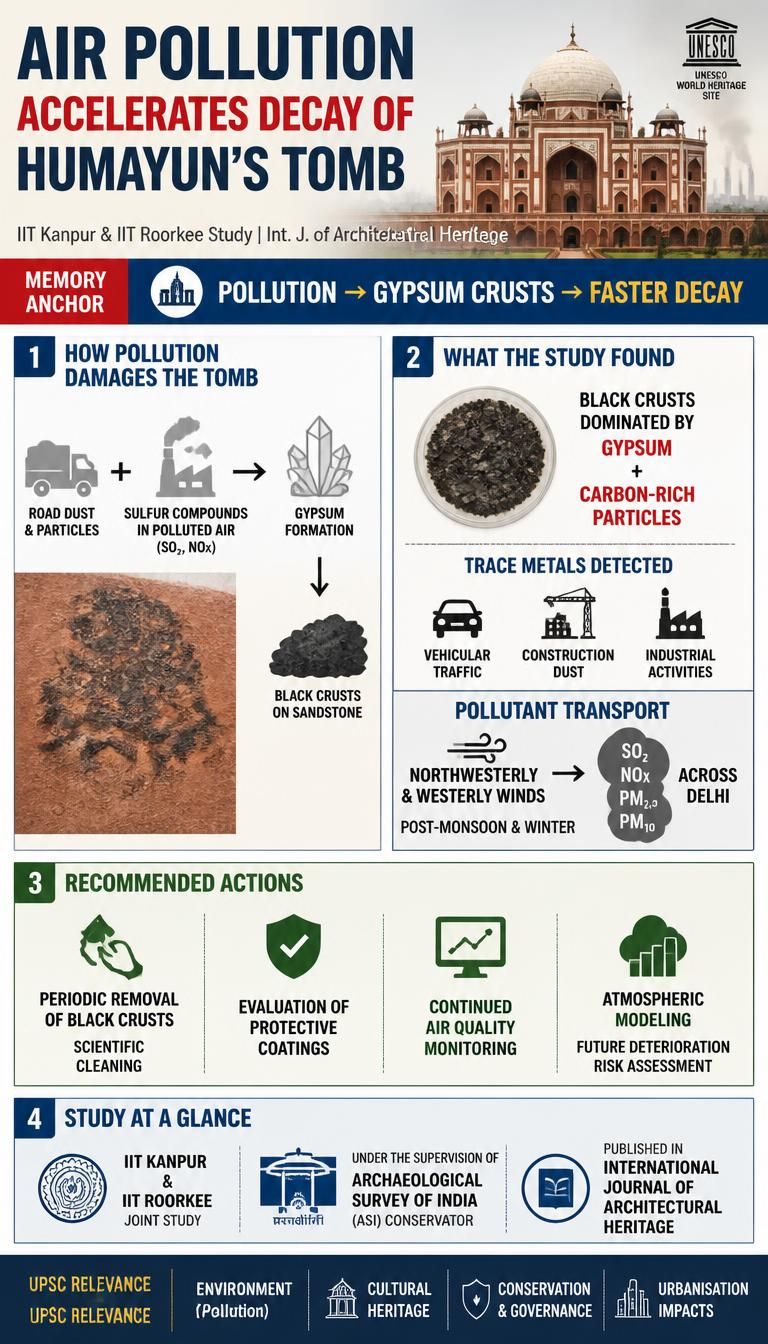
- Samples collected from the UNESCO World Heritage Site revealed that the black crusts are dominated by gypsum and carbon-rich particles.
Air pollution.jpg
Detailed Insights:
- The black crusts form when calcium from road dust and airborne particles reacts with sulfur compounds in polluted air to create gypsum.
- Trace metals found in the crusts are indicative of urban pollution sources like vehicular traffic, construction dust, and industrial activities.
- Prevailing northwesterly and westerly winds during post-monsoon and winter months transport pollutants like SO2, NOx, PM2.5, and PM10 across Delhi.
- The research recommends periodic removal of black crusts using scientific cleaning techniques and evaluation of protective coatings.
- Continued air-quality monitoring and atmospheric modeling are suggested to assess future deterioration risks for the monument.
- The study was conducted under the supervision of a conservator from the Archaeological Survey of India (ASI).
Key Concepts Involved:
- Humayun’s Tomb: A UNESCO World Heritage Site in Delhi, India, representing early Mughal architecture.
- Gypsum: A soft sulfate mineral, often formed on monuments due to the reaction of atmospheric sulfur compounds with calcium-containing materials.
- Particulate Matter (PM2.5, PM10): Microscopic solid or liquid particles suspended in the air, contributing significantly to air pollution.
- Archaeological Survey of India (ASI): An Indian government agency responsible for archaeological research and the conservation and protection of cultural heritage.

SuperKalam is your personal mentor for UPSC preparation, guiding you at every step of the exam journey.
Download the App


STUDY RESOURCES
CONTACT US
ⓒ Snapstack Technologies Private Limited