GS 1: Indian GeographyGS 1: Physical GeographyGS 3: Disaster ManagementGS 3: Environment & EcologyPrelims
Why Even a Strong El Niño Does Not Guarantee a Poor Indian Monsoon, Pg II
Despite strong El Niño, Indian monsoon rainfall can be normal due to complex interplay with Indian Ocean Dipole and other atmospheric factors.
Practice MCQs
811 Students attempted
Key Highlights:
- In 1997, a strong El Niño did not lead to a predicted monsoon deficit; India received nearly normal rainfall.
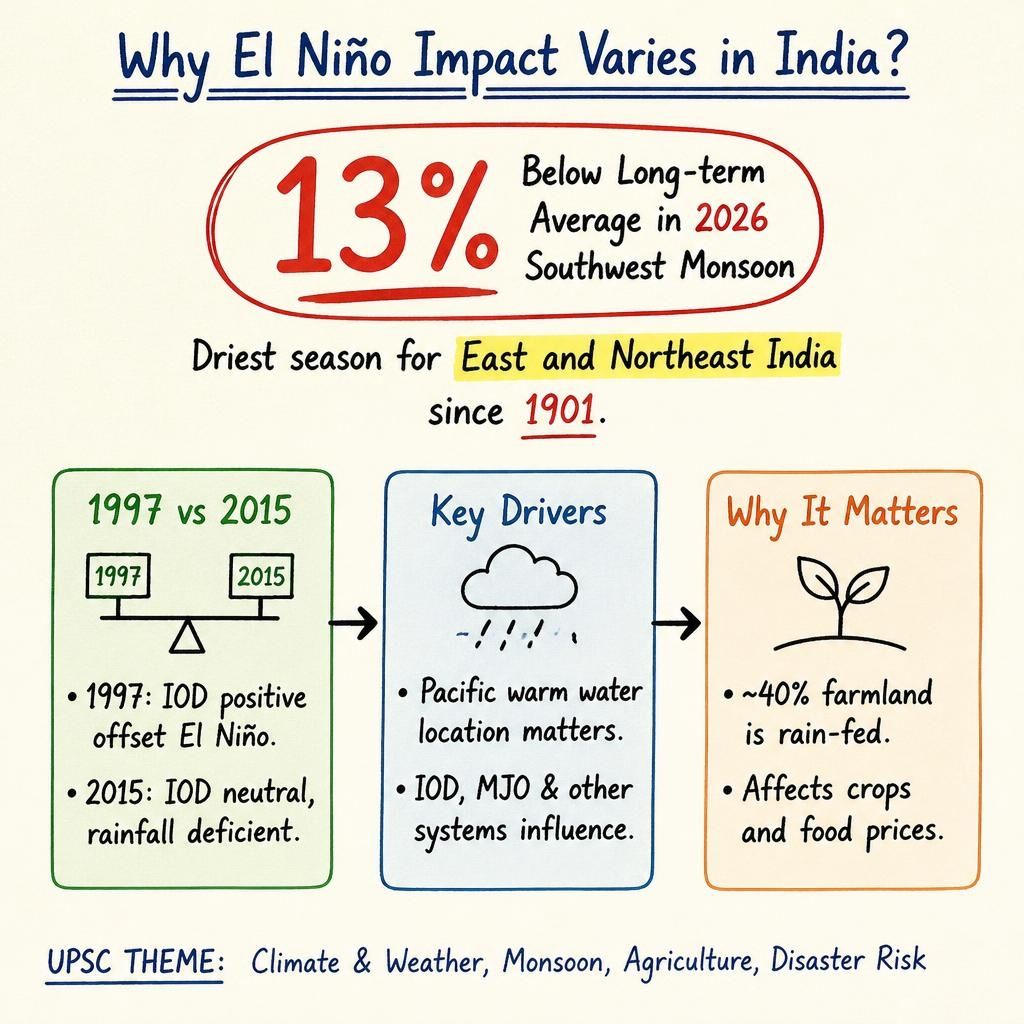
- The 2026 southwest monsoon concluded with rainfall 13% below the long-term average, marking the driest season for East and Northeast India since 1901.
- The Indian Ocean Dipole (IOD) entered a positive phase in 1997, which largely offset the negative impact of El Niño on the monsoon.
- In contrast, the IOD remained neutral in 2015, contributing to deficient rainfall despite a strong El Niño similar to 1997.
- The specific location of the warmest waters in the Pacific during an El Niño event also influences its effect on Indian monsoon rainfall.
- The India Meteorological Department (IMD) has refined its forecasting methods, including combining multiple global climate models since 2021.
El Nino Impact.jpg
Detailed Insights:
- The El Niño Southern Oscillation (ENSO) involves a weakening of Pacific trade winds, causing warm surface water to shift eastward towards South America.
- The descending warmer, drier air associated with El Niño over India typically suppresses rain cloud formation, leading to weaker monsoon rains.
- Historically, five out of seven moderate or strong El Niño years since 1950 have resulted in deficient Indian monsoon rainfall (at least 10% below average).
- The Indian Ocean Dipole (IOD) is a sea-saw phenomenon where a positive phase (warmer western Indian Ocean, cooler eastern) enhances monsoon rainfall over India.
- A 2024 study indicated that changes in the wind belt encircling Antarctica might have prevented the IOD from turning positive in 2015.
- Other atmospheric phenomena like the Madden-Julian Oscillation, high-pressure systems over the Iranian plateau, and moisture from the Arabian Sea can also influence monsoon performance.
- Accurate monsoon forecasts are critical for India, as approximately 40% of its farmland is rain-fed, directly impacting agricultural output and food prices.
Key Concepts Involved:
- El Niño Southern Oscillation (ENSO): A climate pattern characterized by periodic warming of sea surface temperatures in the central and eastern equatorial Pacific Ocean.
- Indian Ocean Dipole (IOD): An irregular oscillation of sea surface temperatures in the Indian Ocean, with its positive phase generally beneficial for the Indian monsoon.
- Madden-Julian Oscillation (MJO): An eastward-moving disturbance of clouds, rainfall, winds, and pressure that propagates around the global tropics every 30-60 days.

SuperKalam is your personal mentor for UPSC preparation, guiding you at every step of the exam journey.
Download the App


STUDY RESOURCES
CONTACT US
ⓒ Snapstack Technologies Private Limited