GS 2: GovernanceGS 2: Social JusticeGS 3: EconomyPrelimsGS 3: Indian Economy, Planning, Mobilization of Resources, Growth, Development and Employment
Even as unemployment falls, lack of ‘decent work’ in India, Pg6
India's falling unemployment rate masks a critical lack of 'decent work', with 90% informal employment and worsening conditions for marginalized women.
Practice MCQs
811 Students attempted
Key Highlights:
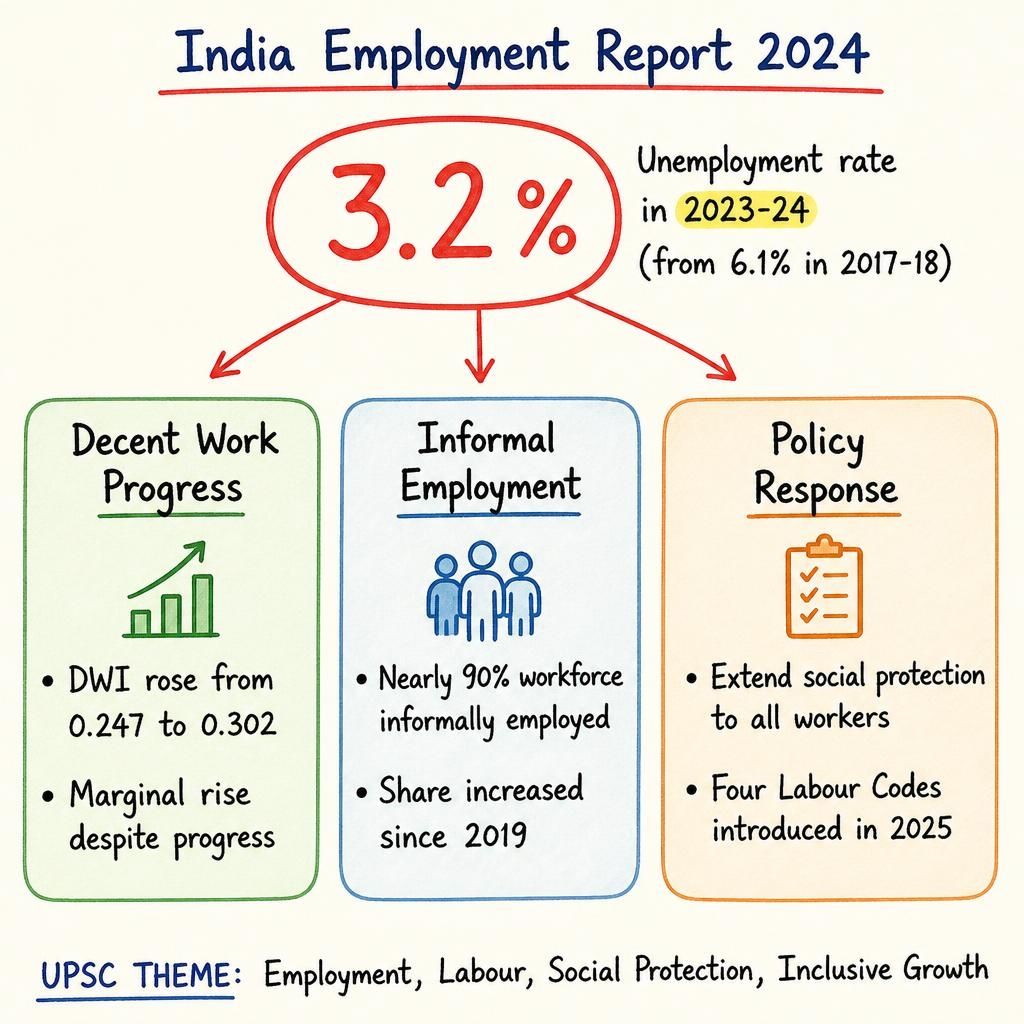
- India's unemployment rate decreased from 6.1% in 2017-18 to 3.2% in 2023-24.
- Despite falling unemployment, the Decent Work Index (DWI) for India rose only marginally from 0.247 to 0.302 between 2017-18 and 2023-24.
- Nearly 90% of India’s workforce remains informally employed, a share that has increased since 2019, as per the India Employment Report 2024.
- The International Labour Organization (ILO) defines 'decent work' as employment offering equitable income, workplace rights, social security, and dignity.
- Progress in decent work is uneven across sectors, regions, gender, and caste groups, with women from marginalized communities experiencing a decline.
Employment Report.jpg
Detailed Insights:
- The Periodic Labour Force Survey (PLFS) was utilized to construct the multidimensional Decent Work Index (DWI) across five major industries.
- Manufacturing and transport sectors showed the highest improvement in DWI, driven by formalization, digitalization, and app-based platform work.
- Agriculture remains the lowest-quality employment sector, with most workers being self-employed or unpaid family workers lacking stable income.
- Informal employment has expanded into the gig economy, logistics, home-based production, and organized industries through contractualization.
- Regional disparities persist, with states like Goa and Kerala performing better than Bihar and Uttar Pradesh in decent work creation.
- The lack of decent work leads to lower spending, savings, productivity, and tax capacity, hindering India's goal of Viksit Bharat by 2047.
- Policy recommendations include extending social protection to all workers and linking formalization to mandatory worker protections.
- The e-Shram platform is a step towards worker registration, but real protection beyond database entry is needed.
- The four Labour Codes, introduced in 2025, aim to simplify regulations but face criticism regarding diminished worker protections due to rising contractualization.
Key Concepts Involved:
- Decent Work: Employment that provides equitable income, workplace rights, social security, and dignity, as defined by the ILO.
- Sustainable Development Goal 8 (SDG-8): Advocates for the promotion of sustained, inclusive, and sustainable economic growth, full and productive employment, and decent work for all.
- Periodic Labour Force Survey (PLFS): A large-scale household survey conducted by the National Sample Survey Office (NSSO) to estimate employment and unemployment indicators.
- Informal Employment: Work arrangements lacking formal contracts, social security benefits, and legal protections, often characterized by low pay and poor working conditions.

SuperKalam is your personal mentor for UPSC preparation, guiding you at every step of the exam journey.
Download the App


STUDY RESOURCES
CONTACT US
ⓒ Snapstack Technologies Private Limited