GS 2: GovernanceGS 2: Social JusticeGS 3: EconomyPrelimsGS 2: Government policies and interventions for development in various sectors
Cancer drug pricing: Test is in actual patient bills, supply, Pg11
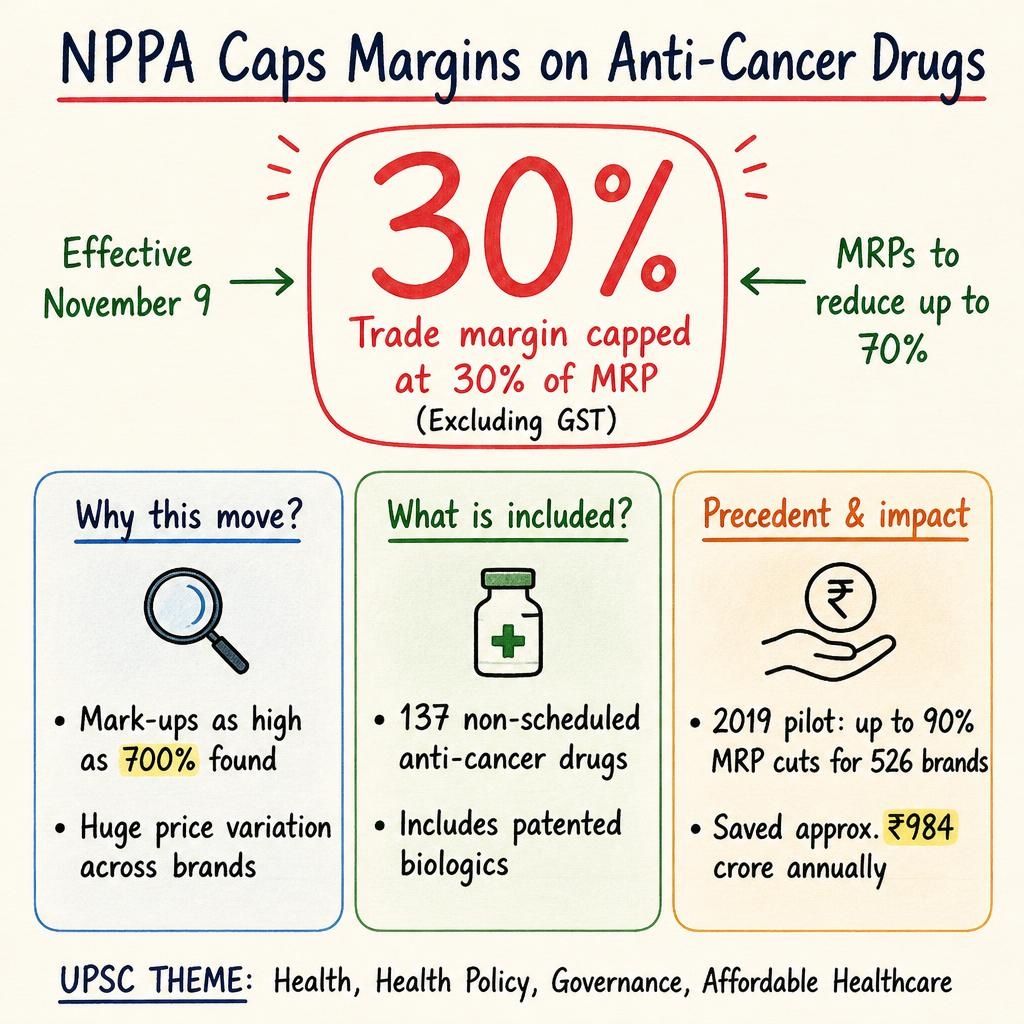
NPPA caps trade margins on 137 non-scheduled anti-cancer drugs at 30%, aiming to reduce MRPs by up to 70% and improve patient affordability.
Practice MCQs
811 Students attempted
Key Highlights:
- The National Pharmaceutical Pricing Authority (NPPA) has decided to implement Trade Margin Rationalisation (TMR) for 137 non-scheduled anti-cancer drugs, effective November 9.
- This measure caps trade margins at 30% of the Maximum Retail Price (MRP), excluding GST, and is expected to reduce MRPs by up to 70%.
- The decision was prompted by NPPA findings of mark-ups as high as 700% on some anti-cancer medicines.
- The initiative includes patented biologics such as pembrolizumab and durvalumab, which are typically not under direct price regulation.
- A 2019 pilot by NPPA on 42 drugs resulted in MRP reductions of up to 90% for 526 brands, saving approximately ₹984 crore annually.
- The move aims to improve affordability and access to critical cancer treatments for patients.
Anti-Cancer Drug.jpg
Detailed Insights:
- India faces a significant challenge with high out-of-pocket expenditure (OOPE) on healthcare, which stands at 43.4% of total health expenditure, with medicines accounting for roughly 70% of these costs.
- The TMR policy focuses on reducing intermediary margins, leaving the manufacturer's realization unchanged, thereby not directly impacting innovation incentives at the production level.
- Analysis by NPPA revealed substantial price disparities, with per-dose prices of drugs like pemetrexed ranging from ₹546 to over ₹72,000, and bevacizumab from ₹6,900 to ₹1.18 lakh.
- Hospitals are anticipated to experience a manageable but noticeable impact on profitability, with large chains potentially seeing a 1-5% fall in EBITDA.
- Concerns exist regarding potential stock-outs of low-cost older drugs and hospitals possibly offsetting lost revenue through increased charges for consultations, diagnostics, or bundled packages.
- The Supreme Court has also questioned the government on broader drug price regulation, highlighting the two-tier system where only Scheduled drugs under the Drugs (Prices Control) Order (DPCO) have price ceilings.
- Effective implementation requires a robust monitoring framework to track actual patient bills, medicine availability, hospital billing practices, and overall treatment access.
Key Concepts Involved:
- National Pharmaceutical Pricing Authority (NPPA): A government regulatory body under the Ministry of Chemicals & Fertilizers responsible for fixing and revising drug prices and ensuring medicine availability and affordability.
- Trade Margin Rationalisation (TMR): A policy mechanism to cap the profit margins of distributors and retailers on pharmaceutical products to reduce their Maximum Retail Price (MRP).
- Drugs (Prices Control) Order (DPCO): An order issued by the Government of India under the Essential Commodities Act, 1955, empowering it to fix and regulate the prices of essential bulk drugs and their formulations.
- Scheduled vs. Non-scheduled Drugs: Scheduled drugs are those included in the National List of Essential Medicines (NLEM) and are under direct price control, while non-scheduled drugs are not directly price-controlled but are subject to certain regulations like annual price increase caps.

SuperKalam is your personal mentor for UPSC preparation, guiding you at every step of the exam journey.
Download the App


STUDY RESOURCES
CONTACT US
ⓒ Snapstack Technologies Private Limited