GS 1: Physical GeographyGS 3: Disaster ManagementGS 3: Environment & EcologyGS 3: EconomyPrelims
Season’s End, Pg10
IMD's 'below normal' monsoon forecast proves conservative, with El Niño impacting rainfall distribution and threatening agricultural output, raising drought concerns.
Practice MCQs
804 Students attempted
Key Highlights:
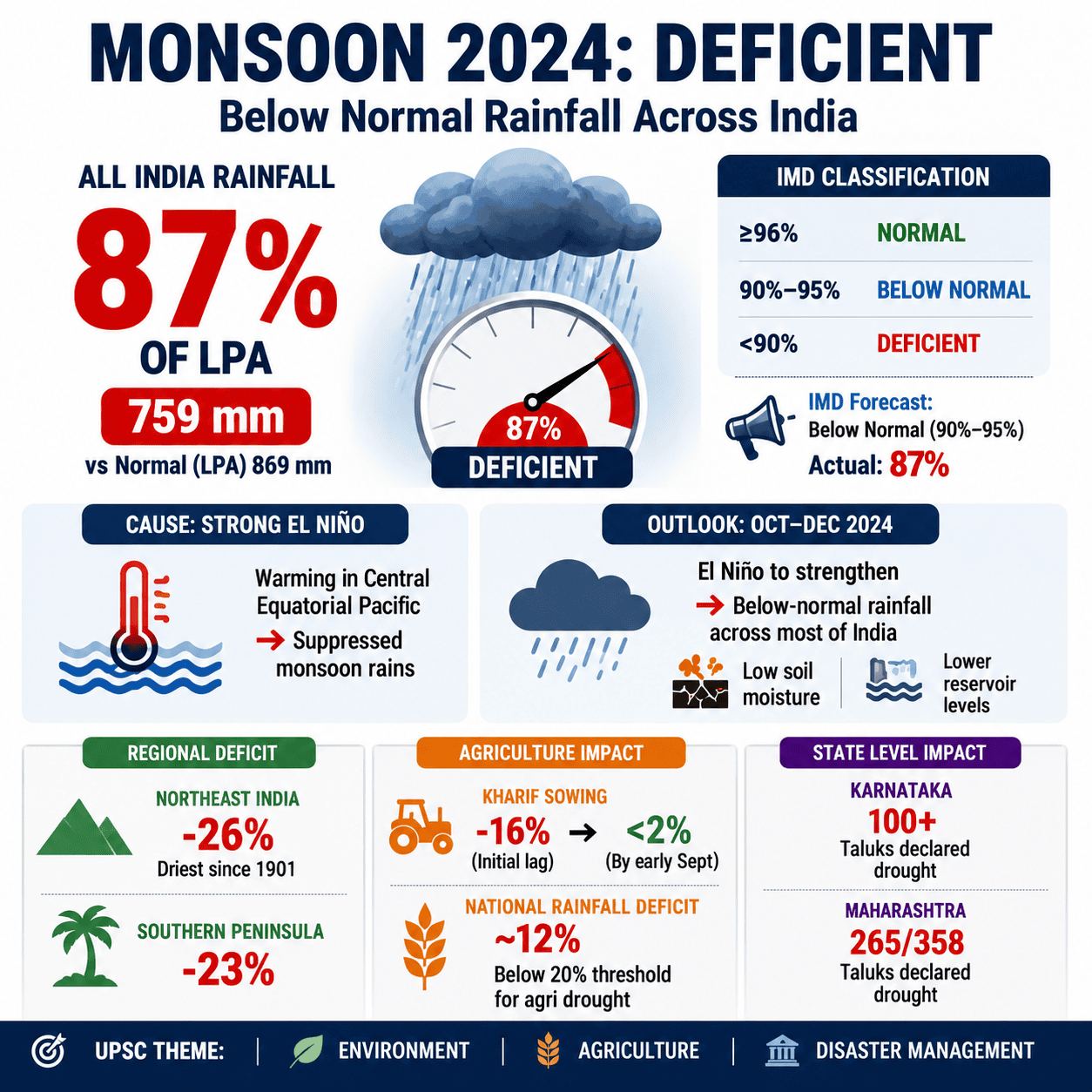
- The India Meteorological Department (IMD) reported the monsoon season ended with 759 mm of rainfall, which is 87% of the normal Long Period Average (LPA) of 869 mm.
- This 87% figure classifies the monsoon as 'deficient', despite the IMD's initial forecast of 'below normal' rainfall (90% to 95% of average).
- A strong El Niño event, characterized by warming in the Central Equatorial Pacific, significantly suppressed monsoon rains.
- Northeast India experienced its driest monsoon since 1901, recording a 26% deficit, while the southern peninsula was 23% short.
- The national rainfall deficit of approximately 12% is below the Centre's 20% threshold for declaring an agricultural drought.
Monsoon Deficit.png
Detailed Insights:
- The IMD's forecast accuracy was challenged by significant monthly variations, with June receiving only 65% of its normal rainfall against a 92% forecast.
- July's rainfall was slightly above its forecast, while August and September were largely in line with predictions.
- El Niño conditions are expected to strengthen, potentially leading to below-normal rainfall across most of India from October to December, impacting soil moisture and reservoir levels.
- Climate change is contributing to more complex monsoon patterns, with Western Disturbances increasingly influencing rainfall during monsoon months in some regions.
- Kharif sowing initially lagged by 16% compared to the previous year but recovered to a deficit of under 2% by early September.
- Several states, including Karnataka (over 100 taluks) and Maharashtra (265 of 358 taluks), have declared drought conditions at the local level.
- The Union Cabinet increased the Minimum Support Price (MSP) for wheat by ₹25 per quintal and mustard by ₹413, aiming to encourage crop diversification.
Key Concepts Involved:
- India Meteorological Department (IMD): The primary agency responsible for weather forecasting and meteorological observations in India.
- El Niño: A climate pattern involving the periodic warming of sea surface temperatures in the central and eastern equatorial Pacific Ocean, influencing global weather.
- Long Period Average (LPA): A statistical benchmark representing the average rainfall over a specific region for a given period, typically 30 or 50 years, used by IMD for monsoon forecasts.
- Western Disturbances: Extra-tropical storm systems originating in the Mediterranean region that bring sudden winter rain and snow to the northwestern parts of the Indian subcontinent.
- Kharif Sowing: The cultivation period for crops sown at the beginning of the southwest monsoon season (June-July) and harvested in autumn (September-October).
- Agricultural Drought: A condition characterized by insufficient rainfall and soil moisture to support healthy crop growth, leading to significant agricultural losses.
- Minimum Support Price (MSP): A guaranteed price set by the Government of India for certain agricultural crops to protect farmers from market price fluctuations and ensure a minimum profit.

SuperKalam is your personal mentor for UPSC preparation, guiding you at every step of the exam journey.
Download the App


STUDY RESOURCES
CONTACT US
ⓒ Snapstack Technologies Private Limited