GS 2: GovernanceGS 1: Indian SocietyGS 2: Social JusticePrelimsGS 2: Government policies and interventions for development in various sectors
Other than outrage, Pg10
Despite post-Nirbhaya laws and schemes, sexual assaults against women and children surge, exposing critical failures in governance, justice delivery, and societal change.
Practice MCQs
804 Students attempted
Key Highlights:
- Despite the implementation of new laws and schemes following the Nirbhaya case in 2012, sexual assaults against women and children persist, indicating significant implementation gaps.
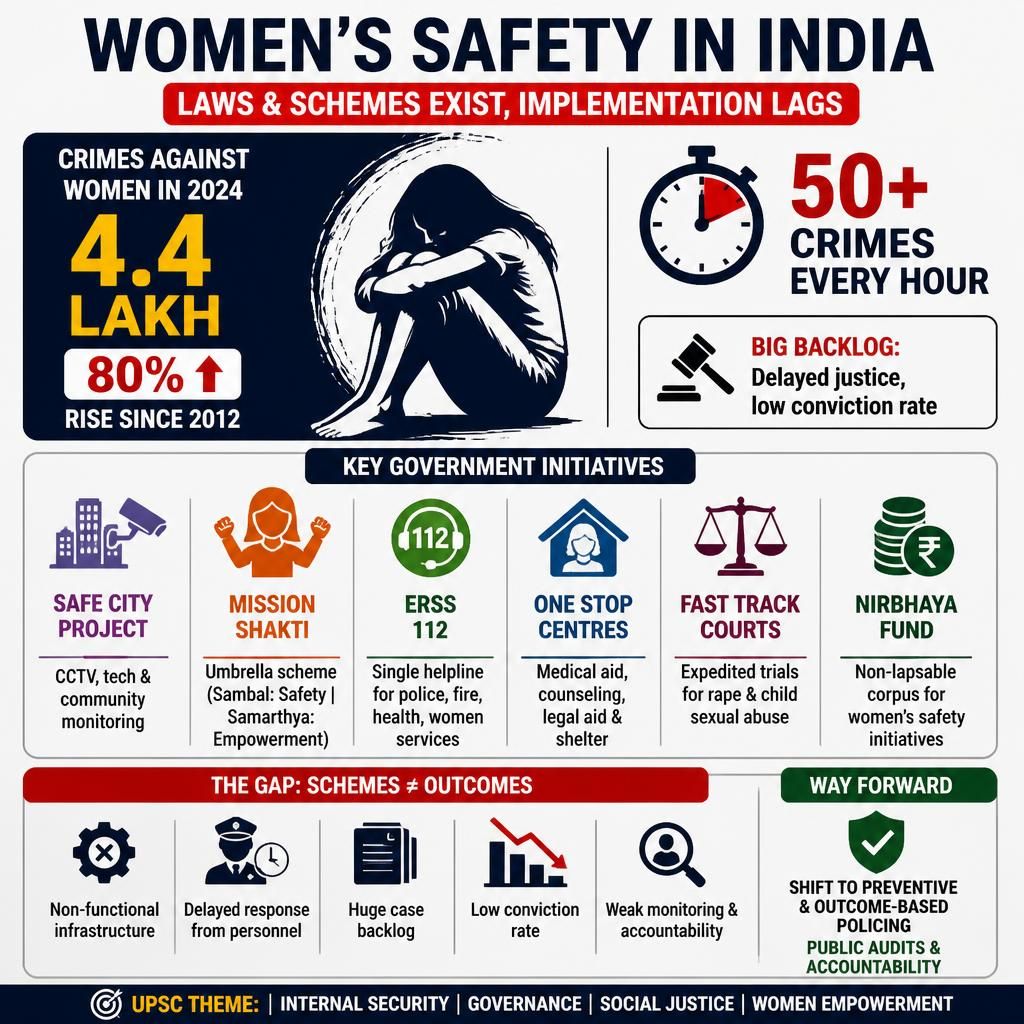
- The National Crime Records Bureau (NCRB) reported approximately 4.4 lakh crimes against women in 2024, an 80% increase since 2012, with over 50 crimes reported every hour.
- Government initiatives like the Safe City Project, Mission Shakti, women's helplines, Emergency Response Support System (ERSS), One Stop Centres, and Fast Track Courts have been launched, many funded by the Nirbhaya Fund.
- The effectiveness of these schemes is questioned due to issues like non-functional infrastructure, delayed response from personnel, and a large backlog of cases in the justice system.
Women Safety.jpg
Detailed Insights:
- The Nirbhaya Fund, established in 2013, is a non-lapsable corpus dedicated to initiatives for women's safety and security, administered by the Ministry of Finance with the Ministry of Women and Child Development as the nodal ministry.
- Mission Shakti, launched during the 15th Finance Commission period (2021-26), is an umbrella scheme for women's safety, security, and empowerment, comprising 'Sambal' for safety and 'Samarthya' for empowerment.
- The Safe City Project aims to create a secure environment for women in public spaces through technology like CCTV cameras and community engagement, implemented in eight metro cities including Delhi.
- One Stop Centres (OSCs), also known as Sakhi Centres, provide integrated support including medical aid, counseling, and temporary shelter to women affected by violence, funded by the Nirbhaya Fund.
- The Emergency Response Support System (ERSS), with the single helpline number 112, integrates police, fire, health, and women's helplines for quick emergency response across India.
- Fast Track Special Courts (FTSCs) were established to expedite trials for heinous crimes like rape and child sexual abuse, with many funded through the Nirbhaya Fund.
- The article advocates for a shift from scheme-based policing to preventive and outcome-based policing, emphasizing public audits and accountability to rectify deficiencies.
- It highlights the need to address the enormous backlog of cases in the justice system to ensure speedy trials for survivors.
- The response to unsafe public spaces should not involve restricting women's freedom but rather challenging the culture of sexual violence and toxic masculinity.
Key Concepts Involved:
- Nirbhaya Fund: A non-lapsable corpus established in 2013 for schemes ensuring women's safety and security.
- Mission Shakti: An umbrella scheme by the Ministry of Women and Child Development for women's safety, security, and empowerment.
- National Crime Records Bureau (NCRB): An Indian government agency responsible for collecting and analyzing crime data.
- One Stop Centres (OSCs): Facilities providing integrated support services to women affected by violence under one roof.
- Emergency Response Support System (ERSS): A pan-India single emergency number (112) system for integrated emergency services.
- Fast Track Special Courts (FTSCs): Dedicated courts established to ensure speedy disposal of cases related to sexual offenses against women and children.

SuperKalam is your personal mentor for UPSC preparation, guiding you at every step of the exam journey.
Download the App


STUDY RESOURCES
CONTACT US
ⓒ Snapstack Technologies Private Limited