GS 2: GovernanceGS 1: Indian SocietyGS 3: EconomyPrelimsGS 3: Changes in Industrial Policy and Effects on Industrial Growth
Industry is growing, but isn’t creating jobs, Pg10
Despite robust growth in India's formal manufacturing, job creation lags significantly, highlighting a critical employment crisis for millions of workers.
Practice MCQs
804 Students attempted
Key Highlights:
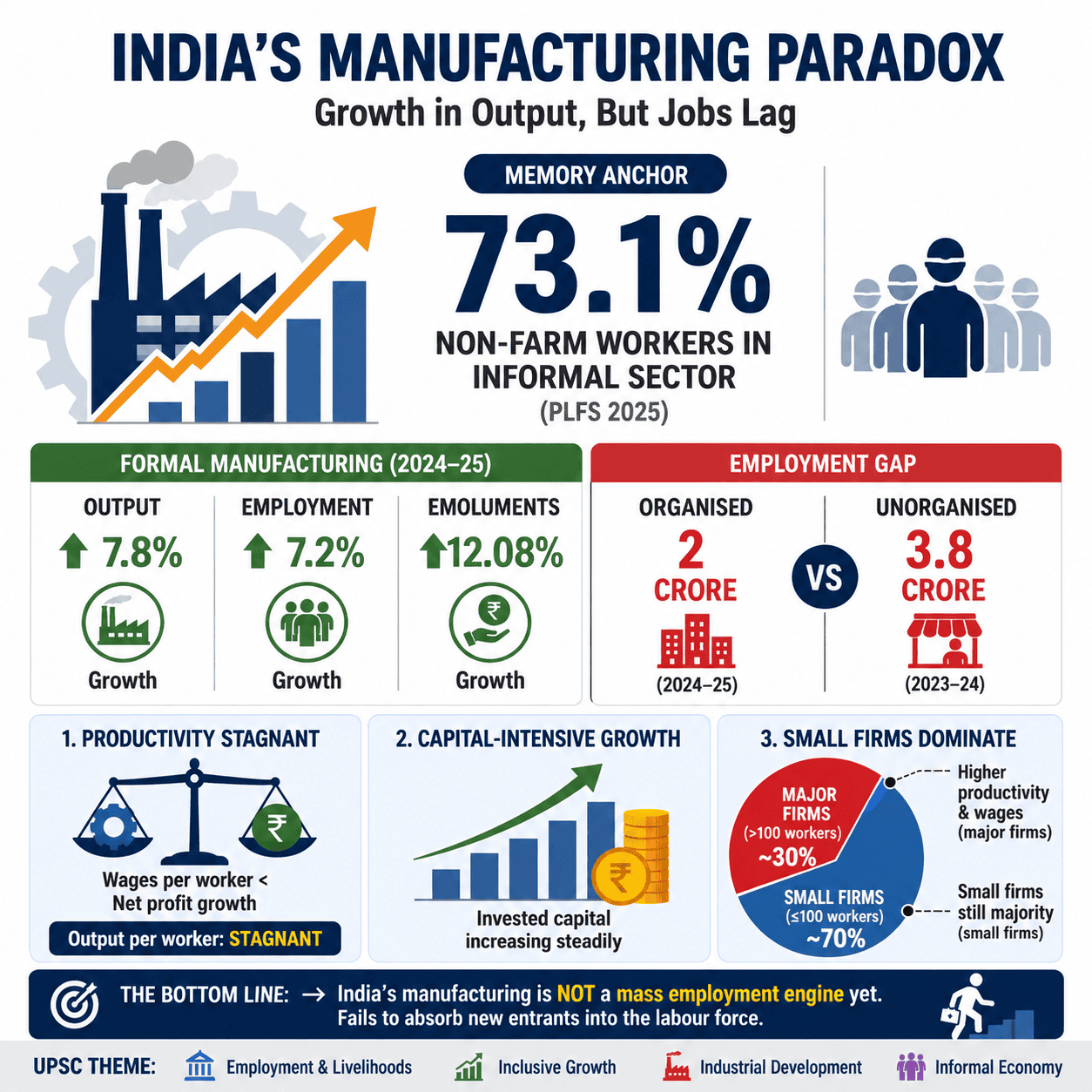
- India's formal manufacturing sector showed growth in output (7.8%), employment (7.2%), and emoluments (12.08%) in 2024-25, according to the Annual Survey of Industries.
- Despite this growth, the sector is not generating sufficient jobs, with 73.1% of non-farm workers engaged in informal-sector enterprises as per the Periodic Labour Force Survey 2025.
- Organised manufacturing employed 2 crore people in 2024-25, but the unorganised segment employed 3.8 crore in 2023-24, highlighting a significant employment gap.
- Wages per worker grew slower than net profit, and output per worker remained stagnant, while invested capital increased steadily.
- India's manufacturing has not become a mass employment engine, unlike economies such as Korea and China, failing to absorb new entrants into the labor force.
Manufacturing Paradox.png
Detailed Insights:
- The growth in formal manufacturing is primarily seen in output and emoluments, but not proportionally in job creation, indicating a capital-intensive growth model.
- The Annual Survey of Industries data reveals that while total persons engaged in organised manufacturing crossed 2 crore in 2024-25, this is a small fraction of the overall labor force.
- The dominance of the informal sector, employing a large majority of non-farm workers, points to a persistent challenge in formalizing the economy.
- The Economic Survey indicates that larger factories (employing over 100 workers) are more productive and offer better wages, but small firms still dominate organised manufacturing.
- The lack of formal job opportunities forces low-skilled and unskilled workers to remain in agriculture or engage in gig work, exacerbating India's employment challenge.
- This trend has implications for consumption, investment, and overall productivity, hindering inclusive economic growth.
Key Concepts Involved:
- Formal Sector: The part of the economy that is taxed, monitored by the government, and included in the Gross Domestic Product (GDP).
- Informal Sector: The part of the economy that is neither taxed nor monitored by any form of government.
- Gig Work: Flexible, temporary jobs, often involving connecting with clients or customers through an online platform.
- Labour Force: The total number of people employed or actively seeking employment within a country.

SuperKalam is your personal mentor for UPSC preparation, guiding you at every step of the exam journey.
Download the App


STUDY RESOURCES
CONTACT US
ⓒ Snapstack Technologies Private Limited