GS 2: GovernanceGS 3: Environment & EcologyGS 3: EconomyPrelimsGS 3: Infrastructure: Energy, Ports, Roads, Airports, Railways etc.
For New Energy, Remove Old Bottlenecks, Pg10
India's renewable energy expansion faces critical transmission and storage bottlenecks. Green Energy Corridor Phase-III aims to strengthen infrastructure, tackling land acquisition and governance hurdles.
Practice MCQs
804 Students attempted
Key Highlights:
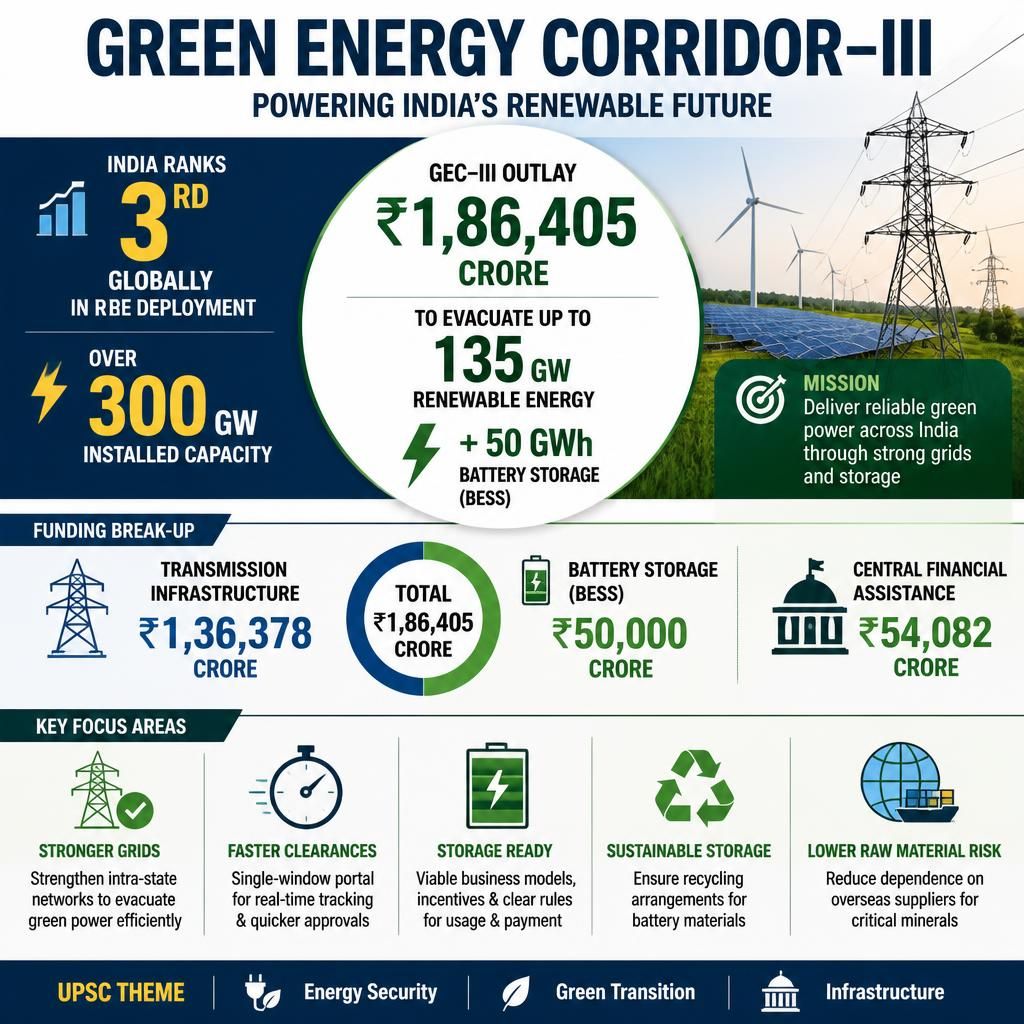
- India ranks third globally in renewable energy (RE) deployment with over 300 GW of installed capacity.
- Despite high capacity, significant solar power curtailment occurred due to transmission constraints and grid security needs, especially during evening peak demand.
- The Centre approved the Green Energy Corridor Phase-III (GEC-III) scheme with an outlay of ₹1,86,405 crore to address these bottlenecks.
- The scheme aims to evacuate up to 135 GW of renewable energy and add 50 GWh of Battery Energy Storage Systems (BESS).
- It allocates ₹1,36,378 crore for transmission infrastructure and ₹50,000 crore for storage, with ₹54,082 crore in Central Financial Assistance.
Green Energy Corridor.jpg
Detailed Insights:
- The variability of solar and wind power necessitates robust transmission planning and storage solutions to meet demand when generation is low.
- The GEC-III scheme focuses on strengthening intra-state networks, crucial for delivering green power from generation-rich regions to consumers across states.
- Past experiences highlight challenges in transmission line development, including Right-of-Way compensation, land acquisition, and delays in environmental clearances.
- The Parliamentary Standing Committee on Energy recommended a portal for approving authorities to enable real-time monitoring and faster decision-making.
- For the 50 GWh storage component, viable business models, incentives, recycling arrangements, and clear rules for usage and payment are essential.
- The sector's reliance on overseas suppliers for critical raw materials for batteries poses a challenge that needs to be addressed.
- Effective implementation requires strong Centre-state collaboration, as renewable resources, transmission corridors, and electricity demand transcend administrative boundaries.
- The scheme is targeted for completion by FY 2032-33 and supports India's goal of 900 GW of non-fossil capacity by 2035.
Key Concepts Involved:
- Green Energy Corridor (GEC): A dedicated transmission infrastructure designed to evacuate large-scale renewable energy from generation-rich areas to load centers.
- Battery Energy Storage Systems (BESS): Technologies that store electrical energy for later use, crucial for managing intermittency and ensuring grid stability for renewable sources.
- Right-of-Way (RoW): The legal right to pass over or through another's property, a significant hurdle in laying transmission lines due to compensation and acquisition issues.

SuperKalam is your personal mentor for UPSC preparation, guiding you at every step of the exam journey.
Download the App


STUDY RESOURCES
CONTACT US
ⓒ Snapstack Technologies Private Limited