GS 2: GovernanceGS 3: Environment & EcologyGS 3: EconomyPrelimsGS 3: Indian Economy, Planning, Mobilization of Resources, Growth, Development and Employment
The Two Balance Sheets Behind Every E-Waste Decision, Pg8
India must shift e-waste decisions from short-term financial gains to long-term strategic value, leveraging urban mining for critical minerals and national capability.
Practice MCQs
797 Students attempted
Key Highlights:
- Discarded IT equipment, or e-waste, represents a significant source of critical minerals such as copper, gold, and palladium.
- Urban mining is the process of recovering these valuable materials from used electronics, reducing the need for virgin mining.
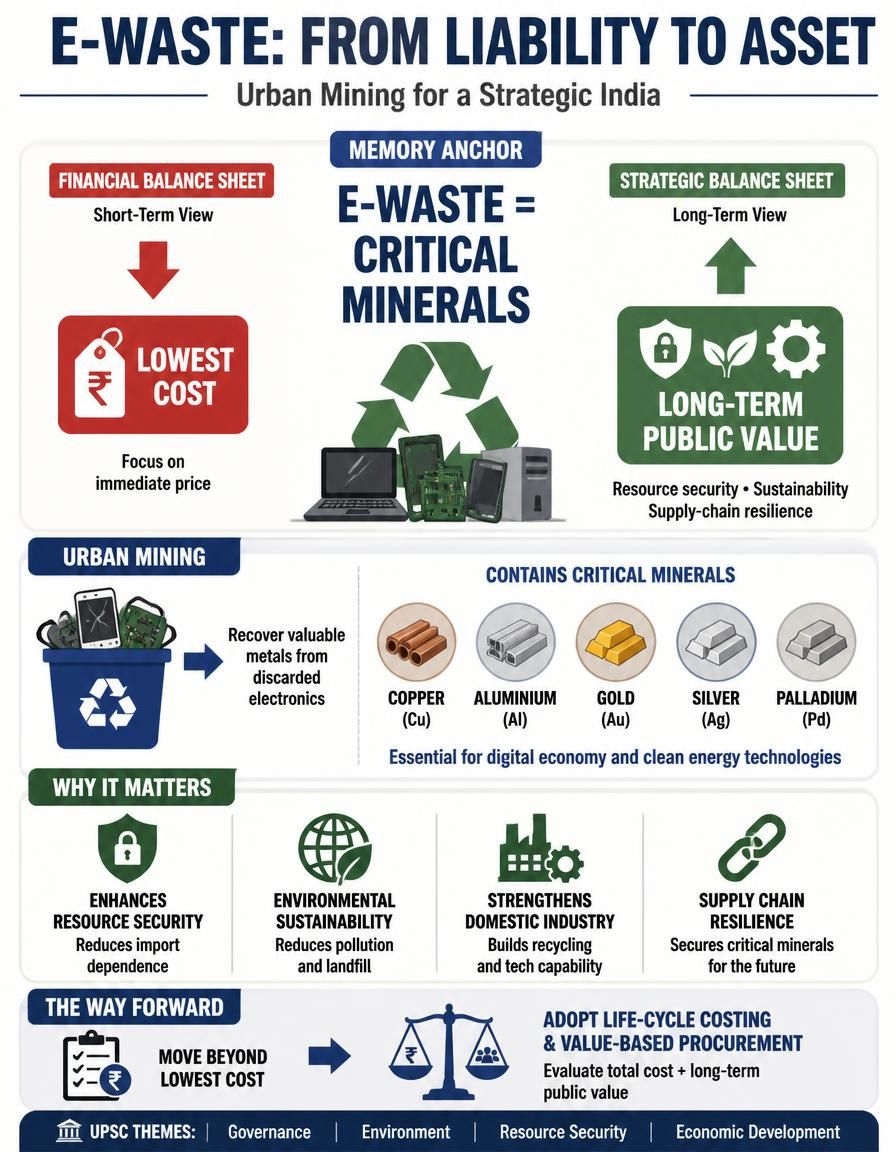
- Every major public or corporate decision involves two balance sheets: an immediate financial one and a long-term strategic one.
- India's current procurement practices, often prioritizing the lowest visible cost, impede the adoption of advanced e-waste recycling.
- Effective e-waste management can enhance resource security, reduce import dependence, and strengthen domestic industrial capabilities.
E-Waste.jpg
Detailed Insights:
- E-waste contains valuable metals like copper, aluminium, gold, silver, and palladium, which are vital for modern digital economies.
- Recovering materials from e-waste requires sophisticated technology, secure data destruction, and environmentally compliant processing, which can increase initial costs.
- The strategic balance sheet accounts for long-term consequences such as resource security, environmental sustainability, and supply-chain resilience.
- Life-cycle costing and value-based procurement are approaches that evaluate the total cost and long-term public value of an investment, rather than just the initial price.
- The Extended Producer Responsibility (EPR) framework should incentivize traceability, recovery efficiency, and technological capability in recycling.
- Neglecting advanced e-waste recycling can lead to cybersecurity risks, increased reliance on imports, and significant environmental liabilities.
Key Concepts Involved:
- Urban Mining: The process of extracting valuable raw materials from discarded products, particularly electronic waste, instead of traditional mining.
- Critical Minerals: Elements essential for high-tech industries and national security, whose supply is at risk due to geopolitical or economic factors.
- Life-Cycle Costing: An economic assessment that considers the total cost of an asset over its entire lifespan, from acquisition to disposal.
- Extended Producer Responsibility (EPR): A policy principle where producers are responsible for the entire life cycle of their products, including post-consumer collection and recycling.

SuperKalam is your personal mentor for UPSC preparation, guiding you at every step of the exam journey.
Download the App


STUDY RESOURCES
CONTACT US
ⓒ Snapstack Technologies Private Limited