GS 2: GovernanceGS 2: PolityPrelimsGS 2: Indian Constitutional Evolution, Features, Amendments, Basic Structure DoctrineGS 2: Structure and Functioning of Executive and Judiciary
Distinguished Jurist: The Unused Route To Appoint An SC Judge, Pg17
Supreme Court Justice calls for activating Article 124(3) to appoint "distinguished jurists," diversifying the bench and enhancing judicial functioning.
Practice MCQs
797 Students attempted
Key Highlights:
- Supreme Court Justice Ujjal Bhuyan recently highlighted the unused provision in Article 124(3) of the Constitution.
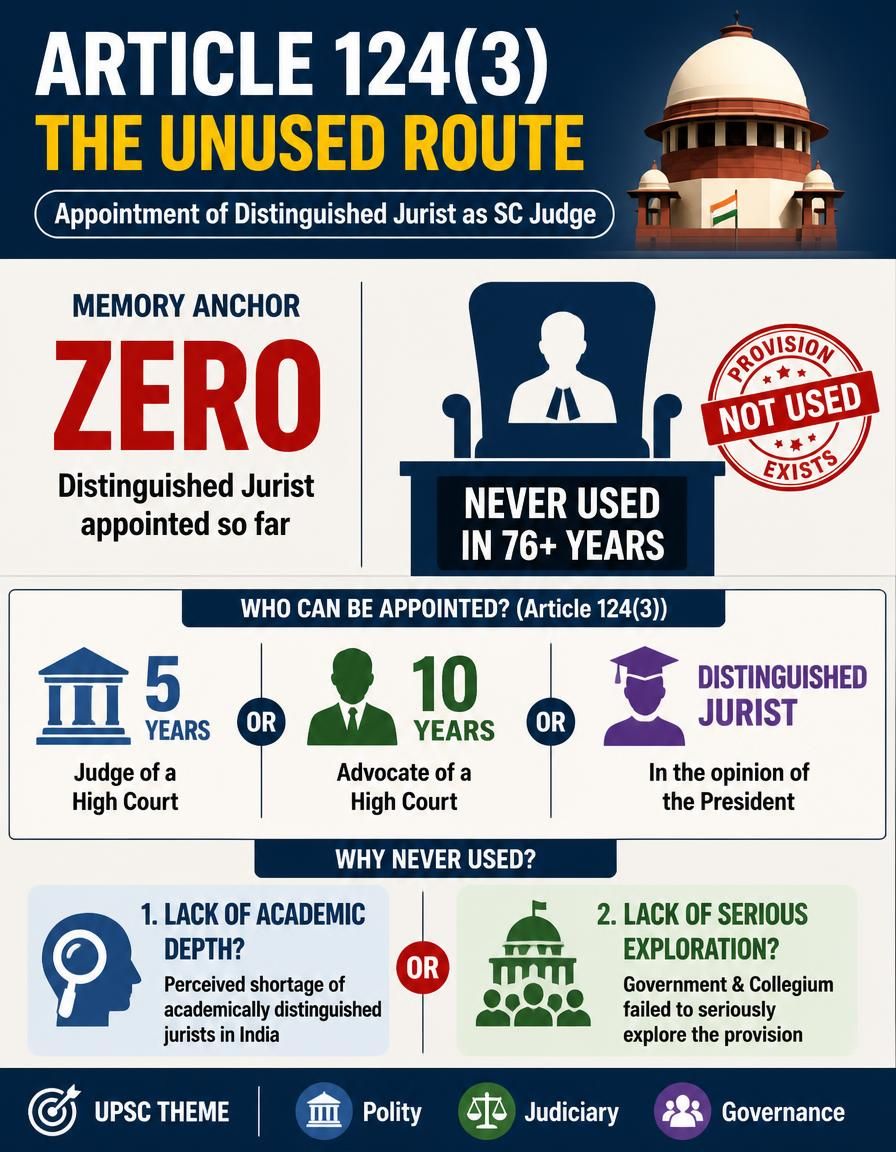
- This article allows for the appointment of a "distinguished jurist" as a judge of the Supreme Court of India.
- Despite the constitutional mandate, this route has never been utilized since the Constitution came into force over 76 years ago.
- Justice Bhuyan emphasized that appointing a distinguished jurist would diversify the bench and enhance its capacity to address public law issues.
Distinguished Jurist.jpg
Detailed Insights:
- Article 124(3) specifies three qualifications for a Supreme Court judge: five years as a High Court judge, ten years as an advocate, or being a "distinguished jurist" in the President's opinion.
- The "distinguished jurist" clause was incorporated during the Constituent Assembly Debates on May 24, 1949, following an amendment proposed by H.V. Kamath.
- B.R. Ambedkar supported the inclusion, aiming to broaden the pool of candidates beyond just judges and advocates.
- A similar provision for High Court judges was briefly introduced by the 42nd Constitutional Amendment Act, 1976, but was subsequently repealed by the 44th Constitutional Amendment Act, 1978.
- Justice Bhuyan suggested two reasons for its non-use: a perceived lack of academic depth in India or a failure by the government and the Supreme Court Collegium to seriously explore this provision.
- The appointment process, governed by the Supreme Court Collegium, requires its recommendation for any jurist to be considered for elevation.
- Rules by the Bar Council of India generally restrict full-time law teachers from practicing, potentially limiting the pool of eligible jurists with practical legal engagement.
Key Concepts Involved:
- Article 124(3): A constitutional provision outlining the eligibility criteria for appointment as a judge of the Supreme Court of India.
- Distinguished Jurist: An eminent legal scholar, academician, or researcher considered eligible for direct appointment to the Supreme Court.
- Supreme Court Collegium: A system comprising the Chief Justice of India and four senior-most Supreme Court judges responsible for judicial appointments and transfers.
- Constituent Assembly Debates: The discussions and deliberations that took place among the members of the Constituent Assembly while drafting the Constitution of India.
- 42nd Constitutional Amendment Act, 1976: A significant amendment during the Emergency, which briefly included the "distinguished jurist" clause for High Court judges.
- 44th Constitutional Amendment Act, 1978: An amendment that largely reversed many changes made by the 42nd Amendment, including the repeal of the "distinguished jurist" clause for High Court judges.

SuperKalam is your personal mentor for UPSC preparation, guiding you at every step of the exam journey.
Download the App


STUDY RESOURCES
CONTACT US
ⓒ Snapstack Technologies Private Limited