GS 2: GovernanceGS 2: PolityPrelimsGS 2: Government policies and interventions for development in various sectorsGS 2: Parliament and State Legislatures
Amendment to paper leak Bill gets assent from President, Pg11
President Droupadi Murmu assents to Public Examinations Bill, enabling fast-track courts, 10-year jail, and ₹50 lakh fine for paper leak culprits.
Practice MCQs
790 Students attempted
Key Highlights:
- President Droupadi Murmu has given her assent to the Public Examinations (Prevention of Unfair Means) Amendment Bill, 2026.
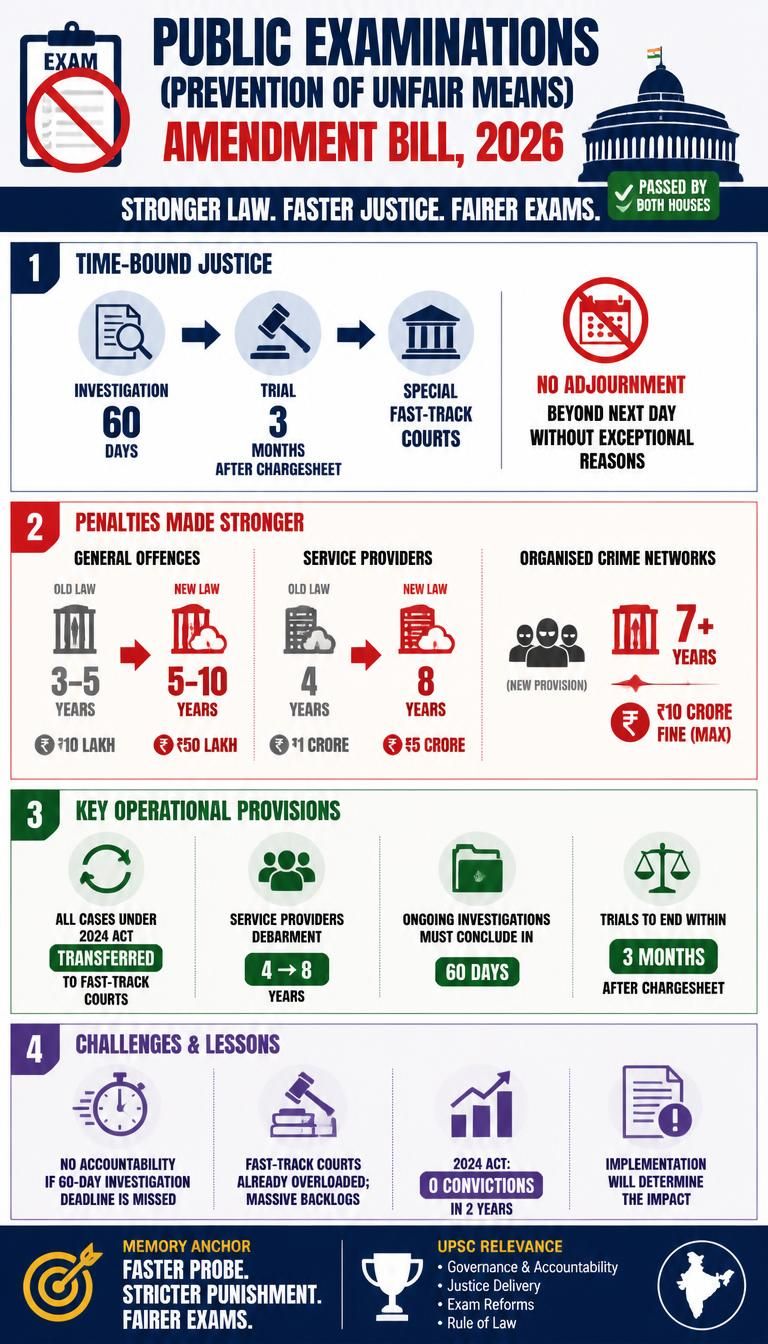
- The amended law empowers States and Union Territories to establish fast-track courts for speedy trials in public examination paper leak cases.
- Individuals involved in paper leaks or unfair means now face enhanced punishment, including a minimum of five years and a maximum of 10 years imprisonment, and a fine of up to ₹50 lakh.
- The legislation mandates that investigations into such offenses must be completed within two months, and trials concluded within three months of filing the chargesheet.
Public Exam Bill.jpg
Detailed Insights:
- The amendment strengthens the existing Public Examinations (Prevention of Unfair Means) Act, 2024, which was originally enacted to curb cheating and uphold the integrity of public examinations.
- For organized crimes related to paper leaks, the amended law proposes a minimum sentence of seven years and a fine of up to ₹10 crore.
- The legislation also includes provisions for the confiscation of properties belonging to convicted offenders to deter malpractices.
- The government expedited the passage of this Bill following widespread student protests against the NEET 2026 paper leak.
- The Act aims to foster greater transparency, fairness, and credibility in public examination systems, reassuring aspirants about the integrity of the process.
Key Concepts Involved:
- Public Examinations (Prevention of Unfair Means) Act, 2024: A central legislation designed to prevent and penalize malpractices like paper leaks and cheating in national recruitment and entrance examinations.
- Fast-track courts: Specialized judicial bodies established to ensure the swift and efficient disposal of specific categories of cases, such as those related to examination malpractices.
- Paper Leak: The unauthorized disclosure or distribution of examination question papers or answer keys before or during a public examination.

SuperKalam is your personal mentor for UPSC preparation, guiding you at every step of the exam journey.
Download the App


STUDY RESOURCES
CONTACT US
ⓒ Snapstack Technologies Private Limited