GS 3: Science & TechnologyGS 3: Internal SecurityPrelimsGS 2: Government policies and interventions for development in various sectorsGS 3: Achievements of Indians in Science and Technology
Why is the NVS-03 satellite launch significant?, Pg14
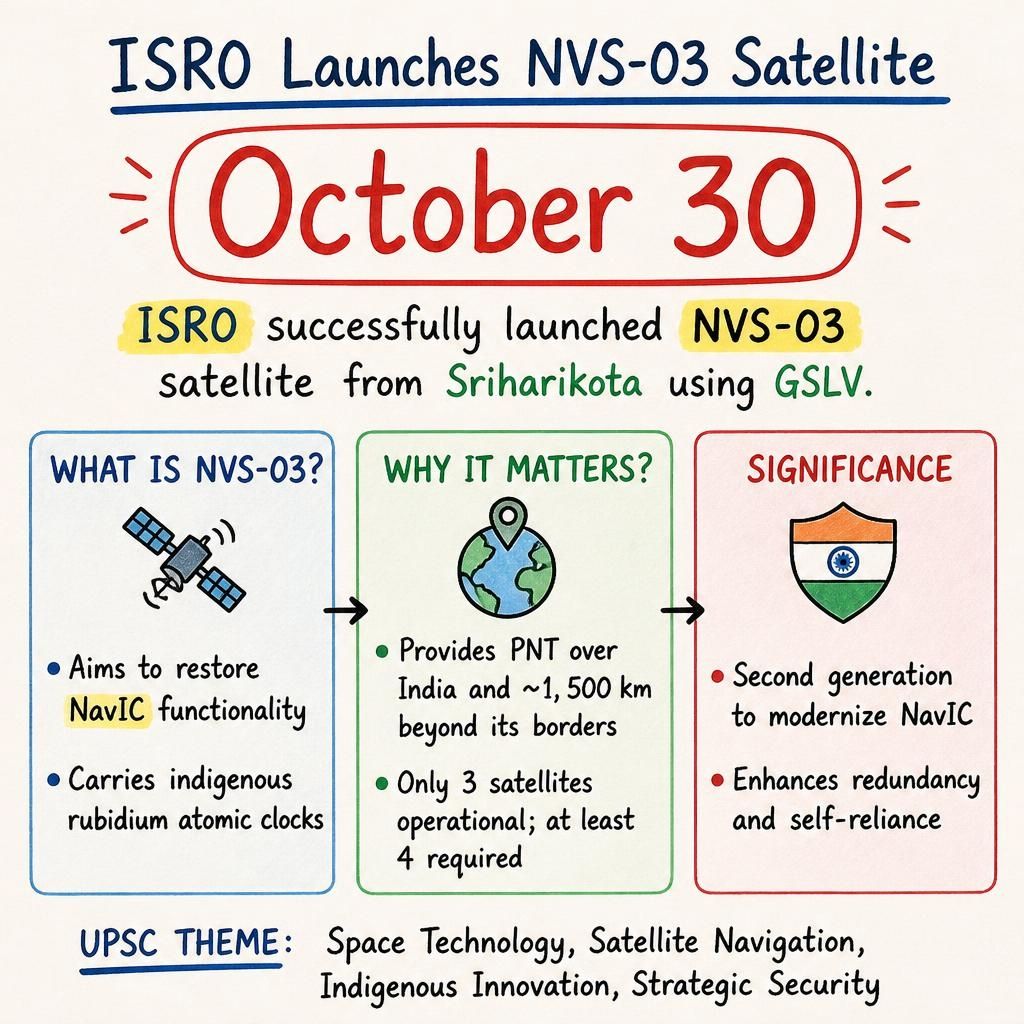
ISRO successfully launches NVS-03 satellite via GSLV, restoring critical NavIC functionality and advancing indigenous rubidium atomic clock technology for India's navigation system.
Practice MCQs
804 Students attempted
Key Highlights:
- The Indian Space Research Organisation (ISRO) successfully launched the NVS-03 satellite on October 30 from the Satish Dhawan Space Centre in Sriharikota.
- The launch was carried out using the Geosynchronous Satellite Launch Vehicle (GSLV).
- NVS-03 aims to restore base-level functionality to India's indigenous navigation system, NavIC.
- NavIC, or Navigation with Indian Constellation, is India's regional satellite navigation system, previously known as IRNSS.
- The satellite carries indigenous rubidium atomic clocks, developed by the ISRO Space Applications Centre.
ISRO NVS-03 Launch.jpg
Detailed Insights:
- NavIC provides positioning, navigation, and timing (PNT) services over India and extending approximately 1,500 km beyond its borders.
- It offers both open signals for civilian applications and restricted, more accurate signals for authorized users, including the armed forces.
- Several first-generation IRNSS satellites have become defunct due to failures of their onboard atomic clocks, with five completely non-functional by July 2025.
- The last functioning atomic clock on IRNSS-1F stopped working in March, leaving only three satellites operational, whereas at least four are required for NavIC to function as intended.
- The NVS-02 mission in January 2025 faced a setback when its thrusters failed to move it into its intended final orbit.
- NVS-03 is part of the second generation of satellites designed to modernize NavIC and replace imported atomic clocks with indigenous ones.
- ISRO is increasing the number of clocks per satellite and developing indigenous clocks to enhance redundancy and self-reliance.
- The NVS-03 launch followed a period of challenges for ISRO, including two successive failures of the Polar Satellite Launch Vehicle (PSLV).
Scientific/Technical Concepts Involved:
- NavIC (Navigation with Indian Constellation): India's independent regional satellite navigation system providing positioning, navigation, and timing (PNT) services.
- Geosynchronous Satellite Launch Vehicle (GSLV): An Indian expendable launch system used by ISRO to launch satellites into geosynchronous transfer orbit.
- Atomic Clock: A highly precise timekeeping device that uses the resonant frequency of atoms as its reference for accurate timing signals in navigation.
- Positioning, Navigation, and Timing (PNT): The core services provided by satellite navigation systems for determining location, direction, and precise time.

SuperKalam is your personal mentor for UPSC preparation, guiding you at every step of the exam journey.
Download the App


STUDY RESOURCES
CONTACT US
ⓒ Snapstack Technologies Private Limited