GS 2: GovernanceGS 2: PolityGS 3: Science & TechnologyGS 3: Internal SecurityPrelims
Why are social media takedowns in focus?, Pg14
Government advisories and amended IT Rules accelerate social media content takedowns, sparking debate over free speech, platform liability, and user grievance redressal mechanisms.
Practice MCQs
804 Students attempted
Key Highlights:
- Social media users have reported a surge in posts, reels, and accounts being blocked or taken down across platforms like Instagram, Facebook, and X.
- These restrictions are occurring amid protests concerning the Special Intensive Revision of electoral rolls and demands for the Chief Election Commissioner's resignation.
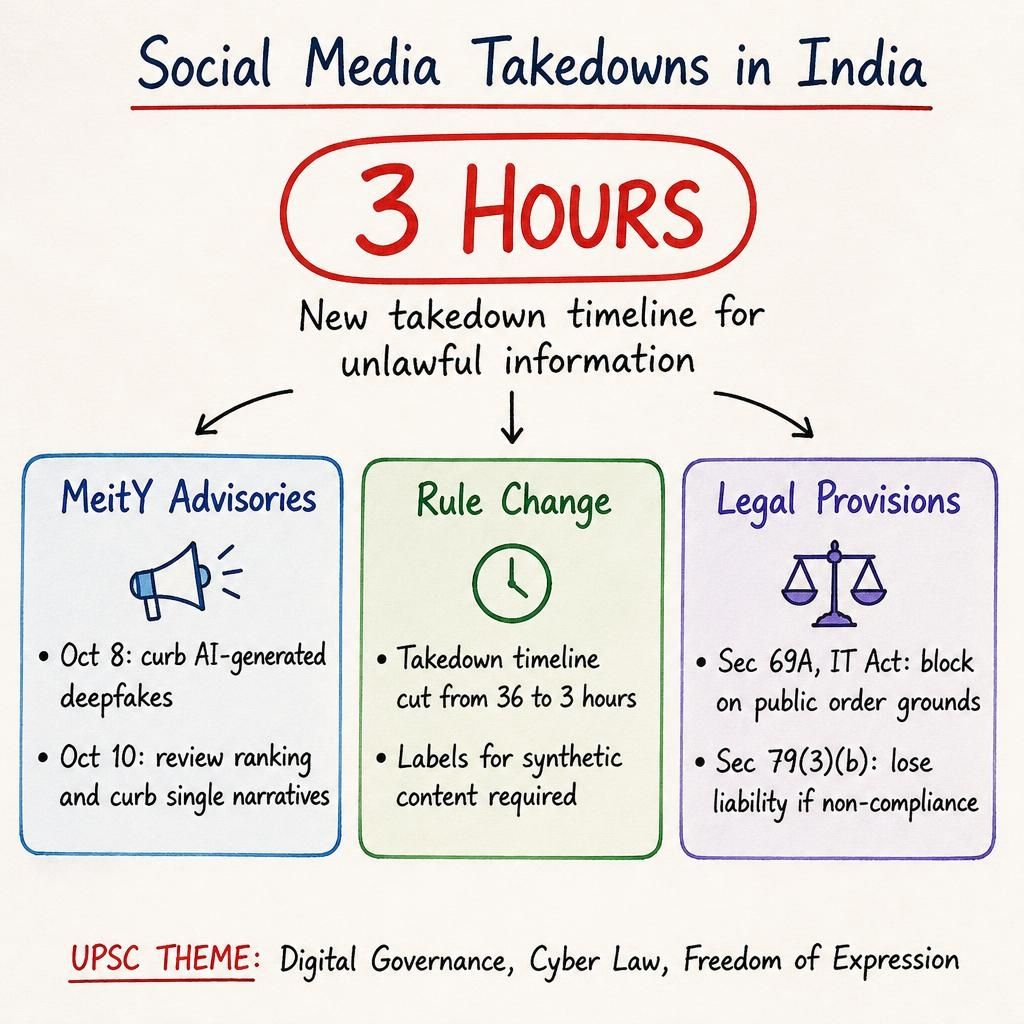
- The Ministry of Electronics and Information Technology (MeitY) issued advisories on October 8 and 10, urging platforms to exercise "enhanced diligence" over content.
- The advisories focused on contextualizing misleading material, curbing manipulated content, and addressing content distribution via recommendation systems.
- The IT (Intermediary Guidelines and Digital Media Ethics Code) Amendment Rules, 2026 reduced the content takedown timeline for unlawful information from 36 hours to three hours.
Social Media Takedowns.jpg
Detailed Insights:
- The October 8 MeitY advisory instructed social media platforms to prioritize complaints from authorized government agencies and curb AI-generated deepfakes.
- The October 10 advisory, specifically for Meta, highlighted concerns about content related to public order being prominently displayed and recommended to users.
- It advised Meta to identify content inciting violence, review its ranking mechanisms, and ensure users are not disproportionately exposed to single narratives.
- The IT (Intermediary Guidelines and Digital Media Ethics Code) Amendment Rules, 2026 also shortened grievance-redressal timelines and added requirements for labeling synthetic content.
- Key legal provisions enabling content restrictions include Section 69A of the IT Act, 2000, Rule 3(1)(d) of the IT Rules, 2021, and Section 79(3)(b) of the IT Act.
- Section 69A allows the Central government to block public access to online information based on grounds like national sovereignty, defense, and public order.
- Rule 3(1)(d) outlines intermediary obligations upon receiving court orders or intimations from authorized government agencies regarding unlawful content.
- Section 79(3)(b) stipulates that intermediaries may lose liability protection if they fail to act on legally required notifications concerning unlawful information.
- Many recent takedowns are attributed to platforms incorporating MeitY advisories into their community standards, leading to automated restrictions.
- Users can challenge restrictions under Sections 69A and 79(3)(b) in constitutional courts.
- For content restricted under a platform's own community standards, users must first approach the platform's grievance officer and then appeal to the Grievance Appellate Committee.
- This shift towards platform-level enforcement has made it more challenging for users to obtain timely relief due to extended appeal processes.
Key Concepts Involved:
- IT (Intermediary Guidelines and Digital Media Ethics Code) Rules, 2021: Regulations governing the responsibilities of social media intermediaries and digital media publishers in India.
- Section 69A of the IT Act, 2000: A provision empowering the Central government to block public access to online information for reasons of national security, public order, and other specified grounds.
- Grievance Appellate Committee: A government-constituted body established to hear appeals from users dissatisfied with decisions made by social media platforms' grievance officers.

SuperKalam is your personal mentor for UPSC preparation, guiding you at every step of the exam journey.
Download the App


STUDY RESOURCES
CONTACT US
ⓒ Snapstack Technologies Private Limited