GS 1: Indian SocietyGS 2: Social JusticeGS 3: EconomyPrelimsGS 3: Inclusive Growth
New phase of India's poverty challenge, Pg17
India sees significant poverty reduction to 2.6% ($3/day) but faces new challenges with rising youth unemployment and regional disparities in key states.
Practice MCQs
804 Students attempted
Key Highlights:
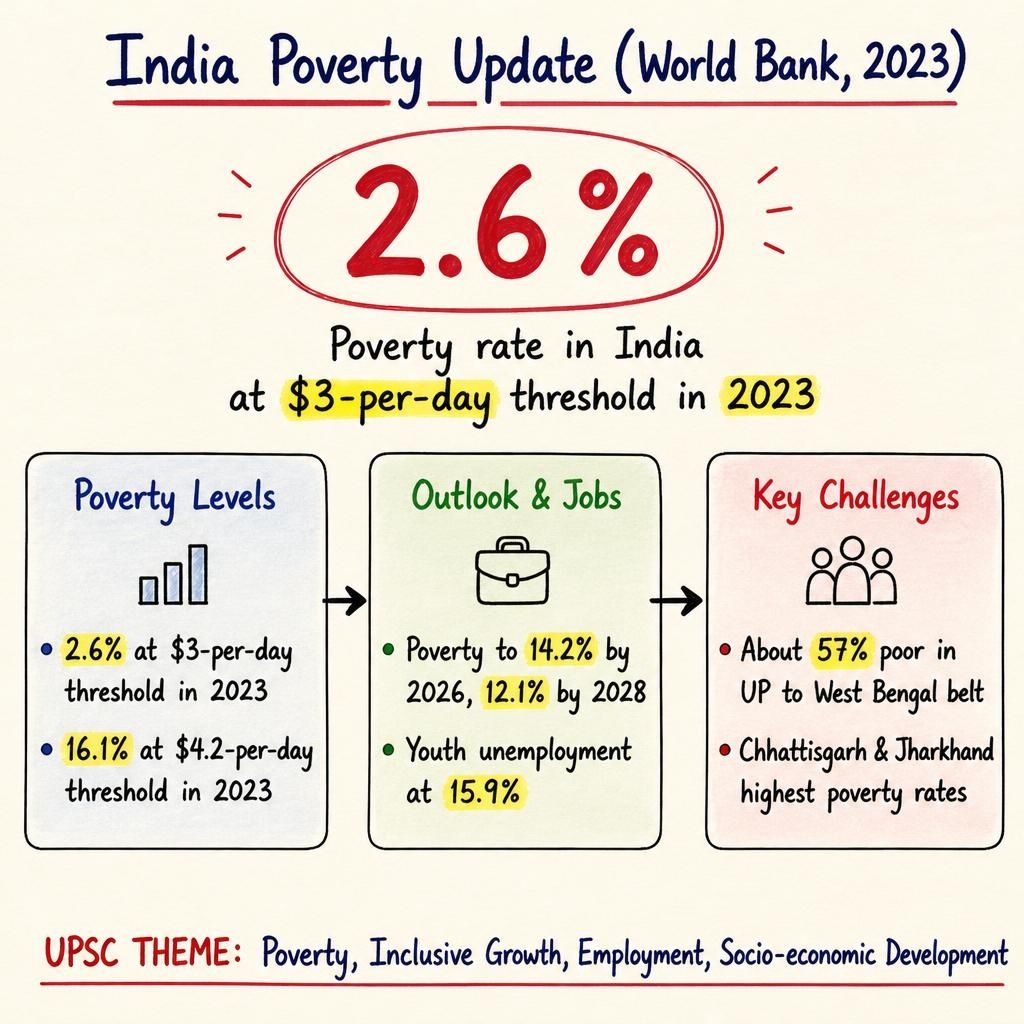
- The World Bank reported India's poverty rate fell to 2.6% using a $3-per-day threshold and 16.1% with a $4.2-per-day threshold in 2023.
- Poverty is projected to decline further to 14.2% by 2026 and 12.1% by 2028, dependent on productive job creation in poorer states.
- Youth unemployment increased to 15.9%, and real earnings have shown little movement despite India's significant GDP growth.
- Approximately 57% of India's poor population resides in a continuous region spanning from Uttar Pradesh to West Bengal.
- Unofficial updates to the C. Rangarajan committee poverty line for 2022-23 indicate Chhattisgarh and Jharkhand have the highest rural and urban poverty rates.
India Poverty Update.jpg
Detailed Insights:
- The World Bank uses international poverty lines of $3 and $4.2 per day to provide a global comparative assessment of poverty levels.
- The observed economic growth has not translated into a widely 'felt' improvement in living standards for many citizens.
- The International Labour Organization (ILO) has also highlighted a global trend where decent living is becoming increasingly unaffordable.
- The C. Rangarajan committee in 2014 established India's official poverty line at Rs 1,407 (urban) and Rs 972 (rural) monthly per capita expenditure.
- Updated unofficial Rangarajan poverty lines reveal substantial poverty reduction in some areas, such as urban Bihar, which saw a drop from 50.8% in 2011-12 to 9.1% in 2022-23.
- Challenges persist in the poverty-concentrated belt, with Jharkhand experiencing a 5.2% decline in factory worker wages in 2024-25.
- A high proportion of youth aged 15-29 are not in employment, education, or training (NEET) in Bihar (81% of districts), West Bengal (75%), and Uttar Pradesh (69%).
Key Concepts Involved:
- Poverty Line: A monetary threshold representing the minimum income or consumption expenditure required to afford basic necessities.
- Lower Middle-Income Country Threshold: A specific daily income level ($4.2 per day) used by the World Bank to measure poverty in lower-middle-income economies.
- Youth Unemployment: The proportion of the youth labor force (typically 15-29 years old) that is actively seeking but unable to find employment.
- Real Earnings: Wages or income adjusted for inflation, reflecting the actual purchasing power of an individual's earnings over time.

SuperKalam is your personal mentor for UPSC preparation, guiding you at every step of the exam journey.
Download the App


STUDY RESOURCES
CONTACT US
ⓒ Snapstack Technologies Private Limited