GS 2: GovernanceGS 1: Indian GeographyGS 2: International RelationsGS 3: Environment & EcologyPrelims
Rising sea level threat to India’s eroding coastline, Pg12
UN declaration addresses rising sea levels; India faces significant coastal erosion, requiring urgent policy and legislative action for climate migrants and infrastructure.
Practice MCQs
797 Students attempted
Key Highlights:
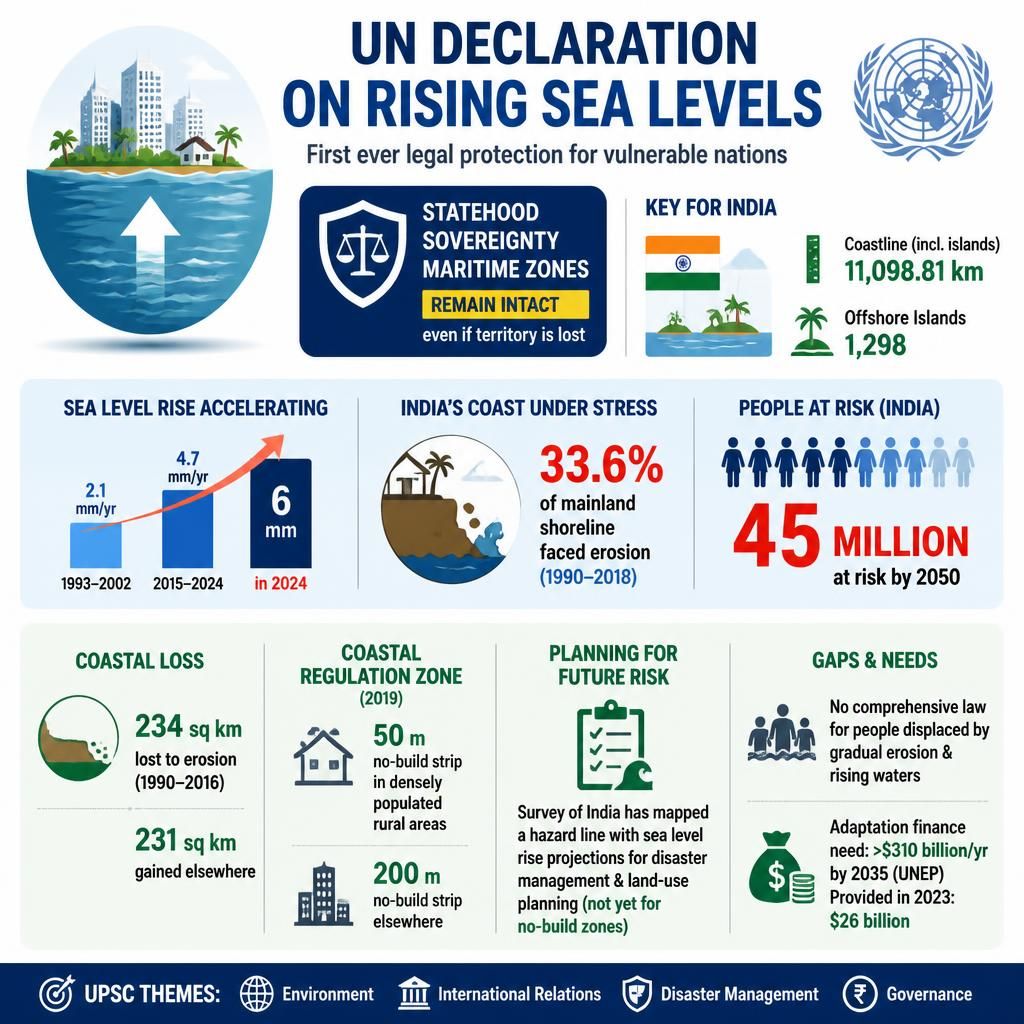
- The UN General Assembly adopted its first declaration on rising sea levels on September 24, 2026, addressing the existential threat to global populations.
- Global sea level rise has accelerated, increasing from an average of 2.1 mm per year between 1993-2002 to 4.7 mm per year from 2015-2024, with a record 6 mm rise in 2024.
- The declaration affirms the continued statehood, sovereignty, and stable maritime zones for countries threatened by sea level rise, even if they lose territory.
- India's coastline, including islands, has a revised length of 11,098.81 km and includes 1,298 offshore islands.
- Approximately one-third (33.6%) of India's mainland shoreline experienced erosion between 1990 and 2018, with significant retreat rates in some areas.
- Projections indicate that 45 million Indians will be at risk from sea level rise by 2050.
Rising Sea Level.jpg
Detailed Insights:
- The UN General Assembly declaration provides a legal framework to protect the statehood of vulnerable island nations like Tuvalu, Kiribati, and the Maldives, ensuring their rights and UN seats are maintained.
- This declaration is significant for India as it protects its extensive maritime boundaries, which are crucial due to its numerous offshore islands in the Arabian Sea and Bay of Bengal.
- The National Centre for Coastal Research found that 234 sq km of India's coastline was lost to erosion between 1990 and 2016, while 231 sq km was gained elsewhere.
- The 2019 Coastal Regulation Zone notification specifies no-build strips of 50 meters in densely populated rural areas and 200 meters elsewhere, measured from the high-tide line.
- The Survey of India has mapped a hazard line that incorporates sea level rise projections, intended for disaster management and land-use planning, but not yet for defining no-build zones.
- India currently lacks comprehensive legislation for people displaced by gradual erosion and rising waters, unlike Fiji, which has integrated relocation into its Climate Change Act (2021) and established a Climate Relocation of Communities Trust Fund Act (2019).
- India advocates for scaled-up and predictable climate finance, with the UN Environment Programme estimating developing countries need over $310 billion annually by 2035 for adaptation, against $26 billion provided in 2023.
- At the COP29 summit in Baku, India objected to the proposed $300 billion annual climate finance goal by 2035, deeming it "too little and too distant."
- India reaffirmed the principle of Common but Differentiated Responsibilities and Respective Capabilities (CBDR-RC), emphasizing that developed nations, historically more responsible for emissions, should contribute more to climate action.
- The next high-level meeting on sea level rise is scheduled for COP31 in Antalya, Türkiye, from November 9-20, 2026, providing India an opportunity to demonstrate progress.
Key Concepts Involved:
- Montevideo Convention: An international treaty from 1933 that defines the criteria for statehood, including a permanent population, defined territory, government, and capacity to enter into relations with other states.
- Coastal Regulation Zone (CRZ): A regulatory framework in India that restricts industrial and construction activities near the coastline to protect coastal ecosystems and manage development.
- Common but Differentiated Responsibilities and Respective Capabilities (CBDR-RC): A principle in international environmental law acknowledging that all states have a shared responsibility to address global environmental destruction, but their capabilities and historical contributions to the problem differ.
- Hazard Line: A demarcation line mapped by the Survey of India that considers future sea level rise and coastal erosion, used for long-term coastal planning and disaster management.

SuperKalam is your personal mentor for UPSC preparation, guiding you at every step of the exam journey.
Download the App


STUDY RESOURCES
CONTACT US
ⓒ Snapstack Technologies Private Limited