GS 2: GovernanceGS 3: Science & TechnologyPrelimsGS 2: Government policies and interventions for development in various sectorsGS 3: Basics of Cyber Security
Will 'talking' cars reduce road accident deaths?, Pg14
Ministry mandates Vehicle-to-Vehicle (V2V) communication system by 2028, enabling cars to wirelessly warn drivers of accident risks, aiming to drastically reduce road fatalities.
Practice MCQs
790 Students attempted
Key Highlights:
- The Union Ministry of Road Transport and Highways will soon mandate the Vehicle-to-Vehicle (V2V) communication system to enhance road safety.
- Draft Central Motor Vehicles (Amendment) Rules, 2026, were published on July 22, seeking public feedback on the V2V system.
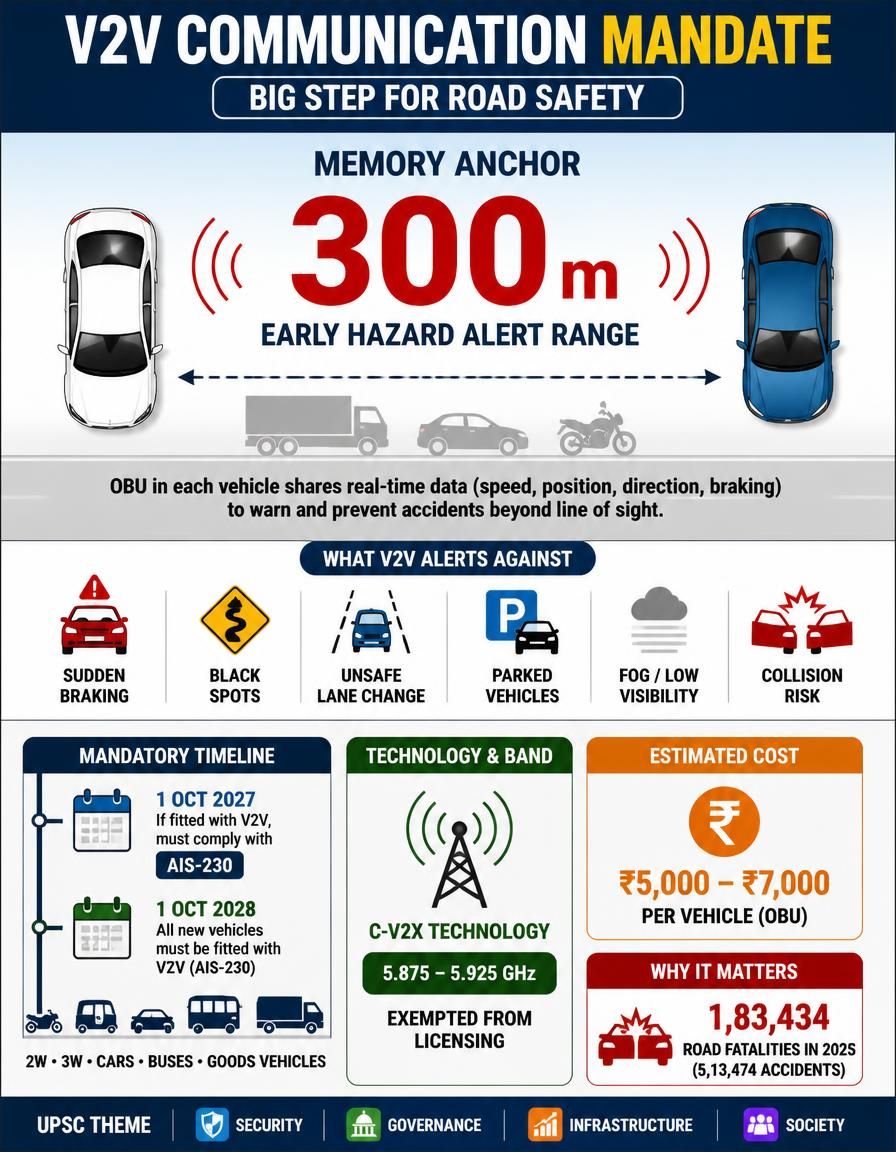
- Vehicles manufactured on or after October 1, 2027, if fitted with V2V, must comply with Automotive Industry Standard-230 (AIS-230).
- All new vehicles (two-wheelers, three-wheelers, cars, buses, goods vehicles) manufactured on or after October 1, 2028, will be required to be fitted with V2V systems meeting AIS-230 specifications.
- The V2V system will utilize Cellular Vehicle-to-Everything (C-V2X) technology in the 5.875 GHz to 5.925 GHz frequency band, which has been exempted from licensing requirements.
- On-Board Units (OBUs) for V2V are estimated to cost between Rs 5,000 and Rs 7,000 per vehicle.
V2V Communication.jpg
Detailed Insights:
- The V2V system involves an On Board Unit (OBU) in vehicles that wirelessly exchanges real-time data like speed, position, direction, and acceleration with other vehicles.
- This system alerts drivers to potential hazards such as sudden braking, black spots, unsafe lane changes, parked vehicles, fog, or collision risks, typically within a 300-meter range.
- Unlike camera-based Advanced Driver Assistance Systems (ADAS) that rely on line of sight, V2V works beyond it, detecting hazards around blind corners or behind large vehicles.
- India faces significant road safety challenges, with 5,13,474 road accidents and 1,83,434 fatalities recorded in 2025, making such interventions crucial.
- AIS-230 specifies technical requirements for V2V systems, including radio performance, cybersecurity, communication security, and provisions for phased introduction of features like emergency brake alerts.
- The implementation of V2V technology raises privacy concerns due to the large amount of vehicle data stored, making it susceptible to cyber attacks.
- The concept draws parallels with aviation technology, where aircraft continuously broadcast their position, speed, and altitude to nearby aircraft and ground stations.
- The mandate will apply to vehicle categories L (two- and three-wheelers), M (cars, buses), and N (goods vehicles).
Key Concepts Involved:
- Vehicle-to-Vehicle (V2V) Communication: A system allowing vehicles to wirelessly exchange data with each other to enhance safety and traffic efficiency.
- Automotive Industry Standard-230 (AIS-230): An Indian technical standard that specifies the minimum requirements for V2V communication systems in vehicles.
- Cellular Vehicle-to-Everything (C-V2X): A wireless communication technology that enables vehicles to communicate with other vehicles, infrastructure, pedestrians, and the network.
- Advanced Driver Assistance Systems (ADAS): Electronic systems in vehicles that use sensors and cameras to assist drivers with driving tasks and improve safety.

SuperKalam is your personal mentor for UPSC preparation, guiding you at every step of the exam journey.
Download the App


STUDY RESOURCES
CONTACT US
ⓒ Snapstack Technologies Private Limited