GS 2: GovernanceGS 2: Social JusticeGS 3: Environment & EcologyPrelimsGS 3: Conservation, Pollution and Degradation
Western Ghats Conservation With Science And Dialogue, Pg6
Long-standing dispute over Ecologically Sensitive Area declaration in Western Ghats continues, involving expert panels, state opposition, and community concerns.
Practice MCQs
782 Students attempted
Key Highlights:
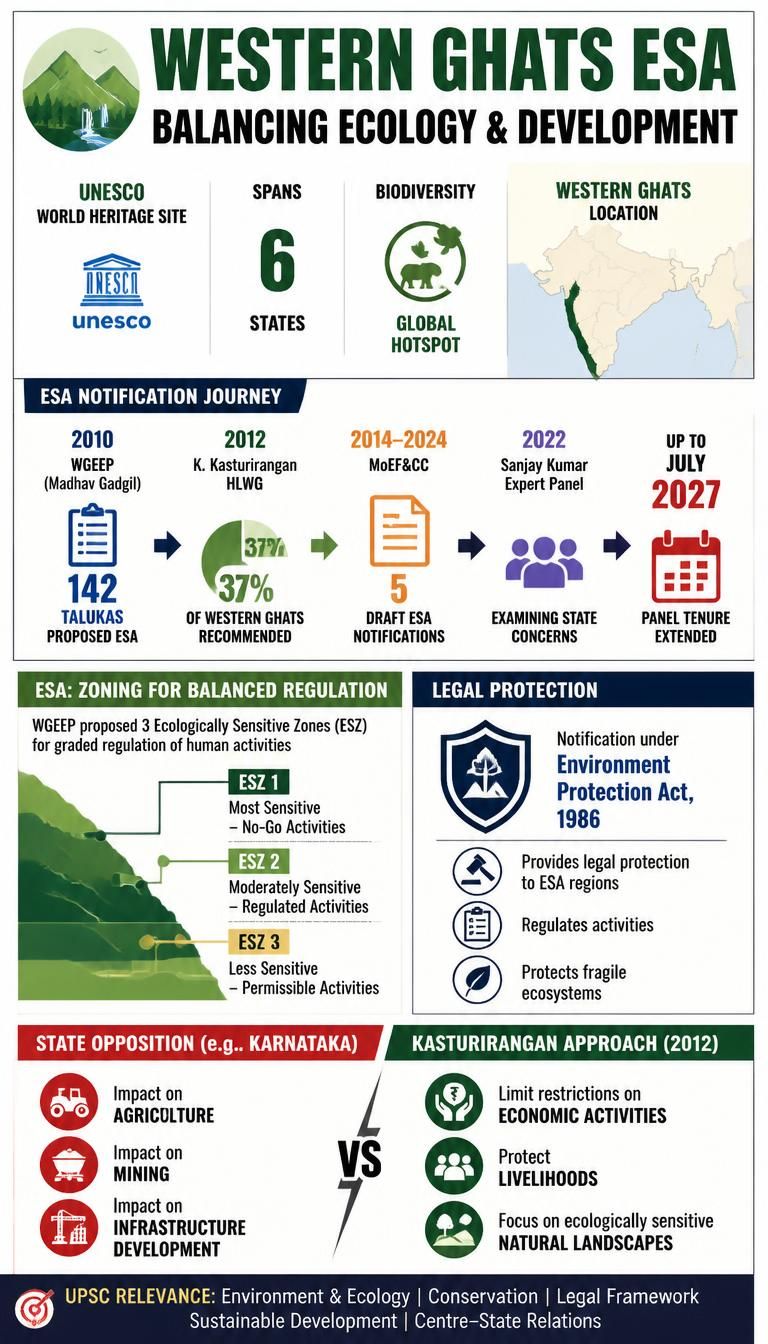
- The Western Ghats, a UNESCO World Heritage Site recognized for its rich biodiversity, spans six Indian states.
- The Western Ghats Ecology Expert Panel (WGEEP), chaired by Madhav Gadgil in 2010, recommended declaring 142 talukas as Ecologically Sensitive Area (ESA).
- Following opposition, the K. Kasturirangan-led High-Level Working Group (2012) reduced the proposed ESA area to 37% of the Western Ghats.
- The Ministry of Environment, Forest and Climate Change (MoEF&CC) has issued five draft ESA notifications since 2014, with the latest expert panel's tenure extended until July 2027.
- States like Karnataka consistently oppose the ESA declaration, citing potential impacts on agriculture, mining, and infrastructure development.
Western Ghats.jpg
Detailed Insights:
- The WGEEP report proposed sub-dividing the ESA into three Ecologically Sensitive Zones (ESZ) for graded regulation of human activities.
- Notification under the Environment Protection Act, 1986, would provide legal protection to the ESA regions, regulating activities to protect fragile ecosystems.
- The Kasturirangan report aimed to limit restrictions on economic activities and livelihoods to ecologically sensitive natural landscapes.
- An expert panel under Sanjay Kumar was constituted in 2022 to examine and address concerns raised by stakeholder states regarding the ESA notification.
- Gujarat and Goa have reportedly agreed to the finalization of the ESA notification, while Maharashtra has sought a fresh review.
- A "phased rollout" or "State-wise finalization" is being considered for the 2024 draft notification to address state-specific concerns.
- Local communities express concerns over reliance on satellite imagery for ESA identification, fearing misclassification of plantation crops as forest cover.
- Indigenous communities living deep within forests are crucial for conservation efforts and should be included in ESA frameworks due to their sustainable practices.
Key Concepts Involved:
- Western Ghats Ecology Expert Panel (WGEEP): A committee formed in 2010 under Madhav Gadgil to recommend conservation measures for the Western Ghats.
- Ecologically Sensitive Area (ESA): Geographically delineated areas with high biodiversity, declared under the Environment Protection Act, 1986, to regulate activities.
- High-Level Working Group (HLWG): A committee formed in 2012 under K. Kasturirangan to review the WGEEP recommendations and propose a revised ESA framework.
- Environment Protection Act, 1986: A comprehensive law in India that provides for the protection and improvement of the environment.

SuperKalam is your personal mentor for UPSC preparation, guiding you at every step of the exam journey.
Download the App


STUDY RESOURCES
CONTACT US
ⓒ Snapstack Technologies Private Limited