GS 3: Science & Technology
Can Chinese AI models shape future of tech race, Pg 17
Chinese AI models such as DeepSeek R1 and Kimi K3 are emerging as strong competitors to leading US models, intensifying the global AI race.
Practice MCQs
782 Students attempted
Key Highlights:
- Chinese AI models such as DeepSeek R1 and Kimi K3 are emerging as strong competitors to leading US models, intensifying the global AI race.
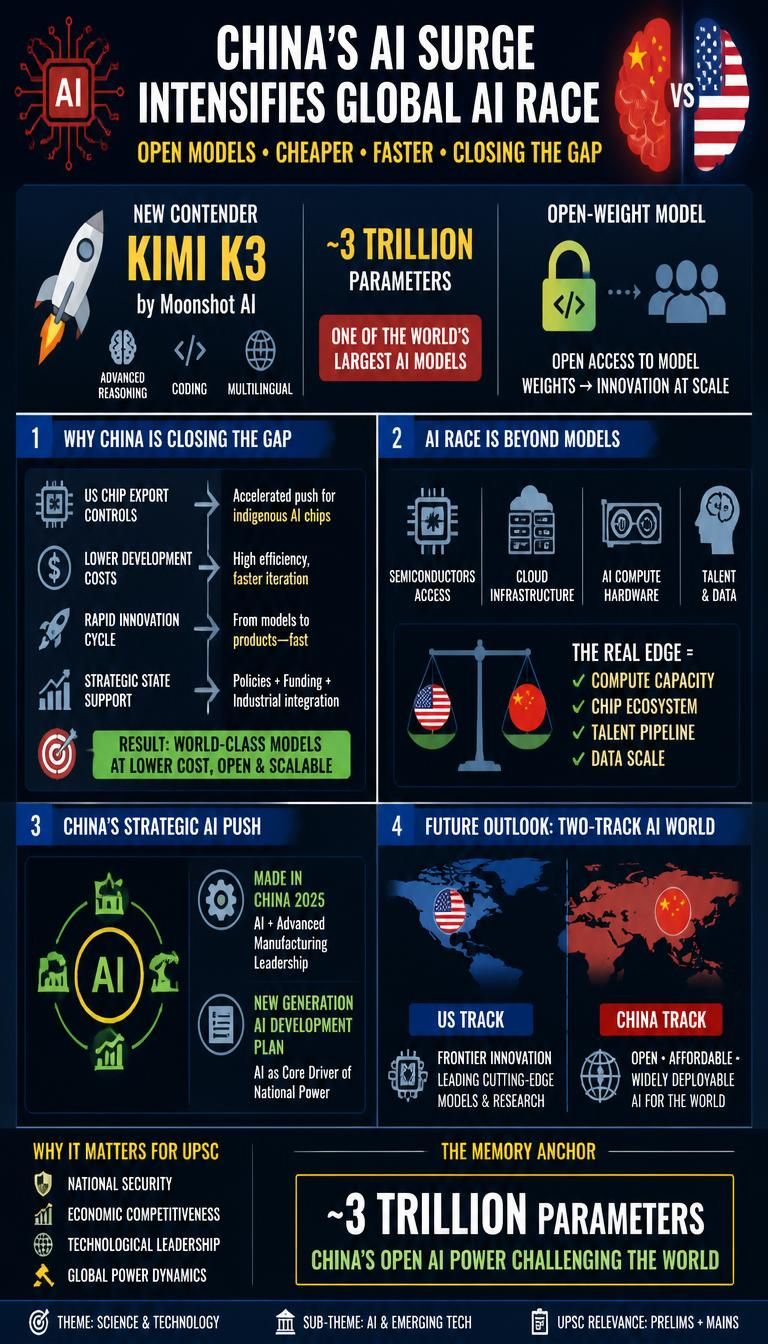
- Kimi K3, developed by Moonshot AI, is an open-weight large language model with around 3 trillion parameters, making it one of the world's largest AI models.
- The article highlights China's strategy of leveraging open-weight AI, lower development costs and rapid innovation to narrow the technological gap with the United States.
- The growing competition extends beyond AI models to strategic sectors such as semiconductors, cloud infrastructure and AI computing hardware.
- The evolving AI landscape is expected to shape future economic competitiveness, national security and global technological leadership.
China AI.jpg
Detailed Insights:
- Kimi K3 is designed for advanced reasoning, coding and multilingual tasks, reflecting China's rapid progress in Generative AI capabilities.
- Unlike proprietary AI systems, open-weight models make trained model parameters publicly available, enabling researchers and developers to modify and build upon them.
- US export controls on advanced AI chips have accelerated China's efforts to develop indigenous AI hardware and reduce dependence on foreign technology.
- The AI race increasingly depends on compute capacity, semiconductor access, talent and data rather than model architecture alone.
- China is integrating AI development with its broader industrial strategy under initiatives such as Made in China 2025 and New Generation Artificial Intelligence Development Plan.
- The future of AI is likely to witness a two-track ecosystem, with the US leading in frontier innovation while China expands affordable, open and widely deployable AI models.
Scientific/Technical Concepts Involved:
- Large Language Model (LLM): An AI model trained on massive datasets to understand and generate human-like text.
- Open-weight Model: An AI model whose trained parameters are publicly released for modification and further development.
- Parameters: Internal numerical values learned during training that determine how an AI model processes information and generates outputs.
- Generative AI: Artificial intelligence capable of creating text, images, code or other content from user prompts.

SuperKalam is your personal mentor for UPSC preparation, guiding you at every step of the exam journey.
Download the App


STUDY RESOURCES
CONTACT US
ⓒ Snapstack Technologies Private Limited