India needs to strengthen measures to promote the pink revolution in the food industry for better nutrition and health. Critically elucidate the statement.
India needs to strengthen measures to promote the pink revolution in the food industry for better nutrition and health. Critically elucidate the statement.
The Pink Revolution refers to India's transformation in meat and poultry production, aiming to enhance protein accessibility and nutritional security while boosting rural incomes through scientific livestock management and processing.
Benefits of Strengthening Pink Revolution
Nutritional Enhancement
- Protein Security: Addresses India's protein deficiency where 73% population suffers from protein inadequacy, providing accessible animal protein sources
- Micronutrient Supply: Meat and poultry provide essential vitamins (B12, iron, zinc) often deficient in vegetarian diets
- Child Nutrition: Animal proteins support cognitive development and reduce stunting rates, currently affecting 35.5% children under five
- Dietary Diversification: Reduces over-dependence on cereals, promoting balanced nutrition across socio-economic groups
- Bioavailability: Animal proteins offer complete amino acid profiles with higher absorption rates than plant proteins
Economic Opportunities
- Export Potential: India's meat exports valued at $4.2 billion (2023-24), with potential to reach $10 billion by 2030
- Employment Generation: Creates 8.5 million jobs across value chain, particularly benefiting women and marginally skilled workers
- Rural Income: Livestock contributes 28.63% to agricultural GDP, providing steady income source for 70 million farming households
- Processing Industry Growth: Meat processing sector growing at 12% CAGR, attracting investments in cold chain and technology
- Foreign Exchange: Reduces dependency on protein imports while boosting export revenues
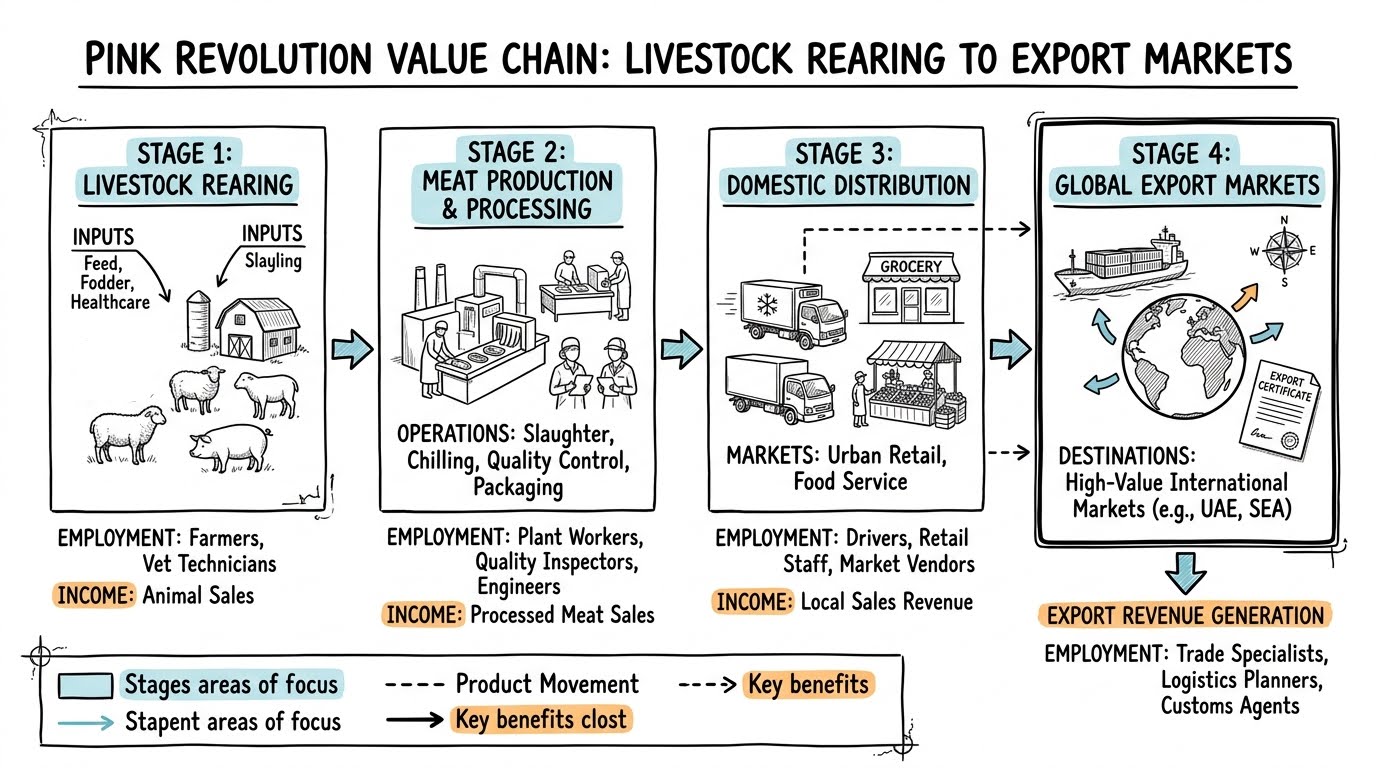
Pink Revolution Value Chain - from livestock rearing to export markets showing employment and income generation at each stage
Challenges Requiring Strengthening Measures
Infrastructure Deficits
- Cold Chain Gaps: Only 4% meat products have proper cold storage, causing 20-25% wastage
- Processing Facilities: Limited modern abattoirs and processing units meeting international standards
- Quality Control: Inadequate food safety testing laboratories and certification systems
- Transportation: Poor connectivity between production centers and consumption markets
- Technology Adoption: Low mechanization and scientific practices in small-scale operations
Regulatory and Social Issues
| Challenge | Current Status | Required Measures |
|---|---|---|
| Food Safety Standards | 60% informal sector operations | FSSAI compliance, licensing |
| Religious Sensitivities | Regional bans, social conflicts | Balanced policies, separate zones |
| Environmental Impact | Pollution from processing units | Waste management, green technology |
| Animal Welfare | Poor standards in many facilities | Humane practices, monitoring |
Policy Support Requirements
- Financial Assistance: Subsidized loans for modern equipment and infrastructure development
- Skill Development: Training programs in scientific livestock management and meat processing technologies
- Research Investment: Development of indigenous breeds and disease-resistant varieties through biotechnology
Government Initiatives and Way Forward
Current Support Measures
- National Livestock Mission: ₹2,800 crore allocation for breed improvement and feed security
- AHIDF Scheme: ₹15,000 crore Animal Husbandry Infrastructure Development Fund for processing and value addition
- Export Promotion: APEDA support for establishing export-oriented processing units meeting international standards
Strengthening Strategy
- Integrated Development: Cluster-based approach linking feed production, rearing, processing, and marketing
- Technology Integration: IoT-enabled livestock monitoring, blockchain for traceability, and mobile-based extension services
- Public-Private Partnership: Encouraging corporate investment in modern infrastructure and technology transfer
The Pink Revolution, when strengthened through comprehensive policy support and infrastructure development, can significantly contribute to nutritional security, rural prosperity, and export competitiveness while addressing current challenges through sustainable and inclusive growth models.
Answer Length
Model answers may exceed the word limit for better clarity and depth. Use them as a guide, but always frame your final answer within the exam’s prescribed limit.
Evaluate this PYQ now
Write your answer & evaluate in just 60 seconds




500+ students evaluated
Model Answers from
- 2013Economy10 MarksView Answer
The circumstances in 2005 forced an amendment to section 3(d) in the Indian Patent Law, 1970. Discuss how it has been utilized by the Supreme Court in its judgment rejecting Novarti's patent application for “Glivec“. Discuss briefly the pros and cons of the decision.
- 2013Economy10 MarksView Answer
Adaptation of the PPP model for the infrastructure development of the country has not been free from criticism. Critically discuss the pros and cons of the model.
- 2013Economy10 MarksView Answer
Discuss the rationale for introducing Goods and services tax in India. Bring out critically the reasons for delay in roll out for its regime.
- 2013Economy5 MarksView Answer
Though India allowed foreign direct investment (FDI) in what is called multi-brand retail through a joint venture route in September 2012, the FDI even after a year, has not picked up. Discuss the reasons.
- 2013Economy5 MarksView Answer
Discuss the impact of FDI entry into the multi-trade retail sector on supply chain management in the commodity trade pattern of the economy.
- 2013Economy10 MarksView Answer
Establish the relationship between land reform, agriculture productivity and elimination of poverty in the Indian Economy. Discuss the difficulty in designing and implementing agriculture-friendly land reforms in India.
Model Answers by Subject


Crack UPSC with your
Personal AI Mentor
An AI-powered ecosystem to learn, practice, and evaluate with discipline



