How important are vulnerability and risk assessments for pre-disaster management? As an administrator, what are key areas that you would focus on in disaster management?
How important are vulnerability and risk assessments for pre-disaster management? As an administrator, what are key areas that you would focus on in disaster management?
Vulnerability and risk assessments serve as the foundation for effective pre-disaster management, enabling scientific identification of hazards and development of targeted mitigation strategies. Recent NDMA data shows that comprehensive risk assessments have reduced disaster mortality by 67% in well-prepared states like Odisha.
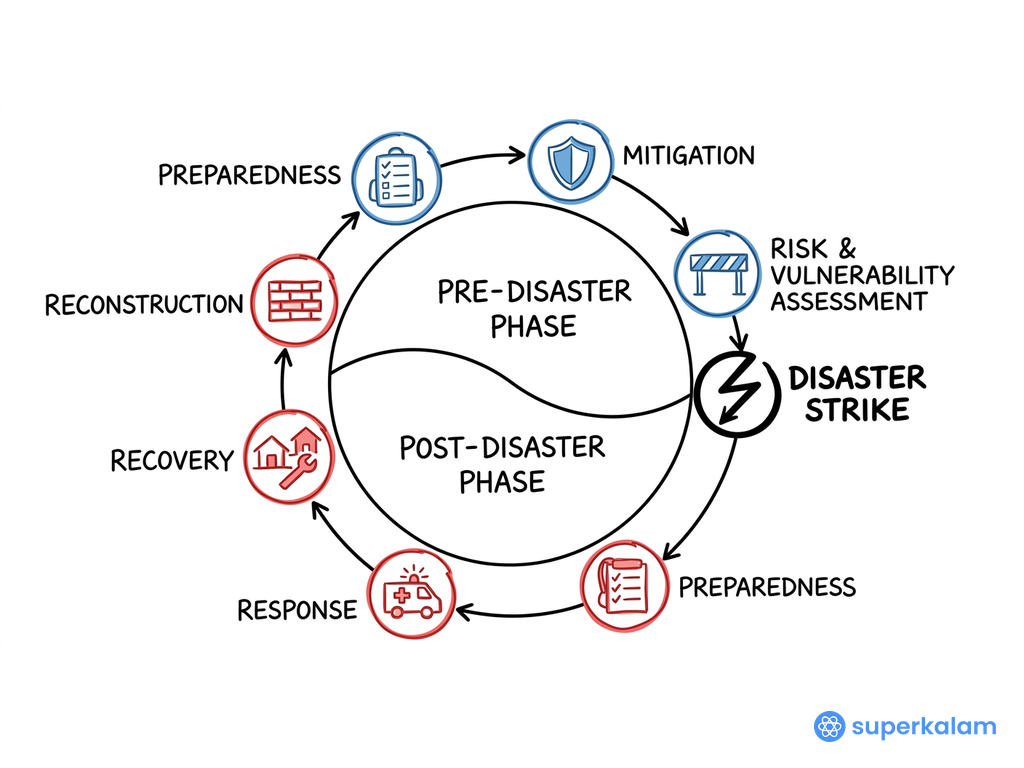
Disaster Management Cycle Circular Representation Diagram
Importance of Vulnerability and Risk Assessments
Scientific Foundation for Planning
- Hazard Identification: Systematic mapping of natural and man-made hazards using GIS technology and satellite imagery
- Vulnerability Analysis: Assessment of population exposure, infrastructure weaknesses, and socio-economic factors
- Risk Quantification: Statistical modeling to determine probability and potential impact of disasters
- Early Warning Development: Creation of location-specific alert systems (Example: IMD's impact-based forecasting launched in 2022)
- Resource Allocation: Evidence-based distribution of funds from SDMF (₹32,031 crore available nationally)
Policy and Infrastructure Planning
- Building Code Implementation: Seismic zonation maps guide construction standards in earthquake-prone areas
- Land Use Planning: Restricting development in flood plains and coastal regulation zones
- Critical Infrastructure Protection: Identifying and strengthening hospitals, schools, and communication networks
- Community Preparedness: Tailored evacuation plans based on local vulnerabilities
- Insurance and Compensation: Risk-based premium calculations and disaster relief mechanisms
Key Administrative Focus Areas in Disaster Management
Institutional Strengthening
- Multi-tier Governance: Effective coordination between NDMA-SDMA-DDMA structure
- Capacity Building: Regular training of disaster response teams and community volunteers
- Technology Integration: Implementation of SACHET app for real-time disaster reporting
- Inter-agency Coordination: Seamless collaboration between civil administration, military, and NGOs
- Legal Framework: Enforcement of DM Act 2005 provisions at grassroots level
Community-Centric Approach
- Public Awareness: Mass education campaigns using local languages and cultural contexts
- School Safety Programs: Comprehensive School Safety Programme covering 1.5 lakh schools
- Community Response Teams: Training local volunteers as first responders
- Inclusive Planning: Special focus on vulnerable groups including elderly, disabled, and marginalized communities
- Traditional Knowledge: Integration of indigenous disaster management practices
Resource Management and Technology
- Emergency Stockpiling: Strategic placement of relief materials and equipment
- Communication Systems: Robust networks including Common Alert Protocol (CAP)
- Financial Mechanisms: Efficient utilization of NDMF allocation of ₹13,693 crore (2021-26)
- Modern Technology: Use of drones, AI, and IoT for disaster monitoring and response
- International Cooperation: Leveraging Sendai Framework 2015-2030 guidelines and global best practices
Effective disaster management requires a paradigm shift from reactive response to proactive risk reduction. The integration of scientific risk assessment with community participation and modern technology creates a resilient framework that not only saves lives but also accelerates post-disaster recovery and development.
Answer Length
Model answers may exceed the word limit for better clarity and depth. Use them as a guide, but always frame your final answer within the exam’s prescribed limit.
Evaluate this PYQ now
Write your answer & evaluate in just 60 seconds




500+ students evaluated
Model Answers from
- 2013Economy10 MarksView Answer
The circumstances in 2005 forced an amendment to section 3(d) in the Indian Patent Law, 1970. Discuss how it has been utilized by the Supreme Court in its judgment rejecting Novarti's patent application for “Glivec“. Discuss briefly the pros and cons of the decision.
- 2013Economy10 MarksView Answer
Adaptation of the PPP model for the infrastructure development of the country has not been free from criticism. Critically discuss the pros and cons of the model.
- 2013Economy10 MarksView Answer
Discuss the rationale for introducing Goods and services tax in India. Bring out critically the reasons for delay in roll out for its regime.
- 2013Economy5 MarksView Answer
Though India allowed foreign direct investment (FDI) in what is called multi-brand retail through a joint venture route in September 2012, the FDI even after a year, has not picked up. Discuss the reasons.
- 2013Economy5 MarksView Answer
Discuss the impact of FDI entry into the multi-trade retail sector on supply chain management in the commodity trade pattern of the economy.
- 2013Economy10 MarksView Answer
Establish the relationship between land reform, agriculture productivity and elimination of poverty in the Indian Economy. Discuss the difficulty in designing and implementing agriculture-friendly land reforms in India.
Model Answers by Subject


Crack UPSC with your
Personal AI Mentor
An AI-powered ecosystem to learn, practice, and evaluate with discipline



