UPSC IAS Interview Questions with Answers 2025-26
UPSC IAS Interview Questions 2025-26: Top questions, model answers, tips, and tricky insights to help you excel in the Personality Test with confidence. Read now!
Nov, 2025
•6 min read
Aspirants, now that you are moving into the final stage of the UPSC exam journey, the UPSC Personality Test. It feels exciting, confusing, and a little scary all at once. Every topper has felt the same at this point.
The board wants to see your clarity, your honesty, and how you think when there’s no time to prepare an answer. That’s why smart, calm, and focused preparation matters so much in these weeks.
Here, we’ll walk you through the most important IAS Interview questions with the mindset that works in front of the interview board.
Let’s prepare for the interview the right way!
UPSC Interview: Marks, Weightage & Key Details
Before you start preparing for the interview questions, it’s important to understand what this stage carries in terms of marks and significance.
1. Total Marks
- UPSC Interview (Personality Test): 275 marks
- UPSC Mains Written Exam: 1750 marks
- Total: 2025 marks
Even though the interview carries fewer marks compared to Mains, its impact is huge. A difference of even 50–70 marks in the interview can push you several hundred ranks up or down.
2. Nature of Evaluation
The interview is not a knowledge test. Instead, the board evaluates:
- Your clarity of thought
- Your honesty and integrity
- Your situational judgment
- Your ability to stay calm
- Your communication skills
- Your alignment with civil service values
3. Duration
- Usually 25–30 minutes
- Some boards may stretch longer, depending on the flow of discussion
4. Who Conducts the UPSC Interview?
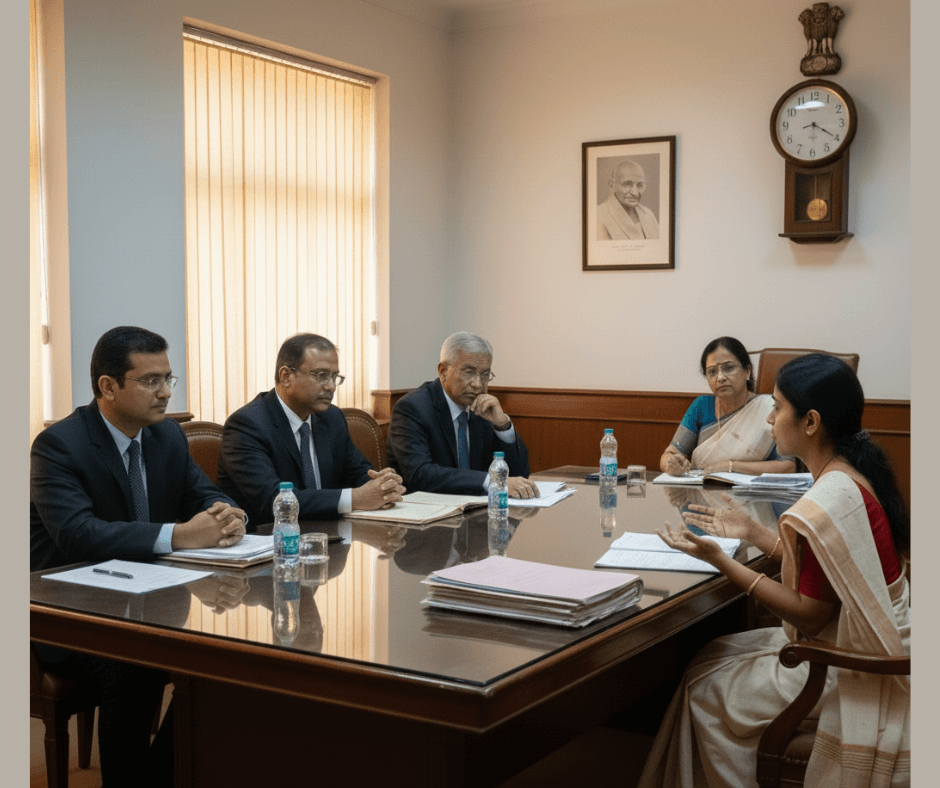
A panel of 5 members, including:
- One Chairperson (usually a UPSC member)
- Four other experienced experts from diverse fields
5. What the Board Really Looks For
They want to see your administrative potential. Not the most knowledgeable candidate, but the most balanced and dependable one.
Top 30 UPSC Interview Questions with Answers
Here are 30 of the most commonly asked UPSC Interview questions with balanced, thoughtful sample answers that reflect the mindset of a mature and grounded aspirant. Use these not to memorise, but to understand the intent, and then build your own honest responses.
1. Tell me about yourself.
I come from ___ (place) and have completed my education in ___ (stream). I briefly worked in ___, where I understood the importance of public service and efficient governance. I enjoy reading, volunteering, and staying updated on current affairs. Overall, I see myself as someone who likes taking responsibility and learning continuously.
2. Why do you want to join the Civil Services?
Civil Services will allow me to work at the grassroots, influence policy implementation, and contribute to nation-building. I’m drawn to the mix of administrative challenge, leadership, and the ability to create real, measurable impact in society.
3. What are your strengths?
I remain calm in demanding situations, I take responsibility for my work, and I’m patient enough to understand people before forming opinions. These strengths help me stay grounded and make balanced decisions.
4. What are your weaknesses?
I tend to be very detail-oriented, which slows me down at times. Over time, I’ve learned to prioritise and focus on delivering results within timelines. It’s still a work in progress, but I’m much more conscious and structured now.
5. Why did you choose your graduation subject?
I chose it because I was genuinely interested in the subject and saw it as a field where I could grow. It has helped me build analytical thinking and a structured approach to problem-solving.
6. Why did you leave your job?
My job taught me discipline and professional responsibility, but over time, I realised that I wanted to work in a space where the outcomes are more public-oriented. Civil Services can provide me the scale, purpose, and challenge that I’m looking for.
7. What will you do if you don’t get selected?
I’ll reassess, work on my gaps, and prepare again with more focus. The goal is clear, and I’m willing to persevere.
8. What is good governance?
Good governance means governance that is transparent, accountable, participatory, efficient, and inclusive. It ensures that public services reach citizens effectively and fairly. It’s when policies don’t just exist on paper but translate into real outcomes.
9. What is the biggest challenge India faces today?
India faces multiple challenges, but I believe the most pressing ones are job creation, skill development, and ensuring equitable growth. All three are interconnected and crucial for long-term stability.
10. What is your view on social media’s influence?
Social media amplifies voices and enables participation, but it also magnifies misinformation. The challenge is to create a balanced ecosystem that encourages digital awareness without compromising free expression.
11. Should India have a two-party system?
Given India’s diversity, a multi-party system reflects our social complexity better. Rather than reducing parties, strengthening internal party democracy may lead to healthier politics.
12. What is more important—development or environment?
Neither can be compromised. Our priority should be sustainable development, where growth and ecological responsibility go hand in hand.
13. How will you handle public criticism as a district administrator?
I believe constructive criticism is valuable. I would listen, understand the concern, and communicate transparently. As an administrator, being accessible matters more than being defensive.
14. What inspires you?
I’m inspired by people who work consistently - teachers, frontline workers, and public servants who quietly transform lives. Their sincerity motivates me.
15. Are you a leader or a follower?
I can be both. Leadership is about responsibility, but good leadership also comes from knowing when to listen and learn.
16. What is your opinion on reservations?
Reservation remains crucial for ensuring social justice and correcting historical disadvantages. At the same time, its effectiveness can improve through periodic reviews and better identification of genuinely marginalised groups.
17. Explain a recent government scheme you admire.
I admire the PM-Jan Dhan Yojana because it transformed financial inclusion from a policy idea to a mass movement. By bringing millions of previously unbanked citizens into the formal banking system, it strengthened financial security and enabled faster, cleaner delivery of benefits through DBT.
18. What does integrity mean to you?
Integrity means doing the right thing even when no one is watching. It’s the foundation of trust in administration.
19. What is your take on AI in governance?
AI is like adding a second layer of intelligence to governance. It can catch patterns that humans might miss, personalise services for citizens, and take a lot of routine burden off administrators so they can focus on real problem-solving. But its power comes with responsibility. Without strong data safeguards, transparency, and human judgment guiding it, AI can do more harm than good. So the goal should be to let AI amplify human governance, not replace the human element that gives governance its empathy.
20. What is your biggest achievement?
One achievement that shaped me was ___, where I learned perseverance, teamwork, and the satisfaction of genuine effort. It taught me that consistent hard work compounds over time.
21. What will you do if you find a senior officer involved in corruption?
If I come across corruption by a senior officer, I would rely strictly on facts and established procedures. My duty would be to document the evidence, report it through the authorised mechanism, and ensure the process stays fair and unbiased.
22. How do you handle stress?
I break tasks into clear priorities, maintain a simple routine, and take short pauses to reset my mind. What helps me most is staying organised and reminding myself of the larger purpose behind the work.
23. What is Article 370?
Article 370 granted special autonomy to Jammu & Kashmir under the Indian Constitution. In 2019, it was revoked to bring the region under the same legal and administrative framework as the rest of India. The move aimed to encourage uniform governance, integration, and long-term development in the region.
24. What is your opinion on India’s population growth?
India’s population growth is a double-edged sword. Our young demographic can become a huge strength if we invest in skills, jobs, and healthcare. But if we fail to create opportunities, it can turn into a pressure point on resources and social systems.
25. Should the death penalty be abolished?
The death penalty is a deeply complex issue. I believe it’s necessary in the rarest of rare cases to uphold justice and deterrence. Our country should retain it with strict safeguards, transparent procedures, and a very high threshold of proof.
26. What if a group protests outside your office, demanding immediate action?
If people are protesting, it means they feel unheard, so my first step would be to listen. I would engage with their representatives, understand the issue clearly, and communicate what can be done and by when. Maintaining peace is essential, but equally important is making people feel respected and reassured that the administration is responsive.
27. What is your view on India’s education system?
India’s education system has massively expanded access, but the next leap has to be about quality — better teacher training, stronger foundational learning, and more hands-on, curiosity-driven classrooms.
28. What does secularism mean?
For me, secularism means the State stands at an equal distance from every religion, giving each the same respect, the same protection, and the same space. It’s about creating an environment where identity doesn’t determine opportunity and where diversity strengthens us rather than dividing us.
29. Why should we select you?
You should select me because I’m willing to learn every day and will take responsibility for the people I serve. I bring sincerity, discipline, and the ability to stay steady under pressure. I genuinely want to work at the grassroots, solve real problems, and uphold the values this service stands for. If given this opportunity, I’ll honour it with hard work and integrity.
30. What is success for you?
Success, for me, isn’t a position or a title. It’s the ability to stay true to my values while creating a positive change, however small. It’s when my actions help someone, when I grow as a person, and when I can look back and know I didn’t take shortcuts. Success is progress with purpose.
Also read: Simple Guide to UPSC Interview Preparation: Essential Tips and Strategies
Current Affairs-Based UPSC Interview Questions
Here are 25 questions covering high-probability, current-affairs areas expected in the 2026 UPSC interview. These questions are designed to help you think deeply and respond like a future administrator.
- What is your view on the ongoing Russia–Ukraine conflict and its impact on India?
- How should India navigate the rising tensions in the Middle East, especially with the recent Israel–Hamas escalation?
- Do you think India–Pakistan relations are entering a new phase after the recent Pahalgam terror attack?
- How should India respond to China’s increasing activities along the LAC?
- What role should India play in promoting peace in the Red Sea region and securing global trade routes?
- Why is the Andaman & Nicobar region strategically important in the current Indo-Pacific context?
- Why is the Great Indian Bustard critically endangered, and what steps can revive its population?
- Why has the Olive Ridley turtle nesting pattern been discussed recently in climate debates?
- India faced extreme heatwaves this year. How should governance adapt to rising climate risks?
- Do you think India is on track to meet its net-zero and renewable energy commitments?
- What is your view on the increasing frequency of urban floods across Indian cities?
- With AI models advancing rapidly, do you think India needs stricter AI regulation?
- How can AI and machine learning improve governance at the district level?
- What is your view on the rise in deepfake misuse and its threat to society?
- How will the recent global supply chain reconfiguration affect India’s manufacturing ambitions?
- Is India prepared for the next big transition in the digital payments and fintech space?
- Do you support India’s push for semiconductor manufacturing? Why or why not?
- Why is India emerging as a major hub for vaccine diplomacy, and how can it expand this role?
- Do you think India needs stronger oversight of the pharmaceutical manufacturing sector after recent global concerns?
- How should India prepare for future pandemics, especially with the rise of zoonotic diseases?
- What lessons should India take from the recent nationwide protests over unemployment and exam irregularities?
- How should the government balance data privacy with national security concerns?
- What is your view on rising mental health challenges among youth in India?
- How significant is India’s progress in the Gaganyaan mission for our space ambitions?
- What are your thoughts on India’s growing leadership in quantum technology?
Master UPSC Current Affairs with SuperKalam
Level up your UPSC prep with SuperKalam’s Current Affairs — smart notes, structured analysis, and daily guidance to help you score with confidence.
Start NowTricky Questions in the UPSC Interview
The UPSC Personality Test is known for asking unexpected, thought-provoking, and sometimes deceptively simple questions. The board wants to see whether you can stay composed and respond with maturity when the situation is uncertain or emotionally charged. These questions often test qualities like:
- presence of mind
- ethical clarity
- logical reasoning
- balanced judgment
- self-awareness
Here are some example questions:
- If you could change one law in India overnight, what would it be and why?
- What is the biggest weakness in your personality — and how does it affect your work?
- What is one belief you hold strongly that most people disagree with?
- A journalist asks you a provocative question based on misinformation. Will you correct them publicly or engage privately?
- If given a choice between posting in your home state and a conflict-prone border district, what will you choose and why?
- What is the difference between being intelligent and being wise? Which one should a civil servant prioritise?
- Can laws alone change social attitudes?
- Is there a moral limit to economic growth?
- What is more important — rights or duties?
- Do you think human bias can ever be removed from decision-making?
Your ability to handle these tricky questions gives the board a glimpse of how you will handle challenges when the “right” answer isn’t obvious.
Walk Into the Interview With Quiet Confidence
You’ve already done what 99% of aspirants only dream of. You don’t need to sound extraordinary. You just need to be aware, balanced, and ready to serve.
- Every question in that room is an opportunity to express your values.
- Every pause is a chance to show composure.
- Every answer is a window into your mindset.
Walk in with the belief that you belong there, because you do.
- Think before you speak: A calm 2–3 second pause shows maturity, not hesitation.
- Speak with balance, not bias: Extreme views are rarely respected; neutrality with clarity always is.
- Own your journey: Your background, failures, struggles — they are strengths, not weaknesses.
- Keep your tone gentle, but your reasoning firm: This combination is deeply admired by the board.
- Accept what you don’t know: Saying “I’m not aware of this, but I would be happy to learn” is a sign of integrity.
- Stay rooted in India’s ground realities: Your answers should reflect empathy for citizens, not classroom idealism.
- Let your personality breathe: Smile when appropriate, maintain eye contact, and stay present.
- Remember the goal: You're not there to impress. You're there to show whether you can lead, decide, and care.
Also see: Preparing for UPSC IAS Interview: Understanding the Syllabus
A Final Note
There will be days when you doubt yourself. There will be questions you cannot predict.
But there is one thing fully in your control — your mindset. If you stay honest, calm, and grounded, no panel can dim your light.
All The Best!
Crack UPSC with your Personal AI Mentor
Your Personal AI Mentor that teaches, instantly evaluates Handwritten Answers & builds Daily Discipline
Download Now