How to do UPSC Prelims PYQs Analysis
Learn how to do UPSC Prelims PYQs analysis to identify trends, focus on high-weightage topics, and improve accuracy with a smart preparation strategy. Click now!
Apr, 2026
•6 min read
Previous Year Questions are a goldmine for UPSC preparation. They show you what UPSC asks, what it repeats, and what it ignores.
But solving them is not enough. PYQs benefits exceptionally when you analyse them smartly. It helps you spot patterns, understand question framing, improve elimination skills, link static concepts with current affairs and enhance knowledge.
With the UPSC PYQs analysis, you study less randomly. And that’s what improves your accuracy and chances of clearing Prelims. In this guide, you’ll learn how to analyse PYQs smartly to improve accuracy, revise better, and bubble the OMR sheet with confidence in Prelims 2026.
Why Analysing UPSC Prelims PYQs is Important
UPSC Prelims PYQs are the closest insight into how the exam actually works. When you analyse them properly, you stop preparing blindly and start preparing with direction. Here’s how UPSC Prelims PYQs analysis helps you:
- You understand UPSC pattern: PYQs show the intent behind questions, whether UPSC is testing concepts, clarity, or analytical ability.
- You identify themes & UPSC's favourite topics: Certain topics repeat in different forms. PYQs help you focus on these high-yield areas instead of covering everything.
- You learn the art of elimination: Prelims is making the best possible choice. PYQs train your mind to eliminate smartly.
- You connect concepts with current affairs: Many questions are static at the core but linked to current events. PYQs help you see this pattern clearly.
- You stay focused: Without PYQs, preparation becomes random. With analysis, your study becomes precise and exam-oriented.
- You build confidence: When you see similar patterns again and again, the paper feels predictable. This directly improves your accuracy.
PYQs shift your preparation from “studying randomly” to “studying focused.” And that’s what ultimately helps you clear Prelims.
Subject-Wise PYQs Analysis: Identifying High-Yield Areas
A orderly UPSC Prelims PYQs analysis of the last five years shows a clear and consistent subject-wise pattern. This is not random. UPSC tends to rotate topics but maintains a broad weightage trend. If you study with this understanding, you can prioritise high-yield subjects, allocate time better, and avoid over-preparing low-return areas.
Below is a subject-wise trend along with key topics repeatedly asked, which you should focus on:
| Subject | 2025 | 2024 | 2023 | 2022 | 2021 | 2020 | Key Topics to Focus |
|---|---|---|---|---|---|---|---|
| Ancient History | 6 | 3 | 1 | 1 | 3 | 3 | Buddhism & Jainism, Mauryan & Gupta period, Sangam age |
| Art & Culture | 2 | 4 | 8 | 7 | 10 | 5 | Architecture, Temple styles, Dance forms, Buddhism-related art |
| Economy | 18 | 13 | 16 | 16 | 14 | 21 | Inflation, Banking, Budget, Fiscal policy, External sector, RBI, Monetary policy |
| Environment & Ecology | 15 | 13 | 16 | 18 | 18 | 19 | Biodiversity, Species, Climate change, Conventions, Protected areas |
| Indian Geography | 1 | 4 | 8 | 5 | 5 | 6 | Rivers, Agriculture, Soils, Monsoon, Places in news |
| Indian Polity | 14 | 19 | 15 | 12 | 18 | 15 | Fundamental Rights & Duties Parliament, Constitutional bodies, Amendments, DPSP |
| International Relations | 8 | 6 | 10 | 11 | 2 | 3 | International organisations, India’s relations, Global groupings, Mapping |
| Medieval History | 0 | 1 | 3 | 5 | 4 | 2 | Delhi Sultanate, Mughal administration, Culture |
| Modern History | 8 | 3 | 3 | 3 | 7 | 9 | Freedom struggle, Acts & policies, Leaders, Timeline-based events |
| Physical Geography | 7 | 8 | 3 | 2 | 2 | 1 | Geomorphology, Climatology, Ocean currents |
| Science & Technology | 13 | 11 | 10 | 15 | 13 | 13 | Space tech, Biotechnology, Defence tech, Basics of physics/biology |
| Social Issues & Schemes | 3 | 7 | 3 | 2 | 2 | 2 | Government schemes, Welfare programs, Reports & indices |
| World Geography | 5 | 8 | 4 | 3 | 2 | 1 | Mapping, Resources, Locations in news |
| Total | 100 | 100 | 100 | 100 | 100 | 100 | — |
Key Insights from Subject-Wise PYQs Analysis
A close analysis of PYQs makes one thing very clear is that smart preparation requires prioritisation, not equal effort everywhere.
- Economy, Environment, Polity, and Science & Technology: These subjects consistently contribute the largest share of questions. Build strong concepts here and revise them multiple times.
- Art & Culture and Modern History: The number of questions may fluctuate in these areas, but they appear every year. A focused and limited preparation can help you secure easy, factual marks.
- Geography and International Relations: Questions from these subjects are rarely asked in isolation. They are often linked to current events, maps, or real-world applications, so always prepare them with context.
- Ancient and Medieval History: Low weightage but questions are often directly from the syllabus. Cover core themes and revise them well instead of going too deep.
Not every subject deserves equal time. PYQs clearly indicate where effort translates into marks.
Difficulty Trend Analysis of UPSC Prelims (2020–2025)
Understanding the difficulty level of UPSC Prelims through PYQs gives you a realistic picture of the exam. It helps you prepare for uncertainty and build the right attempt strategy. Here’s a year-wise breakdown:
| Difficulty | 2025 | 2024 | 2023 | 2022 | 2021 | 2020 |
|---|---|---|---|---|---|---|
| Easy | 33 | 42 | 20 | 25 | 35 | 30 |
| Medium | 35 | 40 | 45 | 48 | 38 | 43 |
| Hard | 32 | 18 | 35 | 27 | 27 | 27 |
What Does This Trend Tell You?
- Prelims is never “easy” overall: Even in easier years like 2024, a large portion of the paper remains medium to hard. You must be prepared for a balanced paper.
- Medium difficulty dominates the exam: Most questions fall in the medium category every year. These are concept-based and require clarity, not rote learning.
- Hard questions are consistent and decisive: Around 25–35 questions are always difficult. These are designed to test depth and often separate top performers.
- Easy questions are your scoring base: 25–40 questions are relatively straightforward. Missing these can cost you the cutoff.
- Paper difficulty fluctuates, strategy should not: Some years are tougher (like 2023), some easier (like 2024). But your preparation should always aim for strong concepts and smart elimination.
Key Takeaway: Do not prepare assuming an “easy” paper. Prepare for a balanced paper with a mix of easy, medium, and hard questions. Your goal should be to maximise easy + medium questions and minimise risks in hard ones.
Must see: UPSC Prelims Previous Year Question Papers (2011–2025)
How to Analyse UPSC Prelims PYQs
Analysing UPSC Prelims PYQs requires understanding why a question was asked, how it was framed, and how you should think in the exam. This is what builds exam-day intelligence. Let’s break down this approach:
Step 1: Identify the Core Topic
- Start by identifying: What key topic is asked?
- Link every question to a specific syllabus area as many factual questions test conceptual clarity
This helps you revise topics in a structured and relevant way
Step 2: Analyse the Options, Not Just the Answer
Prelims is an elimination-based exam, not a direct-answer test. Focus on:
- How UPSC designs close and confusing options
- Keywords like only, correct, incorrect, all
- Similar-looking statements that test clarity
This trains your mind to avoid traps and improve accuracy.
Step 3: Track Repeated Themes
Over time, you will notice patterns.
- Maintain a list of frequently asked topics
- Identify areas where UPSC repeats concepts in new forms
- Focus more on these high-yield zones during revision
Step 4: Link with Current Affairs
Most questions are not purely static.
- Connect static concepts with recent developments
- Read current affairs with the question: Can UPSC frame a question from this?
This makes your preparation focused and purposeful
Example: Applying This Approach to a UPSC PYQ 2022
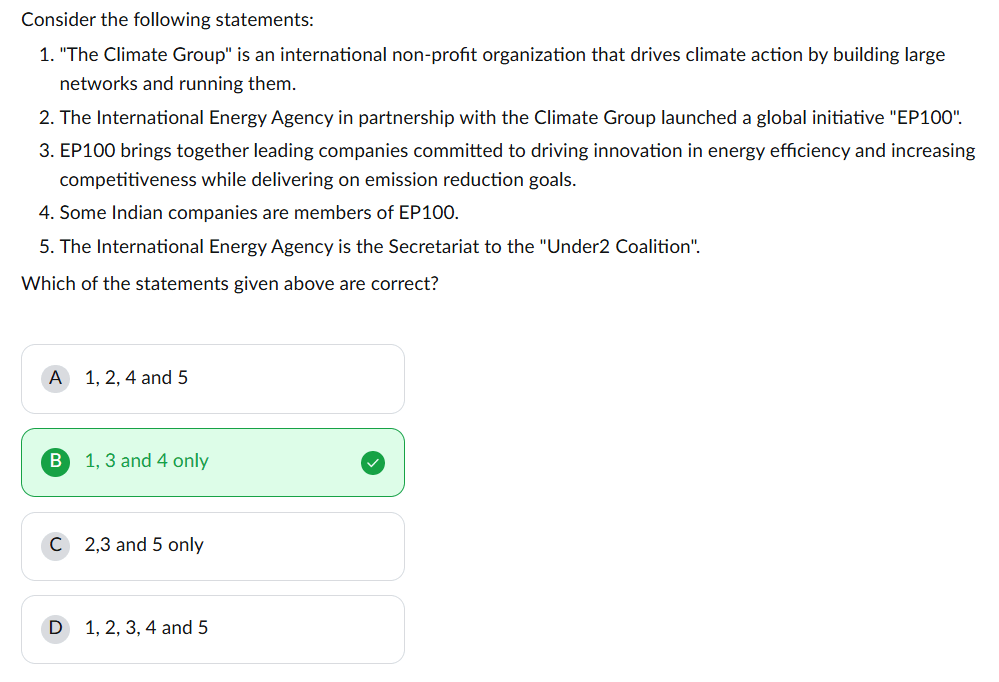
- Question Theme: Climate organisations and initiatives
- Core Topic: Environment + International organisations
- What UPSC is testing: Conceptual clarity about institutions and their roles
Options Analysis
- Statement 2 and 5 are designed to confuse by linking organisations incorrectly
- UPSC checks whether you can differentiate between similar institutions
Understanding the Pattern
- UPSC frequently asks about climate groups, alliances, and global initiatives
- These topics evolve but remain consistent in the exam
Current Affairs Link
- Climate groups like The Climate Group, initiatives like EP100, and coalitions are often in news
If you prepare them contextually, such questions become easy
How Many Years of UPSC PYQs Should You Practice & Analyse?
You don’t need to solve all PYQs ever asked. What you need is smart coverage with proper analysis.
- UPSC Prelims: Solve last 10–15 years PYQs. This range clearly shows recurring themes, option patterns, and elimination logic.
- UPSC Mains: Analyse last 7–10 years PYQs. Focus on understanding the question demand, the answer structure, and the linkage with current affairs.
Solving PYQs without analysis has limited value. Practising for fewer years with a deeper understanding is far more effective.
Practice UPSC Prelims & Mains PYQs the right way on SuperKalam — year-wise, topic-wise, and subject-wise, with clear explanations and trend analysis.
Click here: UPSC Prelims & Mains PYQs
Practice UPSC Previous Year Questions at SuperKalam
Practice UPSC Prelims & Mains PYQs the right way on SuperKalam — year-wise, topic-wise, and subject-wise, with clear explanations and trend analysis.
Practice PYQsConclusion
UPSC Prelims PYQs are the most reliable guide to crack the exam. A focused UPSC Prelims PYQs analysis helps you understand trends, prioritise high-yield topics, and improve elimination skills. When practiced in a correct way, UPSC previous year questions analysis turns your preparation from random study into a clear, exam-oriented strategy.
Let's crack UPSC Prelims 2026 with confidence!
Crack UPSC Smarter with SuperKalam
SuperKalam is your Personal AI Mentor that teaches, instantly evaluates handwritten answers & builds daily discipline
Download Now