Assess the importance of the accounts of the Chinese and Arab travellers in the reconstruction of the history of India.
Assess the importance of the accounts of the Chinese and Arab travellers in the reconstruction of the history of India.
Chinese and Arab travellers' accounts provide crucial external perspectives for reconstructing India's history, serving as independent primary sources that complement indigenous records.
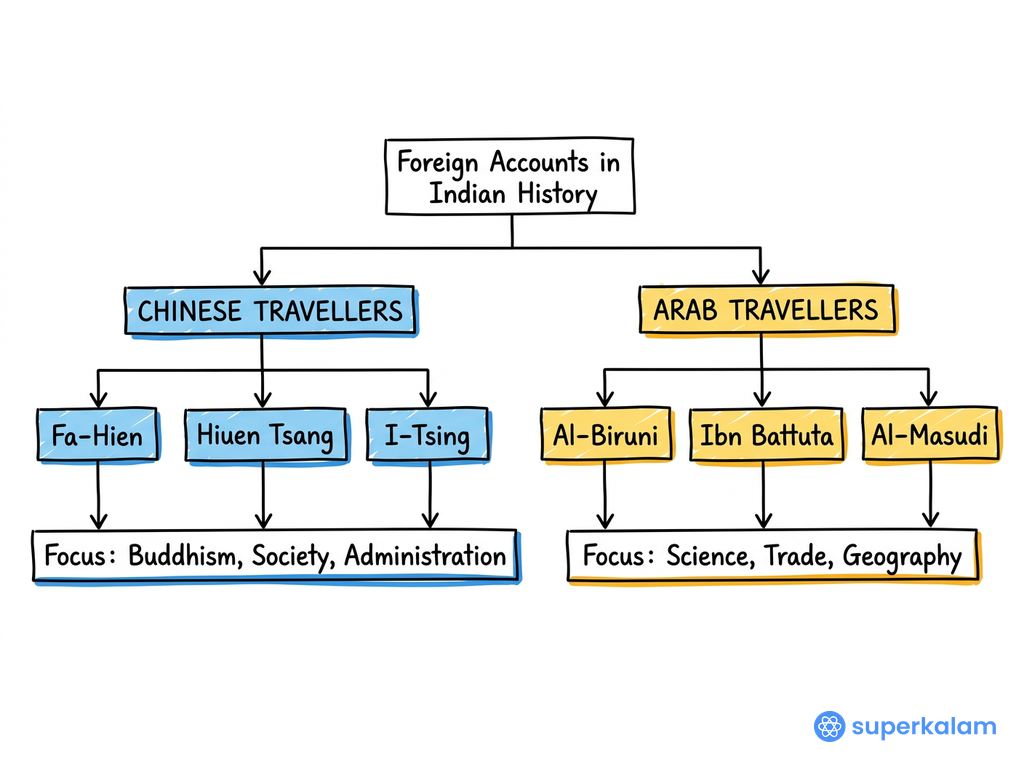
Foreign Accounts Impacting Indian History
Chinese Travellers' Historical Contributions
-
Religious Documentation: Fa-Hien (399-414 CE) recorded Buddhism's decline in its birthplace, documenting monastery conditions and religious practices during the Gupta period.
-
Educational Excellence: Xuanzang (629-645 CE) provided detailed accounts of Nalanda University's curriculum, international student body, and administrative structure, highlighting India's role as a global learning center.
-
Political Insights: Xuanzang's records of Harsha's reign offer valuable information about administrative systems, diplomatic relations, and territorial extent of the Pushyabhuti dynasty.
-
Social Observations: I-Tsing (671-695 CE) documented maritime trade routes, cultural exchanges between India and Southeast Asia, and monastic life.
-
Economic Data: Chinese accounts provide evidence of India's prosperity, trade networks, and agricultural practices during different periods.
Arab Travellers' Historical Contributions
| Traveller | Period | Key Contributions |
|---|---|---|
| Al-Masudi | 10th century CE | Social customs, festivals, cultural practices |
| Al-Biruni | 11th century CE | Scientific knowledge, astronomical achievements, mathematics |
| Ibn Battuta | 14th century CE | Delhi Sultanate administration, social conditions |
| Sulaiman | 9th century CE | Trade relations, Rashtrakuta kingdom insights |
-
Scientific Achievements: Al-Biruni's "Kitab-ul-Hind" documented India's advanced mathematical concepts, astronomical knowledge, and scientific methodologies.
-
Administrative Systems: Arab accounts describe revenue collection, judicial systems, and administrative hierarchies under various Indian rulers.
-
Maritime Commerce: Detailed documentation of Malabar Coast trade, spice routes, and commercial practices connecting India to the Arab world.
Historical Significance
-
Corroborative Evidence: These accounts independently verify information from inscriptions, literary texts, and archaeological findings.
-
Gap Filling: They provide crucial information for periods with limited indigenous sources, particularly during political transitions.
-
Objective Perspective: External viewpoints offer unbiased observations of Indian society, free from local prejudices and cultural assumptions.
-
Cultural Documentation: Detailed descriptions of festivals, customs, and social practices help reconstruct India's cultural heritage.
These travellers' meticulous observations remain fundamental to understanding India's multifaceted past. Modern historians continue to rely on works like Xuanzang's "Si-Yu-Ki" and Al-Biruni's comprehensive studies for authentic historical reconstruction, demonstrating their enduring scholarly value.
Answer Length
Model answers may exceed the word limit for better clarity and depth. Use them as a guide, but always frame your final answer within the exam’s prescribed limit.
Evaluate this PYQ now
Write your answer & evaluate in just 60 seconds




500+ students evaluated
Model Answers by Subject


Crack UPSC with your
Personal AI Mentor
An AI-powered ecosystem to learn, practice, and evaluate with discipline



