What problems are germane to the decolonization process in the Malay Peninsula?
What problems are germane to the decolonization process in the Malay Peninsula?
The decolonization of the Malay Peninsula (1957-1963) involved complex challenges stemming from British colonial policies and diverse ethnic composition. Malaysia's transition to independence faced multifaceted problems requiring careful political management.
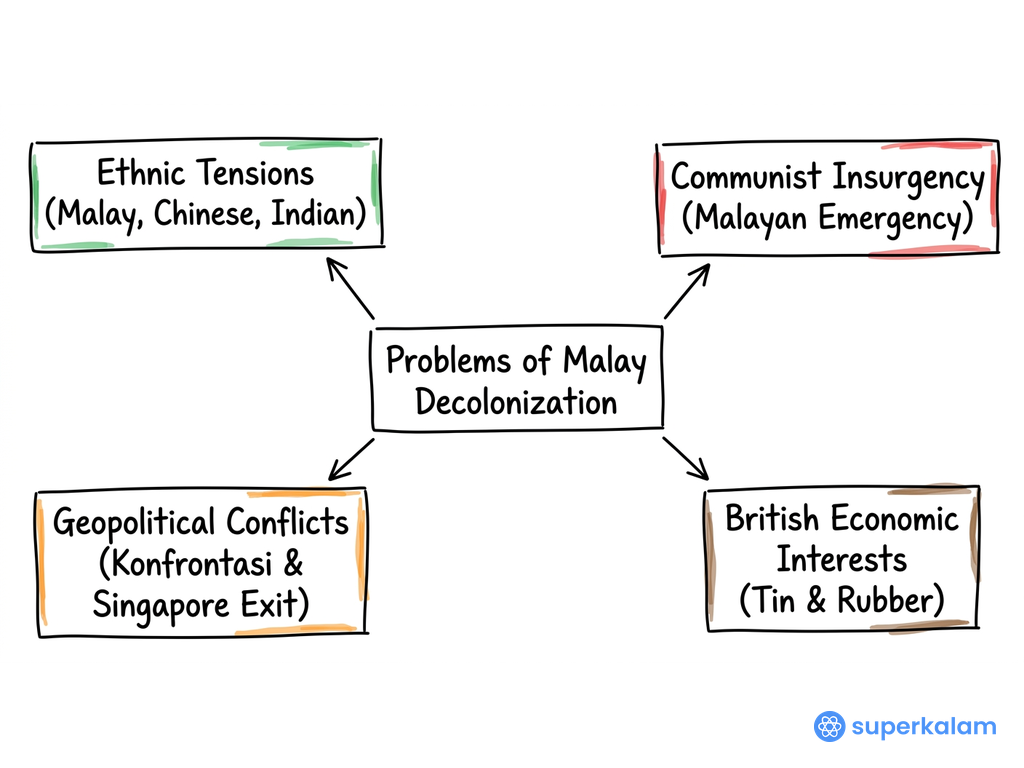
Problems of Malay Decolonization Concept Map
Ethnic Division and Communal Tensions
- Divide and Rule Legacy: British colonial policy created deep ethnic divisions between Malays, Chinese, and Indians, fostering mutual suspicion and competition
- May 13, 1969 Racial Riots: Post-independence communal violence killed hundreds, highlighting unresolved ethnic tensions from colonial administration
- Language Controversies: Debates over Bahasa Malaysia vs. English and Chinese/Tamil languages created educational and administrative complexities
- Religious Divisions: Islamic-majority Malays vs. Buddhist/Hindu minorities faced integration challenges in forming unified national identity
- Residential Segregation: Colonial-era ethnic enclaves persisted, limiting inter-communal interaction and understanding
| Community | Colonial Role | Post-Independence Challenges |
|---|---|---|
| Malays | Administrative/Agricultural | Political dominance vs. economic backwardness |
| Chinese | Trade/Commerce | Economic success vs. political marginalization |
| Indians | Plantation labor/Clerical | Educational advancement vs. social discrimination |
Economic Structural Problems
- Export-Dependent Economy: Colonial focus on tin mining and rubber plantations created vulnerability to global price fluctuations
- Wealth Disparities: Chinese dominance in commerce versus Malay agricultural poverty required New Economic Policy (1971) intervention
- Infrastructure Imbalance: Colonial development favored west coast ports and mining areas, leaving east coast underdeveloped
- Foreign Capital Control: British companies retained significant economic influence post-independence, limiting sovereignty
- Rural-Urban Divide: Plantation economy legacy created stark differences between developed urban centers and impoverished rural areas
Political Integration Difficulties
- Federal Structure Challenges: Integrating 11 Peninsular states with Sabah and Sarawak required complex constitutional arrangements
- Traditional Rulers vs. Democracy: Balancing nine Malay Sultanates with modern democratic governance created constitutional complications
- Emergency Rule (1948-1960): Communist insurgency delayed normal political development and democratic consolidation
- Singapore Separation (1965): Racial tensions forced Singapore's ejection from Malaysian federation, weakening economic integration
- Regional Security: Indonesian Confrontation (1963-1966) threatened newly independent Malaysia's territorial integrity
The decolonization process required delicate balancing between ethnic interests, economic restructuring, and political stability. Modern Malaysia's success stems from constitutional arrangements like Article 153 protecting Malay special position while ensuring minority rights through Rukunegara principles.
Answer Length
Model answers may exceed the word limit for better clarity and depth. Use them as a guide, but always frame your final answer within the exam’s prescribed limit.
Evaluate this PYQ now
Write your answer & evaluate in just 60 seconds




500+ students evaluated
Model Answers from
- 2017Modern History15 MarksView Answer
Highlight the importance of the new objectives that got added to the vision of Indian Independence since the twenties of the last century.
- 2017Modern History15 MarksView Answer
Examine how the decline of traditional artisanal industry in colonial India crippled the rural economy.
- 2017Modern History10 MarksView Answer
Why did the ‘Moderates’ fail to carry conviction with the nation about their proclaimed ideology and political goals by the end of the nineteenth century?
- 2017Modern History10 MarksView Answer
Clarify how mid-eighteenth century India was beset with the spectre of a fragmented polity.
Model Answers by Subject


Crack UPSC with your
Personal AI Mentor
An AI-powered ecosystem to learn, practice, and evaluate with discipline