How does the cryosphere affect global climate?
How does the cryosphere affect global climate?
The cryosphere, Earth's frozen water reservoir including glaciers, ice sheets, sea ice, and permafrost, serves as a critical regulator of global climate through complex feedback mechanisms and energy balance processes.
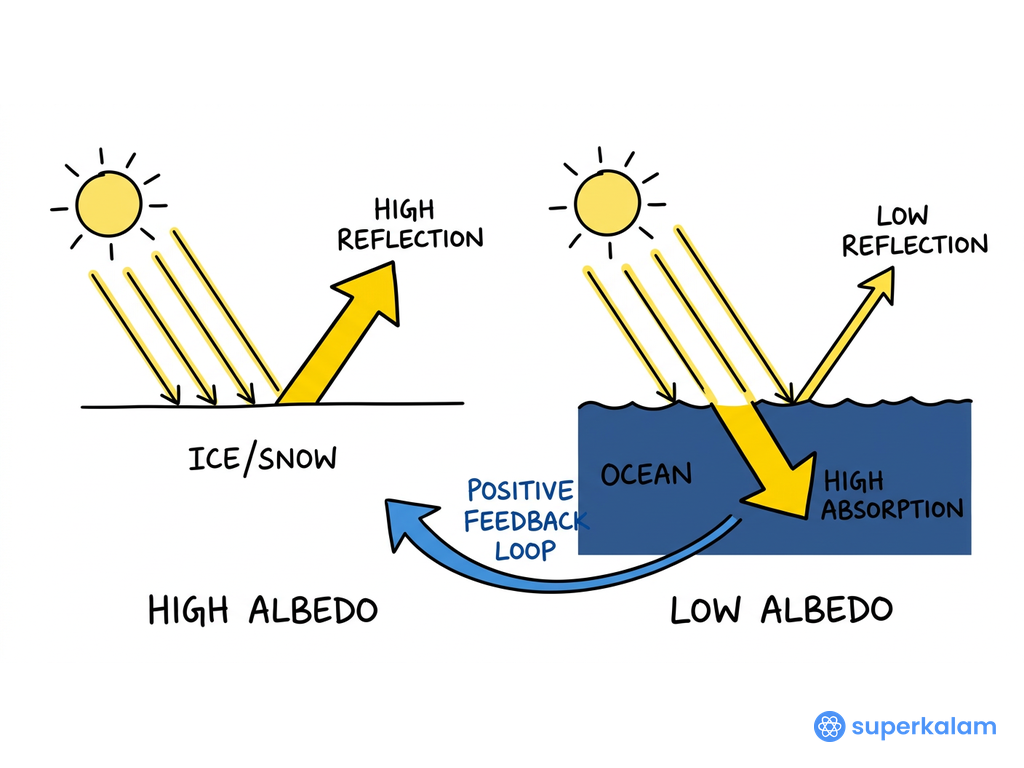
Ice Albedo Feedback Comparative Thematic Diagram
Albedo Effect and Energy Balance
- Solar Radiation Reflection: Ice and snow surfaces reflect 80-90% of incoming solar radiation back to space, maintaining Earth's energy equilibrium
- Temperature Regulation: High albedo prevents excessive warming by reducing heat absorption compared to darker surfaces like ocean water
- Seasonal Variations: Snow cover changes create seasonal climate patterns, with maximum albedo during winter months
- Surface Temperature Control: Cryospheric albedo helps maintain polar and high-altitude temperature stability
- Global Energy Budget: Contributes significantly to Earth's overall energy balance through reflective cooling
| Component | Albedo (%) | Climate Impact |
|---|---|---|
| Fresh Snow | 80-90 | Maximum cooling effect |
| Sea Ice | 50-70 | Ocean temperature regulation |
| Glacial Ice | 30-50 | Long-term climate stability |
| Bare Ice | 20-40 | Reduced cooling efficiency |
Ocean Circulation and Heat Distribution
- Thermohaline Circulation: Melting ice affects ocean salinity and density, influencing global current systems like the Atlantic Meridional Overturning Circulation (AMOC)
- Deep Water Formation: Cold, dense polar waters sink and drive global ocean conveyor belt circulation
- Heat Transport: Ocean currents redistribute heat from equatorial to polar regions, moderating global temperatures
- Regional Climate Patterns: Changes in circulation affect monsoons, storm tracks, and precipitation patterns
- Marine Ecosystems: Altered currents impact nutrient distribution and marine food chains globally
Feedback Mechanisms and Climate Change
- Ice-Albedo Feedback: Arctic sea ice reached 14.33 million km² in March 2025, 1.31 million km² below 1981-2010 average, creating accelerated warming cycles
- Permafrost Carbon Release: Thawing permafrost releases stored 1,700 billion tons of carbon, amplifying greenhouse gas concentrations
- Glacial Retreat: Himalayan glaciers show 16.94 km²/year loss rate (1988-2020), with 110 glaciers disappeared in Arunachal Pradesh
- Sea Level Contribution: Current rise rate of 0.23 inches/year (2024) exceeds projections through thermal expansion and ice melt
- Water Cycle Disruption: Reduced glacial storage affects seasonal water availability for 2 billion people dependent on glacier-fed rivers
The cryosphere's destabilization threatens global climate stability, emphasizing urgent need for Paris Agreement implementation and enhanced monitoring through Global Climate Observing System initiatives.
Answer Length
Model answers may exceed the word limit for better clarity and depth. Use them as a guide, but always frame your final answer within the exam’s prescribed limit.
Evaluate this PYQ now
Write your answer & evaluate in just 60 seconds




500+ students evaluated
Model Answers from
- 2017Physical Geography15 MarksView Answer
What characteristics can be assigned to the monsoon climate that succeeds in feeding more than 50 percent of the world population residing in Monsoon Asia?
- 2017Physical Geography15 MarksView Answer
Account for variations in oceanic salinity and discuss its multi-dimensional effects.
- 2017Physical Geography10 MarksView Answer
How does the Juno Mission of NASA help to understand the origin and evolution of the Earth?
Model Answers by Subject


Crack UPSC with your
Personal AI Mentor
An AI-powered ecosystem to learn, practice, and evaluate with discipline